Ratmansky Rules

We tend to think that ballets create fantasy worlds far removed from the messiness of real life. However, it is impossible to consider Odesa and Solitude, the two Alexei Ratmansky works New York City Ballet has offered this winter season at Lincoln Center, without also thinking of Russia’s invasion of Ukraine in 2022 and Alexei Navalny’s solitary confinement and recent death in a Siberian prison.
Ratmansky, who was born in St. Petersburg, is of Ukrainian descent. From 2004 to 2008 he was artistic director of the Bolshoi Ballet in Moscow and before that, he spent several years as a principal dancer with the Ukrainian National Ballet. His history, then, is closely tied to both Russia and Ukraine, despite the fact that he is now settled in the United States where he has been appointed artist in residence at New York City Ballet.
Ratmansky choreographed Odesa in 2017 as a guest artist at NYCB. The work was inspired by stories of Jewish gangsters in Odesa after the Russian Revolution. It is set to “Sketches to Sunset,” a klezmer infused score by Leonid Desyatnikov.
The ballet is structured in standard plotless form, that is, as a series of solos, duets, and group dances without a narrative, but with a particular mood. The mood, in this case, is a bit louche, as befits a piece dealing with an underworld sub-culture. There is, for example, an apache duet in which a woman is roughly treated by her partner. Another man receives a hard slap from a woman when he annoys her. But ultimately the rough atmosphere is a thematic pretext, which doesn’t do damage to an underlying ballet vocabulary and structure.
Kesso Dekker’s multi colored costumes for the piece reinforce an idea of plush exoticism, while the dancers, led at Saturday’s matinee by Alexa Maxwell, Sara Mearns, Emma Von Enck, Tyler Angle, Joseph Gordon, and Andrew Veyette, conveyed the right blend of bravado touched with vulgarity.
Despite Odesa’s familiar structure, the ballet is anything but uninspired. It is striking how, in this instance, Ratmansky employs dance forms that could be called cliches, and yet renders them vivid and fresh. What makes him different from so many choreographers, and which Odesa demonstrates, is that he comes to a non-narrative work with an overarching vision, he doesn’t simply arrange steps. One senses he has a plan that is greater than a ballet’s disparate parts and that holds everything together. The result is that his works have an unusually high level of logic and clarity. At the same time, the dancers emerge as living human beings, not merely objects to be moved about the stage.
Solitude, which premiered on Feb. 15, is light years away from Odesa. Where the earlier work conforms to well-established structural patterns, Solitude is far more original.
Although Solitude has a narrative, and therefore may seem conservative, the narrative serves as a way into larger themes of mourning and loss that go far beyond specific incidents. The ballet begins with a father kneeling on the stage, holding the hand of his young son, who lies, fallen, beside him. From there the work opens up to include thirteen additional dancers who move as if bowing to forces beyond their control. Their bodies bend and flag beneath the weight of overwhelming pressure.
Solitude is set to Gustav Mahler’s funeral march from his first symphony, and the fourth movement from his fifth. The composer’s richly emotional music is countered by the choreography, which remains restrained but powerful, as solos and groups of various sizes follow one after another.
In the performance I saw on Saturday afternoon, the father was danced to great effect by Adrian Danchig-Waring, who kept emotion internalized, his central solo like a clenched fist, the tension tightly controlled. His son was Felix Valedon, a student at the School of American Ballet, whose projection of innocence and his commitment to the role made his portrayal particularly poignant.
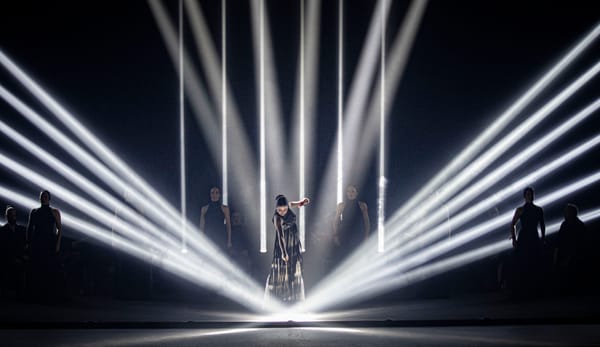
The atmosphere of Solitude is somber, its one few bright spots the child’s colorful shirt. The lighting, by Mark Stanley, is subdued, while Moritz Junge’s costumes resemble the quasi-military garments favored by Ukraine’s leader, Volodymyr Zelensky.
The word “solitude” can indicate both being alone and loneliness. Americans, far away from the world’s current conflicts, have little idea what it means to lose one’s family, country, and consequently, much of one’s identity. In this work, Ratmansky pays tribute to the magnitude of such losses.
copyright © 2024 by Gay Morris