One of Spain's Glories

"Soul + Alma"
Theatre Flamenco of San Francisco
Herbst Theater, War Memorial Building
San Francisco, CA
February 1, 2020
Last November the Cowell Theater celebrated “100 Years of Flamenco in the Bay Area” with a Gala performance that packed the house with current and past Flamenco dancers/aficionados. For the 53rd home season, Artistic Director Carola Zertuche of Theatre Flamenco of San Francisco, the oldest local Flamenco company, presented Flamenco as a 21st century art. Even though it is only February, “Soul + Alma” just might prove to become one of the more exciting and challenging performances this year. The Herbst Theater was packed; the audience enthusiastic, though probably not there primarily for Flamenco. Zertuche, however, may have gained some converts. Besides artists from Spain, she also scheduled locally: The Glide Ensemble Chorus, a cappella singers from the Glide Memorial Church. They accounted for the “Soul” part in the title. These days Theatre Flamenco is tablao size, but not in its reach. The program consisted mostly of solos and duets; with bata de colas and picos just about absent. Black was the color of the day. The individual works were choreographed, yet left space for impulses.
The program opened with the Glide Singers in a stirring rendition of “Encourage my Soul” (‘and let us journey on’). It called to mind that the most “soul” based Flamenco is the ancient cante hondo—which also speaks of pain, despair and persistence. Cristina Hall and Zertuche’s choreography (with Eduardo Guerrero stepping in half way through) started in silence with simple, repeated motions. Seen in profile, the women slowly bent to the ground and reached up with an outstretched arm. Again, again and again until you could feel in your own body the unforgiving mechanics of the slaves’ back-killing labor.
Hall followed with stunning twenty-minute “Seguiriyas” in which she uses canes as percussion instrumentt in the way Flamenco musicians, particularly in the past, emphasized the beat. But these pieces of wood were close to ten feet tall, becoming crutches, blankets, weapons and tools. The Bay Area native, who now lives in Spain, where she has worked, among others, with Israel Galván, transformed this cante hondo into a highly theatrical form. Fragments of implied narratives moved into abstractions. The dance recalled Euripides, but also the violence, sorrow, and pain that seems to be the particular fate of women, ancient or new. Elements of ballet (long lines, pirouettes and bourrées), modern and imagistic dance expanded but did not deny Flamenco’s essence. Though a brilliant exposure of a broadly based technique, more importantly Hall also presented brilliant, telling portrait of an ongoing suffering humanity. For the dancer it was a tour de force, for this audience member it became almost too much to bear.
The Glide’s version of “Hold On Just a Little While Longer”, with the repeated and insistent refrain of ‘everything will be alright,’ featured Guerrero as a Christ figure, carrying his cross on the way to Golgotha. The idea of the chorus encouraging this iconic figure, offered all kinds of choreographic potential. But this was just too simpleminded. Hall and Zertuche’s palmas provided support.
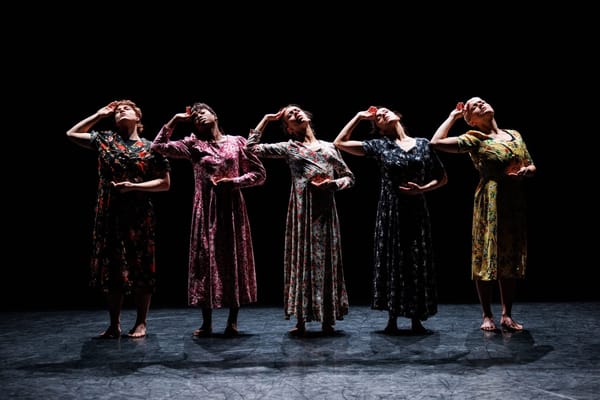
The mood quickly changed in Zertuche and Hall’s feminist “Peteneras”, often performed with Flamenco’s most “typical” accessories, the bata de cola and pico. The two artists paid a theatrical—in the very best sense of the word—tribute to these two quintessential “props.” The fire red ruffled train exploded from below a black dress and was extinguished almost before it had registered; the shawl, a simple black square of cloth, became a mask, a hood but also a frame for the women’s faces. This was Flamenco as sisterhood, fast paced, in unison, imagistic and telling. Zertuche performed her solo, “Cana” in male attire that emphasized the long curvatures of her torso, her whipping turns and precision footwork that almost lifted her off the ground. She used the bolero jacket as a prop the way male dancers do.
Despite possibly misjudging its length, Guerrero’s truly happy “Alegrias” charmed. the audience. Dressed in shiny black leather, long locks falling down his back, he strutted onto the stage, secure that we could not possibly resist these long legs, sleek looks and slightly bemused manner. Guerrero is a superb showman; I wouldn’t have been surprised if had arrived on a shiny motorcycle. However, he is also an impressive artist who dances hugely on the floor, in the air; and he just about speed-bourréed into the wings. He is as athletic as he is passionate, at home in the tradition but also fiercely pushing against boundaries. Flamenco, Jazz, Ballet and any number of other traditions are part of his breath-taking technique even as he collapses his body, leaps in contortions and fires off staccato footwork on toes and heels.
Guitarist Juani de la Isla’s solo “Bulerias” showcased Flamenco’s light-hearted and melodic side. Unfortunately Amparo Heredia’s powerful, deep-throated laments, particularly in her solo, were badly amplified.Google informed me that Camarón de las Isla Letra wrote the evening’s last song “La Leyenda del Tiempo.” The Glide artists, plus a male soloist, performed it in Spanish. When first heard, the work, apparently, caused a scandal as having provoked the birth of Flamenco Nuevo. Zertuche and her artists showed us what that can be.
copyright © Rita Felciano