Old and New
Valse Fantaisie, Continuo, Vivaldian Chat, A Glimpse, Reflections
BalletNY
Symphony Space
New York, NY
January 8, 2004
The Fugate/Bahiri BalletNY (formerly DanceGalaxy) presented a varied program of old and new, lyrical and dramatic works. If some of the experiments were less successful, the company, basically a pick-up group of dancers with various backgrounds and performance histories, looked well-rehearsed and engaging.
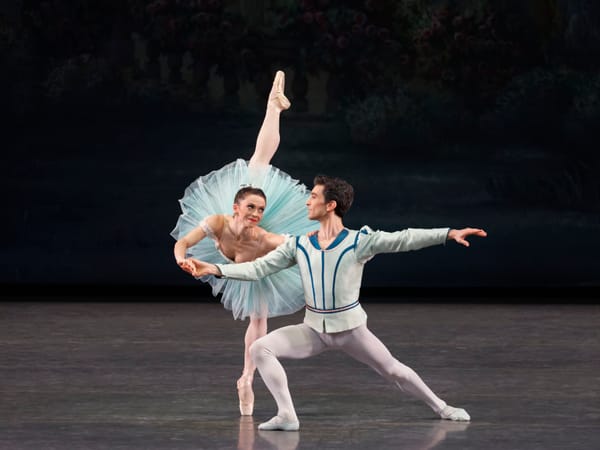
The 1967 version of Balanchine’s Valse Fantaisie (to Glinka—the music was taped) opened the program. It was set by Judith Fugate, who had danced it at the New York City Ballet. It suited her strengths so well, with its romantic urgency and stylish arms, and her company caught the windswept, lyrical, and otherworldly quality with a beautifully controlled amplitude. The four corps girls were true sylphs, with delicate and perfectly placed arms, but were modern, fearless ones, sweeping through the music. Cheryl Sladkin, especially, stood out for her elegance and sense of reaching further.
The man, danced by Todd Fox, is one of Balanchine’s quintessential poets, seeking, running, always moving. Some of these movements were a little beyond him; there were some technical insecurities, but he got the spirit, as did his elusive sylph, Jenna Rae Lavin. It was beautiful choreography, beautifully danced.
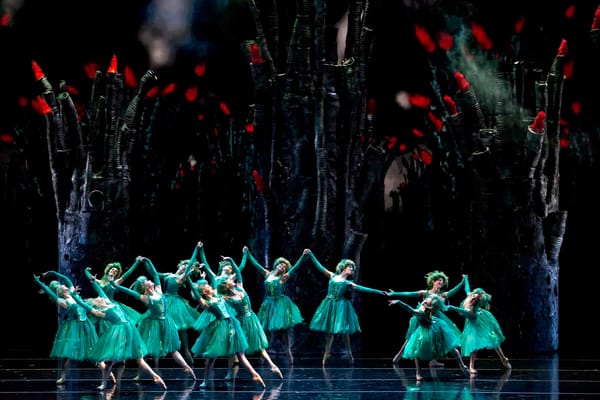
Antony Tudor’s 1976 Continuo has apparently been rediscovered, and this was its third performance in New York in less than a year. (The ABT Studio Company has made it something of a calling card.) It, too, is a beautiful work, and was set, like the ABTSC version, by Donald Mahler. The costumes were light grey, instead of the pure white that ABTSC uses, and this helped bring out a tinge of gentle melancholy that suits the sweet but elegiac music. ABTSC’s bright angels have become more ghostly, more mysterious, and more grownup. Eliane Munier and Griff Braun were the more prominent couple, but this is very much of an ensemble piece and the other two couples (Cheryl Sladkin with Ian Thatcher and Carolina Capdevila with Todd Fox) complimented them perfectly. This deceptively simple work took on a hauntingly beautiful atmosphere.
The new works provided a sharp and interesting contrast to these pure dance works, but unfortunately neither Thaddeus Davis’ Vivaldian Chat nor Ann Marie DeAngelo’s A Glimpse came anywhere near the choreographic richness of the older works. Peter Martins’ Reflections was just his usual heavy on lifting and short on dancing exercise, notable only for the understated dramatic intensity of Christina Fagundes.
Thaddeus Davis, too, was going for dramatic intensity in his athletic pas de deux for his wife, Tanya Wideman Davis, and Prince Credell. Two people meet, somewhat sullenly, to classical music (Bach and Vivaldi), grapple to Thomas Newman, and stay together with the classics. The dancers caught the shifting moods—sometimes he wants to be free, sometimes she does, he comforts her, she comforts him—and the audience certainly enjoyed the dancers’ high kicking strength, but there wasn’t much new or particularly musical about the choreography.
Ann Marie DeAngelo’s A Glimpse must be classed as an honorable failure; the idea was intriguing, but the execution lagged behind. It was based on Theophile Gautier’s novel Mademoiselle de Maupin, in which (thanks to the plot summary) a poet and his mistress are both attracted to Mademoiselle de Maupin, dressed as a boy—this is meant to signify “the sovereignty of art and its independence of moral and social conditions.” Medhi Bahiri, dressed in nineteenth century garb, read a few sentences (presumably from the novel) in French, then their English translation, and introduced the three characters. The theatrical effectiveness, though, diminished when the dancing started. In a somewhat clichéd attempt at timelessness, the Poet wore blue jeans and did some rap dancing. There were various pas de deux and pas de trios, of the Soviet ice dancing and Oscar ceremony ilk. Again, the dancers (David Robertson as the Poet, Tiffany Stadler as his mistress, and Jenna Rae Lavin as de Maupin) were well-rehearsed and committed, and as interesting as the choreography would let them be. But the true importance and significance of art can’t really be spelled out in block letters; it must be shown. And fortunately, BalletNY, with their loving and detailed productions of Balanchine and Tudor, show clearly how beautiful and powerful and moving dance can be.
copyright © 2025 by Mary Cargill