O Sole Mio
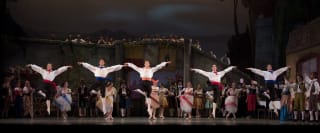
"Napoli"
Oregon Ballet Theatre
Keller Auditorium, Portland
October 6, 2018
In 2015 Oregon Ballet Theatre staged the third act of August Bournonville’s 1842 ”Napoli.” It’s the best-known part of this enchanting ballet, often excerpted in mixed programs; the variations have become a staple in competitions and gala events. It turns out that the Oregonians used this last act as a dress rehearsal for the entire “Napoli.” That meant commissioning sets and costumes along the lines of the original ones. At this time, OBT is the only American company with its own “Napoli” production. (Arizona Ballet’s 2016 version borrowed theirs from the Royal Danish Ballet). OBT currently employs twenty-one dancers, a junior company of fourteen and six apprentices. So Artistic Director Kevin Irving took a substantial risk, both artistic and financial, to do the entire “Napoli”. It more than paid off.
Coached by Frank Andersen, Dinna Bjørn (who choreographed the second act) and Eva Kloborg -- all of them Royal Danish Ballet alumni -- OBT’s combined forces, which also included impressively coached children from the school, did a fine job in a fully developed, musically astute, and finely detailed recreation of a great work. The dancers had to draw on abilities few of them thought they had. Best of all, since the company now owns this “Napoli” they can grow into.
For the rest of us, we finally learned what those exuberant third act festivities were all about. Story ballets, whether as tragedy “Swan Lake,” “Romeo and Juliet” and “Onegin” — or with a happy ending –- “Sleeping Beauty”, “Cinderella” and “Don Quixote” are fairy tales. That’s why we love them. On many levels “Napoli” is a fairy tale as well, even though it supposedly happens in a real city. Bournonville gives us an idealized picture of Neapolitan life, one in which good wins over evil. Northern Europeans still love what they see on their summer vacation on top of Italy’s boot. I remember walking the streets of Naples and hearing people singing through open windows and pushing their vegetable carts. Bournonville may have enjoyed similar experiences, particularly since he was there in exile, having dared to address king Christian VIII from the stage.
In this Bournonville fairytale, if that’s what it is, the lovers go through travails until they live happily ever after in their casetta on the edge of the Mediterranean. Making it special is Bournonville’s having developed his story in terms of detailed characters for which we immediately suspend our disbelief. Using both dance steps and mime, which includes physical acting in addition to gestural language, he packed the stage with people that worried, cheated, joked, quarreled, prayed, fought and loved. The first act’s bustling crowd is so lively that a couple of times I found myself distracted from the main story. Almost off stage, for instance, a couple’s private “conversation” demanded attention. What were they talking about? They made me miss the lovers’ departure.
The pristine ballabile with the women’s rond de jambes and the men’s fine entrechats highlighted the first act. With some help from Rossini and Charley Butler trumpet, Jeffrey Stanton’s Pescarillo just about dealt a deathblow to grand opera. And I am pretty sure it was Rossini again who called up the storm that shipwrecked and almost drowned our lovers.
“Napoli” was beautifully cast. Every minute on stage Teresina (Xuan Cheng) and Gennaro (Peter Franc) showed that they were meant for each other. Both them were playful and teasing, soft but also fierce. Cheng buoyantly joined her girl friends but quickly showed backbone in mocking and forcefully rejecting the excellent macaroni seller Giacomo (Adam Hartley) and his sidekick and competitor Peppo (Michael Linsmeier). She stood up to her mother Veronica (Lisa Kip), but she also snuggled up to make her change her mind; she smoothed Gennaro’s fury at his comrades’ quarreling with a couple of simple caresses.
Passionate with Teresina and assertive but also generous with the villagers, Franc’s Gennaro immediately makes his presence known with that front-facing grand jeté. He is a man to be reckoned with. So having lost his Teresina to the waves, his gestural anger and self-hate looks almost operatic. But Franc pulled these emotions inside, and they dragged him, step by step towards the Virgin’s sanctuary where, crushed to the ground, he appears to have given himself up. Help, of course, arrives with the medal he is given by the friar. Franc gave that trajectory from despair to faith a mature beautifully nuanced interpretation.

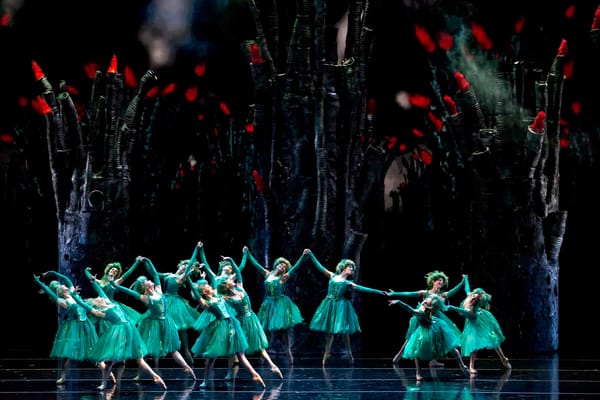
The second act Blue Grotto, could be seen as Bourneville’s ballet blanc homage to classical ballet. Michael Mazzola’s lighting might have been a tad less dark to make the upstage action more readable. The naiads’ choreography showcased soft runs, low arms, unisons and small hops reminiscent of both “La Sylphide” and “Giselle.” With more practice, the tiny slips and insecurities, no doubt, will be taken care of. The trio of naiads’ (Eva Burton, Kimberly Fromm, Katherine Monogue) who shaped themselves into something like a frame around Golfo (Chauncey Parsons), turned him into an image, perhaps a counter icon to the one of the Virgin in the human realm. Parsons interpreted Golfo less as a villain than as a non-human creature, entranced by what the waves have carried in.
The second act, also, excellently shows the communicative power of mime when done with large, clearly reading gestures. It’s an art that has almost disappeared though some of it can still be seen in silent movies. A terrified wide-eyed Teresina scurries from place to place, grabbing her chest but also succeeding in telling her story from the world outside. Ambiguously, the naiads, with eyes that looked dead stretch out welcoming hands yet hold Teresina at bay when she asks for help. Despite her fear, Teresina seems to be fascinated by Golfo. Gennaro arrives just in time. Their slow recognition becomes “Napoli’s” high point, a triumph for Cheng and Franc. The exquisite hand-to-hand gestures lit a spark of recognition, the turning of the ring opened eyes, but finally, it was Gennaro’s beating heart that convinced her. “O Sanctissima”, the still popular Neapolitan hymn to the Virgin, accompanied the offered medal. Even for non-believers it must be satisfying to see that Teresina’s striding so triumphantly towards Golfo, medal in hand, had him melt like the Wicked Witch in “The Wizard of Oz.”
The third act offered the most cohesively excellent performances. It showed that OBT has lived with the intricacies of Bournonville’s art. In this act, at a moment when we are all prepared for the wedding festivities, true evil raised its head. Giacomo and Peppo’s slandering and suggestions of witchcraft, and the speed with which it was disseminated, was chilling. But feisty Teresina saved the day by dragging the priest back to the stage, and Gennaro got to kick the villains out of town. The iconic bridge, however, needs a more varied crowd looking down on the celebrations.
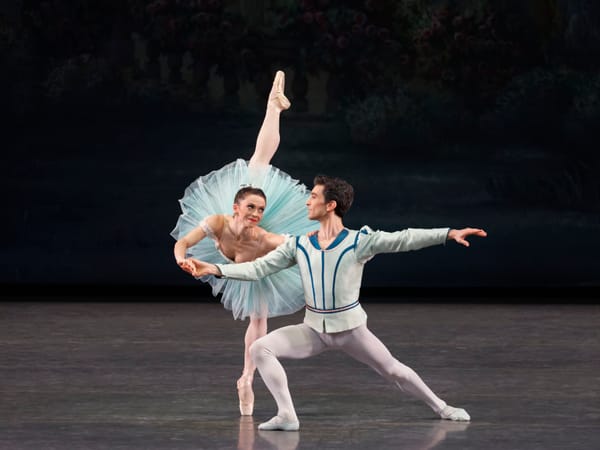
The Pas de Six and its many solo variations, showed buoyant dancers, sometimes barely touching the floor; fast turns and stitching footwork that dazzled they eye even as you could not catch all the details. Amazingly, the dancers never showed how fiendishly difficult, these fortunately short, variations are. When Gennaro joined Teresina in the spitfire Tarantella, theirs had a charmingly flirtatious catch-me-if you can quality to it. But I am not sure whether the whole community participation in the finale was not a gilding of the lily.
Still, October 6, 2018 was a banner day for Oregon Ballet Theatre.
copyright © 2018 by Rita Felciano