Mark Morris at the Mostly Mozart Festival
Mark Morris Dance Group
“Love Song Waltzes, “I Don’t Want to Love,” “The Trout”
Mostly Mozart Festival
Rose Theater, Lincoln Center
New York, New York
August 9, 2018
Two of the three works being offered this weekend by the Mark Morris Dance Group for the Mostly Mozart Festival have to do with love: “Love Song Waltzes” from 1989 and “I Don’t Want to Love” from 1996. The third work, “The Trout” a world premiere set to Schubert’s “Trout” Piano Quintet in A Major, if not about love, per se, certainly is about companionship or the search for it. Morris’s work has long been known for its focus on community. In these days of turmoil and strife, I found “The Trout” particularly consoling.
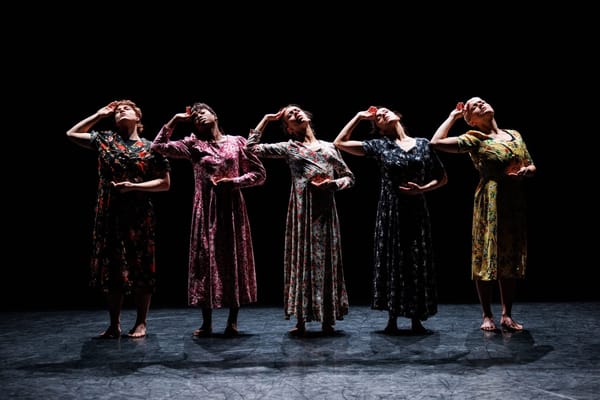
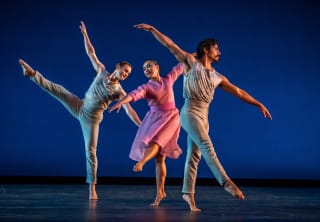
The piece has costumes by Maile Okamura, which consist of shirtwaist dresses in gauzy fabrics for the women and pants and tank tops for the men, all in pastel colors. These give “The Trout” a sense of being in the present, despite its nineteenth century score. The work begins with dancers walking on and off a darkened stage, greeting each other, slinging an arm over another’s shoulder in comradely fashion, or appearing to look for someone, as if anticipating the arrival of a friend. The greeting, seeking, finding continues through the first movement. The second, andante, movement is notable for the women whirling slowly in the men’s arms and for gentle lifts, the third scherzo, for small quick jumps. The final two movements take on a more formal balletic quality, with movements that hint at the kinds of national dances one finds in nineteenth century ballet classics – upright posture, hand on hip, quick skipping steps. Then, near the end, a repeated gesture is introduced, one of invitation, the arm extended, palm upward. The gesture is abstracted and generalized, but it serves as a metaphor for the whole work, which is congenial and intimate. “The Trout” is hardly a dance one would consider political, yet it makes a point about the value of amity, cooperation, and good will that could serve as a lesson for many, today.
“Love Song Waltzes” and “I Don’t Want to Love” make for interesting contrasts. The first is set to Brahms waltzes, the second to Monteverdi madrigals. The Brahms is more deeply felt, the Monteverdi lighter in tone. One senses that a German lover may die of love while an Italian one may passionately feel they are dying before contemplating the next conquest.
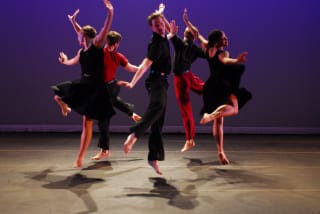
“Love Song Waltzes,” danced in red and black costumes that are uncredited, was Morris’s second foray into Brahms Waltzes. In 1982 he had set his “New Love Song Waltzes” to Brahms’s “Neue Liebeslieder Walzer.” Morris captures the swing and surge of waltz rhythm and at various points even has couples waltz about the stage in the traditional social dance position. The couples sometimes consist of men and women, but are just as likely to be same sex in a gender arrangement that Morris pioneered in modern dance. Generally, the mood in this work is one of love and loss rather than the giddy moment of love discovered. In one of the few solos of the evening, company veteran Lauren Grant swoons in a series of falls that convey anguish. And at the end of the work Domingo Estrada, Jr. waltzes each of the eleven other members of the cast off the stage one by one, until he is alone. He walks off by himself.
“I Don’t Want to Love” is more hyperbolic in its emotion than “Love Song Waltzes,” sometimes amusingly so. The first song/dance, which gives the work its title, is full of negative gestures (who knew there were so many?) as this lover swears off “that wicked evil-doer.” Another song, “It’s Not Right to Break Faith,” has the dancers pointing one arm skyward, while with the other they place hand to heart in the ballet mime gesture for love and fidelity. Yet another, “Zephyr Returns,” is notable for light, effervescent leaps and jumps as if riding waves, while “Lament of the Nymph” features an impassioned Leslie Garrison, dressed in a diaphanous white gown by Isaac Mizrahi. She decries a faithless lover in movement that has her throwing herself at the other dancers in a maelstrom of grief. Here, as in most of these dances, the community is present to support the lover who has been left behind.
Morris’s close relationship to music is well known and, if anything, that relationship has become deeper over the years. The musicians of the Mark Morris Dance Group Music Ensemble earn equal billing with the dancers—in fact are given a higher place in the written program. There are times when I wonder if Morris is not more interested in the intricacies of the scores than the choreography of the dances. He doesn’t so much expose those intricacies, or extrapolate from them, as surrender to them. The result is that in “The Trout,” in particular, the music appears to have more clarity, complexity, and impact than the dance.
One further point: Considering that the program spans nearly thirty years of Morris’s work, it is remarkable how consistent his approach to choreography has been over that time. One would hardly know that “Love Song Dances” was made decades before “The Trout.” The structure is similar, with much entering and exiting throughout, constantly shifting patterns and groupings, the use of vernacular gestures as recurring motifs, and very little solo work. A few choreographic surprises from this important choreographer would be welcome.
copyright © 2018 by Gay Morris