Magician and Muses
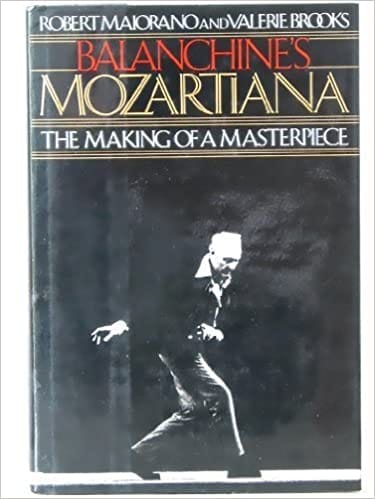
"Balanchine's Mozartiana - The Making of a Masterpiece"
by Robert Maiorano and Valerie Brooks
Freundlich Books, New York, 1985
Not new, this book about the making of a ballet remains an important item of danced literature. Its principal author, Robert Maiorano, was a dancer with New York City Ballet for 15 years, beginning in 1961. For the company's Tchaikovsky Festival in 1981, Maiorano asked Balanchine's permission to attend rehearsals for his announced new "Mozartiana" that would be premiered at the festival's opening. Balanchine gave his consent. Maiorano, although he had written on his own previously, enlisted journalist Valerie Brooks as co-author. They wrote not for each other but together. As a dancer, Maiorano had a dash of Edward Villella's drive and a drop of Helgi Tomasson's elegant finish as part of his observant, efficient manner. Relating what went on at the Mozartiana rehearsals and premiere, the authors give us description, explanation, suspicions and some fascinating asides.
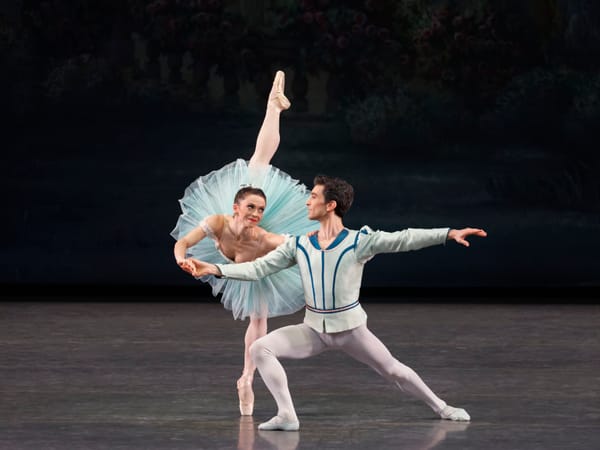
Balanchine had worked with Peter Ilyitch Tchaikovsky's "Mozartiana" music long before 1981 but, as usual, he preferred to start afresh rather than revive. It was one day in May, just prior to the festival, that NYC Ballet mistress Rosemary Dunleavy announced two afternoon rehearsals that would require the presence of not only Balanchine and herself but also dancers Suzanne Farrell and Ib Andersen plus pianist Gordon Boelzner. We are told how Farrell is dressed and groomed, and how she warms up. Andersen is sweaty, having come from the rehearsal of another ballet. Balanchine enters on the dot, casually clad but regal in his bearing. At the piano is Boelzner with the company's principal conductor, Robert Irving. Balanchine, also going to the piano, comments on the music and the audience's tendency to interrupt with applause. Irving departs for another rehearsal and Balanchine goes to take Farrell by the hand in order to begin. The opening seems to be a presentation of Farrell. It is repeated, and it is Dunleavy's job to remember the exact steps or moves when, as sometimes happens, the choreographer and the dancers forget what comes next.
As a writer about people, Maiorano is a romantic rather than a realist. He portrays George Balanchine as an idealist monogamist and not as a harem fantasist. Farrell, according to Maiorano, is Balanchine's ultimate muse. That is correct insofar as his last piece of choreography was "Variations for Orchestra", a new solo for Farrell to Stravinsky's variations in memory of Aldous Huxley. Farrell danced the premiere on 2 July 1982 at the New York State Theater, "Mozartiana " had been Balanchine's ninth from last new staging. Its principal dancers were to be Farrell and Ib Andersen but injury and illness haunted this production.
Not mentioned is Farrell's marriage to fellow dancer Paul Mejia, their resignation from NYC Ballet after what they felt was Balanchine's refusal from then on to let Mejia dance, her unsatisfactory attempt to perform standard repertory in Canada, and their joining Maurice Bejart's company in Brussels, Belgium. There is just a brief reference to Farrell's years with Bejart's company: that she regularly gave herself a Balanchine class during that period. She, but not Mejia, returned to NYC Ballet in 1975 and reconciled with Balanchine.
Injury and illness haunted "Mozartiana". Farrell was still feeling her hip replacement and was having trouble with a toe but persisted in dancing all out. Anderson injured himself seriously and was partially replaced by the young Christopher d'Amboise. Balanchine was experiencing body pain yet demonstrated nonetheless. The mood at rehearsals wasn't dour. Visitors came to watch: "The door opens and the photographer Costas enters. Balanchine asked him as a friend, not as a photographer, to the rehearsal. He carries a present rather than a camera - a large tin of French cookies, which Balanhine accepts with a bow and thanks in Greek." At a subsequent rehearsal, choreographer Jerome Robbins visits. He is the company's co-director. Amazing how helpful he is to Balanchine during the rehearsal. Still another visitor is the translator of Russian, Lucia Davidova - one of Balanchine's first friends in America.
Balanchine died on 30 April 1983. Maiorano's book ends with the words NYC Ballet's co-founder Lincoln Kirstein spoke to the audience that evening: "Balanchine is with Mozart, Tchaikovsky and Stravinsky ...".
Prices for the book listed on the Internet are extremely variable, from $7.63 to $54.95.
copyright 2020 by George Jackson