Love's Many Faces
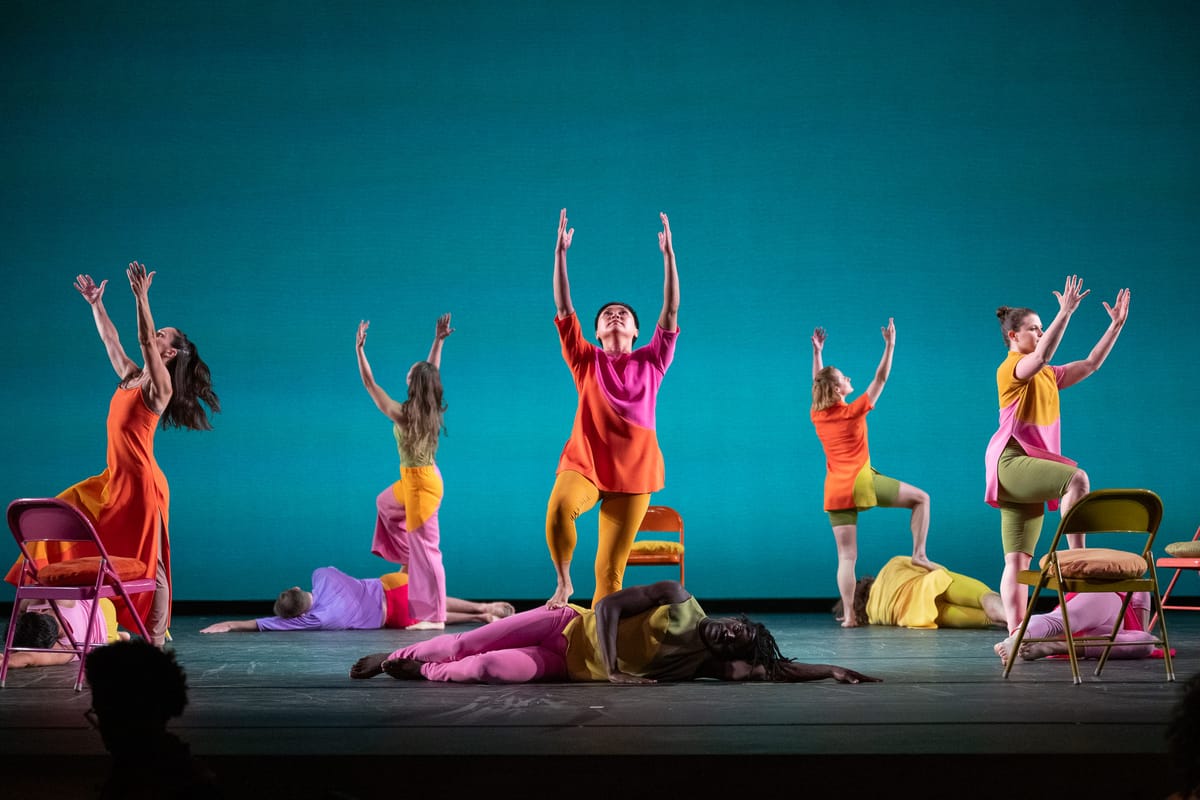
“The Look of Love”
Mark Morris Dance Group
Ted Shawn Theatre
Jacob’s Pillow Dance Festival
Becket, Massachusetts
Saturday, July 1, 2023
In the early 1980s, a young Mark Morris rode the cutting edge of the zeitgeist with works that gave an important place to gender identity and fluidity. Forty years later, his dances are those of an established master; no need to unsettle or provoke. However, Morris hasn’t lost his ability to sense the tenor of the times. Today the mood is more somber than rebellious, while at the same time demanding some relief from the gloom, and for many the tragedy, of the last few years. Morris’s “The Look of Love,” which opened the summer season at Jacob’s Pillow, satisfies on both counts through a clear-eyed view of romance. It reminds us that whatever happens in world events, love continues its eternal round of highs and lows.
The work features songs of Burt Bacharach from the 1960s, arranged by Ethan Iverson, with lyrics by Hal David. At the Pillow, the music was performed live by a four-piece music ensemble, with lead vocals by Marcy Harriel backed by Clinton Curtis and Blaire Reinhard. The dance says something about Morris’ current frame of mind. David’s lyrics tend to be wistful and occasionally dark; lost love is their recurring theme. Morris’s dances reflect that mood, and yet they contain an energy that can’t be denied, one that reads as resilience, and if not optimism, at least hope. Isaac Mizrahi, long a Morris collaborator, provided the neon colored costumes, which add to the dance’s sense of buoyancy.
Morris doesn’t treat Bacharach’s songs as pop throwaways. His sensitivity to music is long established, and he reveals, in tunes like “Walk on By” and “I’ll Never Fall in Love Again” the complexities of Bacharach’s music, which he mirrors in his choreography through ever shifting patterns of movement. The ten dancers at the Pillow performances, each a strong individual, were Mica Bernas, Karlie Budge, Domingo Estrada, Jr., Courtney Lopes, Dallas McMurray, Brandon Randolph, Nicole Sabella, Christina Sahaida, Billy Smith, and Noah Vinson.
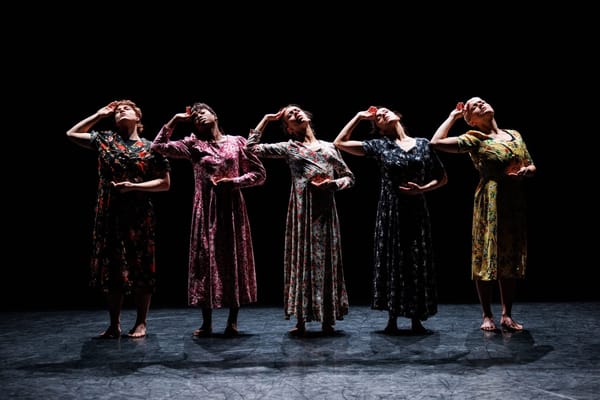
At numerous points throughout the hour-long piece, Morris creates gestures that pantomime an image in the song being sung. For example, the dancers look skyward and hold up one hand, as we do when testing for rain, while the vocalist sings the words, “raindrops keep falling on my head” from the song of the same name. Once established, Morris often makes such pantomimed gestures part of a larger pattern of movement, which renders them abstract. He doesn’t use this device consistently, so it retains it visual interest each time it appears. When it does, it can cause a touch of laughter and delight in the audience as the gesture is repeated and recognized in a new context.
Morris also incorporates other kinds of recurring moves, some of which are unconnected to any specific meaning. Among them is a winding grapevine step found in eastern European folk dance. Much of Morris's early exposure to dance was through Balkan folk dance, so the grapevine step is part of his personal history. Movement throughout “The Look of Love” is, for the most part, grounded, as it is in modern dance, a form that is also prominent in his training and work.
Morris is well-known for favoring groups over individuals. Solos and duets are usually short-lived, quickly morphing into group dances. For him, community has always been key. Here, in individual dances, we often see community fall apart, only to reemerge in new configurations. Groups wax and wane, shifting shapes and sizes. The dancers interact with chairs and cushions, props that they arrange in ever changing ways, as one song leads to another. Such devices help lend the work continuity and connection amid the variety of songs.
At this stage in his career, Morris seems to find inspiration not only in music, but in building movement structures from familiar steps that he can shuffle and reshuffle into ever evolving shapes that grow, merge and dissolve before our eyes. This kaleidoscopic approach, so central to “The Look of Love,” would seem to provide him with enough material and fresh ideas for years to come.
copyright © 2023 by Gay Morris