Lit Up
“Keep,” “The Accidental,” “Grace Action”
Pennsylvania Ballet
The Joyce Theater
New York, NY
March 30, 2016
Change is the essence of creative being, and Pennsylvania Ballet showed that under the new leadership of Artistic Director Angel Corella the company is embracing its future with particularly remarkable vitality. The works the troupe brought on its first tour to New York in over a decade were all New Year premieres, all recently created ballets, and all set specifically on the dancers of this company. Though PAB is clearly still transitioning into its new identity, both in overall look and performance style, as the evening progressed with very different ballets, the impact of their execution kept getting only better.
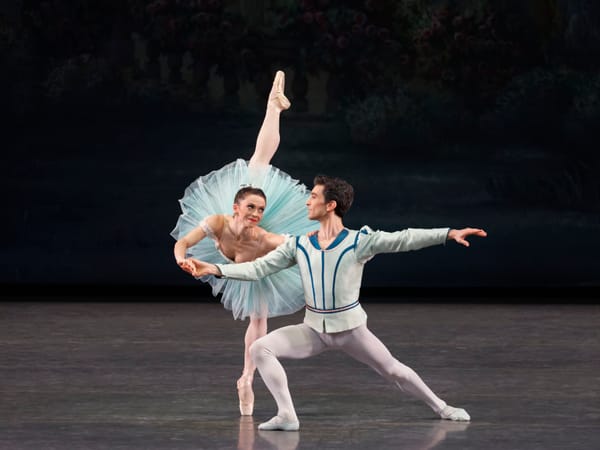
Matthew Neenan’s 2009 “Keep,” a ballet about the challenges of love to quartets by Borodin and Rimsky-Korsakov, opened the program with a multi-hued collection of pas de deux that presented a multitude of different emotions and as many possible interpretations. The dancers embodied different artistic identities, but two in particular used the work to really shine – Lauren Fadeley and Lillian DiPiazza.
Fadeley’s exuberant projection of the music added vibrancy to the piece from her very first appearance on stage, and I can’t recall the last time I saw gargouillades look so light and playful. Her partner, Ian Husley, was the perfect complement to this energy, looking a bit timid and innocently confused in the interaction where Fadeley flirtatiously pushed him away, only to again resume their joyful dancing. DiPiazza’s style and presentation were different, bringing elegant pensiveness to the lyrical steps and music from the moment she leaned over Jermel Johnson, as though listening to his heartbeat, to begin her leading part. From the more archaic-styled movements that resembled a minuet, to the more classical ones, DiPiazza was able to turn even the simplest sections into stylish and emotionally potent vignettes.
Choreographically, “Keep” was imperfect. Its three sections, segregated by lighting and costume color into the red, green and yellow phases, transitioned from the more jovial to the more demure inflections in the steps and mood, and explored some compositions of classical steps with more modern ones and turned-in positions. But, while some dancers could inhabit the piece, it seemed that others, like Amy Aldridge and Francis Veyette, who possess richly inspired maturity in their dancing, and Alexandra Hughes and Johnson, who showed remarkable lines and command of the stage, could have left much more of an impression with better material.
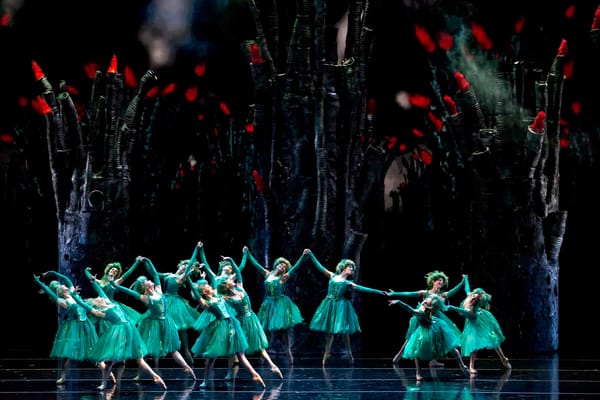
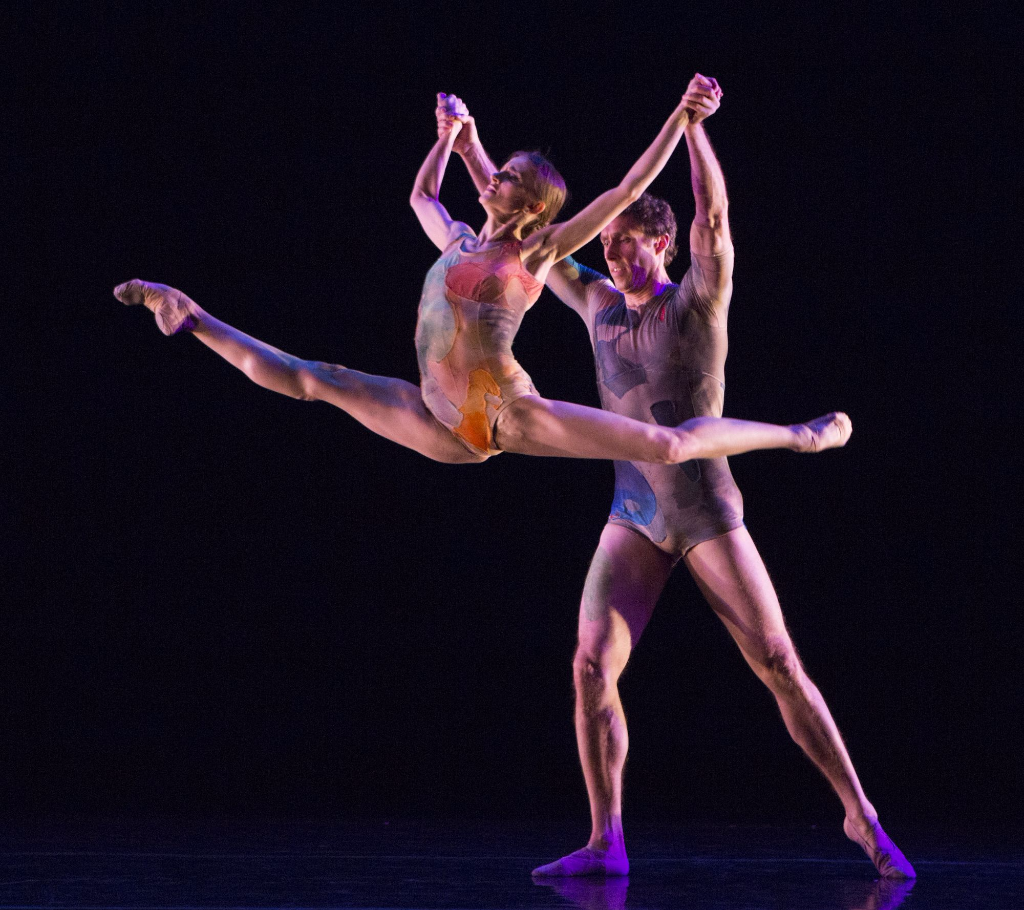
The second work, Trey McIntyre’s 2014 ballet “The Accidental” to a collection of songs by Patrick Watson, seemed a superior work and offered nuanced self-assurance enveloped in the soft rock plush of the musical accompa-niment. The one real complaint with it would have to be the odd costuming – the skin-tight, flesh-colored leotards and body suits embellished with nature-inspired colored designs kept calling to mind Adam and Eve, and the pieces would have likely worked better in something more calibrated to the jazzy and soft-rock flavors of the songs.
That aside though, it too revealed some remarkable dancers. The small-statured Oksana Maslova, partnered by the taller and more commanding James Ihde, used the steps and dissonance of their size to create an attention grabbing duet. Maslova gave focus to her power in the various supported leaps and dismissive flicks out of little developpés, and it was completely unexpected to see the almost seductive string of movements these dancers presented coming out of the contained classic fifth position that they assumed at the start of the piece. Another “Accidental” revelation was apprentice Craig Wasserman, whose solo at the end of the piece possessed remarkably seamless continuity of motion – a quality that coupled with the music made the scene feel like one uninterrupted thought in movement. He retained this mesmerizing quality even when he would descend into a full grand plié in fifth position, and then, floor-bound, rotate out of it to elevate himself again.
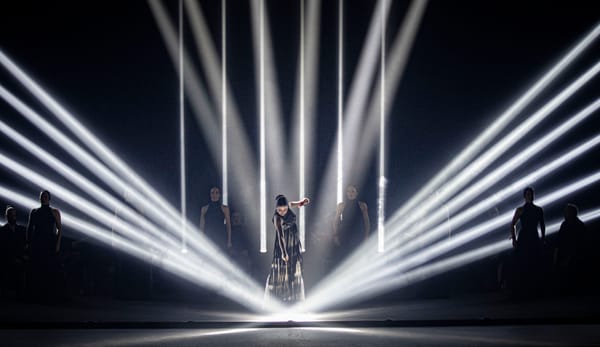
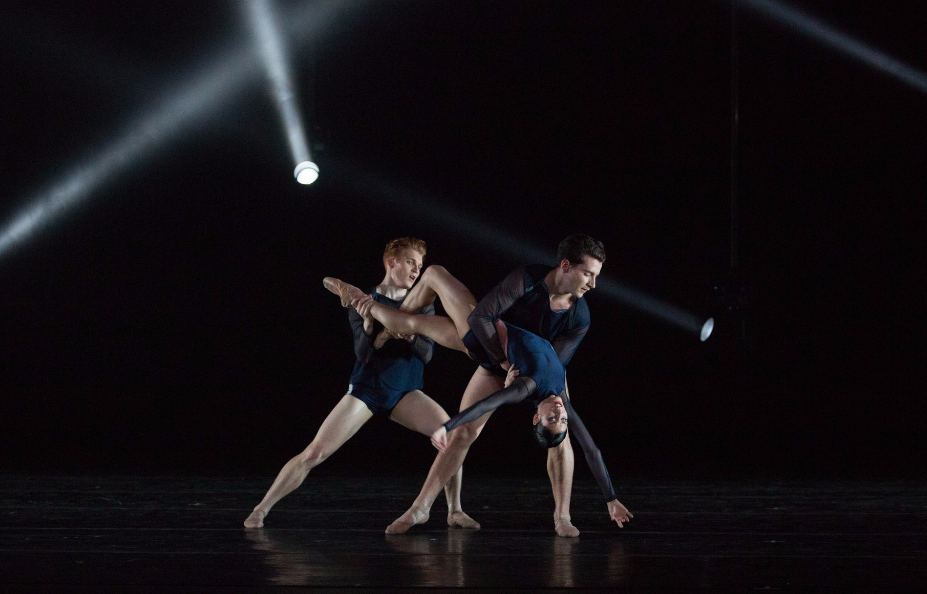
But the company saved the best for last. “Grace Action,” a 2015 ballet by Nicolo Fonte, to music by Philip Glass, was a dimly lit, intoxicating journey that sparkled with technical cohesion and expert punctuation. The lyrical motion and fluidity in the geometric pattern and movement transitions at first set an emotional base of brewing intensity, and then used the music and the dancers’ individual interpretations to layer more and more complex tones.
The particular choreographic style wasn’t new; its emphasis on dancers’ aesthetic and physicality resembled Forsythe or McGregor – but its presentation by these dancers, and the fusion of the totality of the work’s elements, was in a new voice. Structurally, the emphasis on lines and angles in the shapes and movements of the body was fully integrated in the piece, as in the scene where two women in the back of the stage would syncopate arm movement of two men in the front, giving the overall choreographic phrase both symmetry and contrast with this echo. Beyond that, the dancers’ individual expression added intangible elements, and some of the company’s artists really took the opportunity to say something of their own with the work. DiPiazza and Mayara Pineiro gave their interpretations more sophisticated and elegant treatment, while Fadeley switched her exuberance of the first act for stronger, more imposing and space consuming presentation, which not only added to the music but also worked to show her expressive range.
“Grace Action” is a work that definitely begs for repeat viewing, as does the company itself. The dancers’ commitment and comfort with ballets was evident, and they seemed to have really loved performing these works, with this troupe. Their enlivened individualities were also welcome sight, and hopefully in line with the company’s direction. PAB’s next chapter may just be beginning, but both Corella’s vision, and the dancers’ performance in New York, suggest it would be one worth reading. It’s an exciting time for the company, and it’s difficult not to be excited with them.
copyright © 2016 by Marianne Adams