Humanity in Splitsville
"Split"
Lucy Guerin Inc
Baryshnikov Arts Center
New York
October 13, 2018
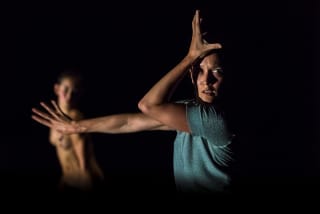
Two women – one naked, one in a modest blue dress – dance parallel figures to the sound of drums, on a bare stage marked off by a square of white tape. The gestures suggest a range of human activities: play, sport, religious ritual, repetitive work, rest, sex, sleep, and dance itself, ballet and modern and folk. The moves are identical but look different, articulate and sensuous in the flesh, hidden or suggested in the folds of a dress. The two dancers have plenty of room to share, and seem to co-exist peacefully. After 15 minutes or so, they pause and divide the square in two, laying a line of tape straight down the center.
The next section of the dance takes place in one-half the space, and peace gives way to a relationship that looks sometimes like beggar and hoarder, sometimes like predator and prey. The fully clothed LIlian Steiner is interested mainly in eating, and the naked Melanie Lane in taking some of that lunch for herself. Lane, described in the program as Javanese-Australian, crouches and then pounces on the fully clothed, quite White Australian Lilian Steiner, who evades, resists, repels her. They do not get along, they do not work together. But still there's room for this tense relationship to play out.
That's until they divide the square again, and again, and again, in shorter and shorter increments of time. One-eighth of the space becomes one-sixteenth, one thirty-second, sixty-fourth, 128th, 256th. Within an hour the stage has shrunk to a box too small for two to stand abreast, so the naked woman climbs onto the shoulders of the clothed one. They topple backward as the lights go out.
"Split" is the work of Australian choreographer Lucy Guerin and her two dancers, also from Down Under. I've never been to Australia, but from what I've read and heard, it represents a unique cultural borderland between Western modernity and Indigenous peoples -- a perfect place from which to observe the collapse of civilization.
In recent years we've come to talk about the current phase of the earth's history as the Anthropocene Age, the fateful period when the human race proliferated and polluted its way to the top of the food chain, extinguishing other species daily while exhausting the earth's resources, all the while dreaming of ever-cleverer solutions to the problems spawned by our supremacy.
"Split" suggests we are running out of answers. It's the most compelling argument I've ever seen for sustainable development. It is also a spectacular work of art, a simple concept danced and acted with total conviction; the naked, fierce Melanie Lane the perfect adversary for the prim narcissistic Steiner. The sound score by the British artist Scanner was also perfect -- elemental drumming, divided into twos, fours, eights and sixteens, even as the stage was being cut by just those proportions. This is the sort of thing we've come to expect from the Baryshnikov Arts Center, an organization with global reach and a dynamite philosophy: Aesthetics as Ethics, beauty that packs a punch.
Copyright 2018 by Tom Phillips