Hübbe's Farewell
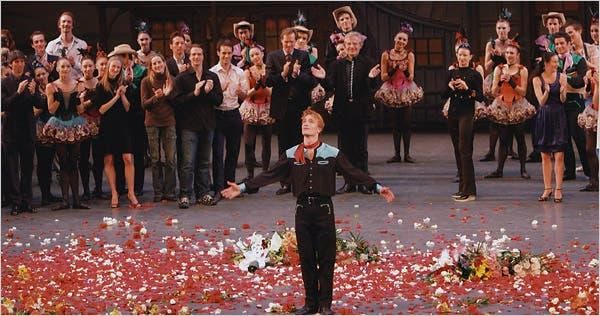
"Apollo", "Flower Festival in Genzano", "Zakouski", "Cool", "Western Symphony"
New York City Ballet
New York State Theater
New York, NY
February 10, 2008
New York The packed and appreciative audience said goodbye to Nikolaj Hübbe in a cowboy hat, flirting with Maria Kowroski, while being saluted by his colleagues—the applause backstage could still be heard as the audience was leaving. This cheerful and cheeky final farewell was some compensation for the loss of that great artist. Loss for the New York audience, that is, since he is taking over his original company, the Royal Danish Ballet. Possibly as a farewell gift, two young dancers, Kathryn Morgan and David Prottas, danced Bournonville’s “The Flower Festival Pas de Deux”, which Hübbe staged. Prottas had clear, sharp, beats, but I was more impressed by the demeanor of Morgan, no slouch herself in the technique department. Innocence and young love are so hard to convey without descending into simpering, grinning, or mugging, especially with Bournonville’s fondness for blowing kisses to the audience, so at odds with the contemporary postmodern attitude, but Morgan was natural, sweet, and lovely. This theatrical commitment was a hallmark of Hübbe’s career, and that, more than his fine technique, gave him a unique place in the company.
His farewell "Apollo" was a summation of these qualities; powerful, committed, and individual. He found his own truth in the steps, and gave an unforgettable performance; his final walk to Parnassus, especially, was unique. Unlike most dancers, he didn’t keep his arm raised in an ascending arc around the stage, he dropped it halfway, as if accepting a burden, then turned back to the muses to make sure they were coming too, a little touch that made the god touchingly vulnerable and human; no one wants to be alone.
His Terpsichore was Wendy Whelan, a dancer who matches Hübbe’s intensity. Their partnership in “Liebeslieder Waltzer” saw one of Hübbe’s deceptively simple performances. How hard can it be, really, to walk on stage and stand at the back, watching other dancers? And how difficult can it be, in “Vienna Waltzes”, to gaze lovingly at Rachel Rutherford (hardly hardship duty), and walk off stage? Or how complicated is it to walk on in “The Sleeping Beauty” and have wave your hands around in front of the Countess. But where other dancers can enter at Point A and go to Point B, with perfectly correct posture and pointed feet, Hübbe could enter at Point A and the audience would see the most beautiful woman in the world, standing in a magical forest, or in the bittersweet, mythical Vienna of the Strauss waltzes, or in a profound conversation with the handsomest, most generous and gracious of gentlemen.
Or Hübbe could walk on a bare stage, and begin to dance in the solemn Balanchine solos of “Square Dance” or “The Four Temperaments” and seem to be living Hamlet’s soliloquy. The list of ballets he has, at present, no replacement is long, but for me, “Liebeslieder Waltzer” is unimaginably incomplete without him. The 19th century balletomanes may have had the poetry in Zucchi’s back, but today’s NYCB audiences had the music in Hübbe’s arm, music which will last a lifetime.
copyright © 2008 by Mary Cargill



