"Garden Blue" and other works at American Ballet Theatre
“Songs of Bukovina,” “Garden Blue,” “In the Upper Room”
American Ballet Theatre
David H. Koch Theater
New York, New York
October 19, 2018
Under the rubric, “ABT Women’s Movement,” American Ballet Theatre is promoting women choreographers during its current fall season at the Koch Theater. Two were represented in Friday’s program: Jessica Lang and Twyla Tharp. Tharp, of course, has been on the scene for decades, and “In the Upper Room” has been in ABT’s repertory since 1988. Lang has made one ballet for ABT (“Her Notes” in 2016); her second, “Garden Blue,” was premiered Friday. Not that Lang is a novice, she has had her own dance company since 2011, and has made dances for a number of different groups.
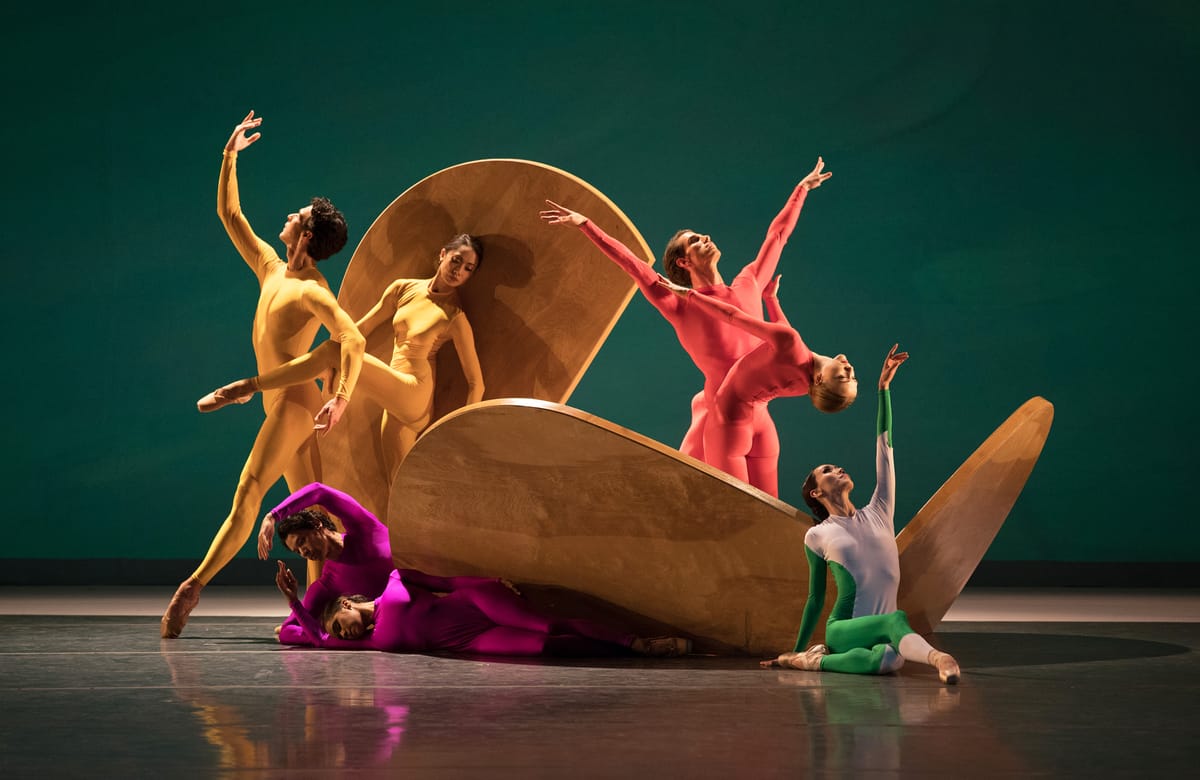
“Garden Blue” features three couples (Misty Copeland and Herman Cornejo, Katherine Williams and James Whiteside, Stella Abrera and Thomas Forster), and a soloist (Hee Seo). It is set to the first three sections of Dvořák’s “Dumky” Piano Trio No. 4 in E Minor. The music, which includes numerous references to Ukrainian folk songs, seems an odd choice for a dance that makes no references to any kind of folk material. Rather “Garden Blue” is an abstract ballet that suggests, in its set and costumes by Sarah Crowner, a theme of nature, indeed a garden. Crowner has provided a backdrop of infinite blue space, along with three large sculptural forms that resemble butterflies. One is hung above the stage, the other two are positioned on the stage. Throughout the ballet, the dancers move and manipulate the two stage sculptures in various ways. Crowner’s costumes are in brilliant hues of yellow, fuchsia and red for the couples, and green and white for the soloist, which suggest blossoms and reinforce thoughts of nature.
The choreography consists primarily of duets for each of the couples interspersed with dancing for the soloist. Lang seems to have been inspired primarily by the sculptures and how the dancers might interact with them. Sometimes we see the performers lying beneath these structures, rolling over them, posed against them, or moving them from place to place. The sculptures themselves are not stationary, but have rounded contours that allow them to rock independently, which provides another source of movement.
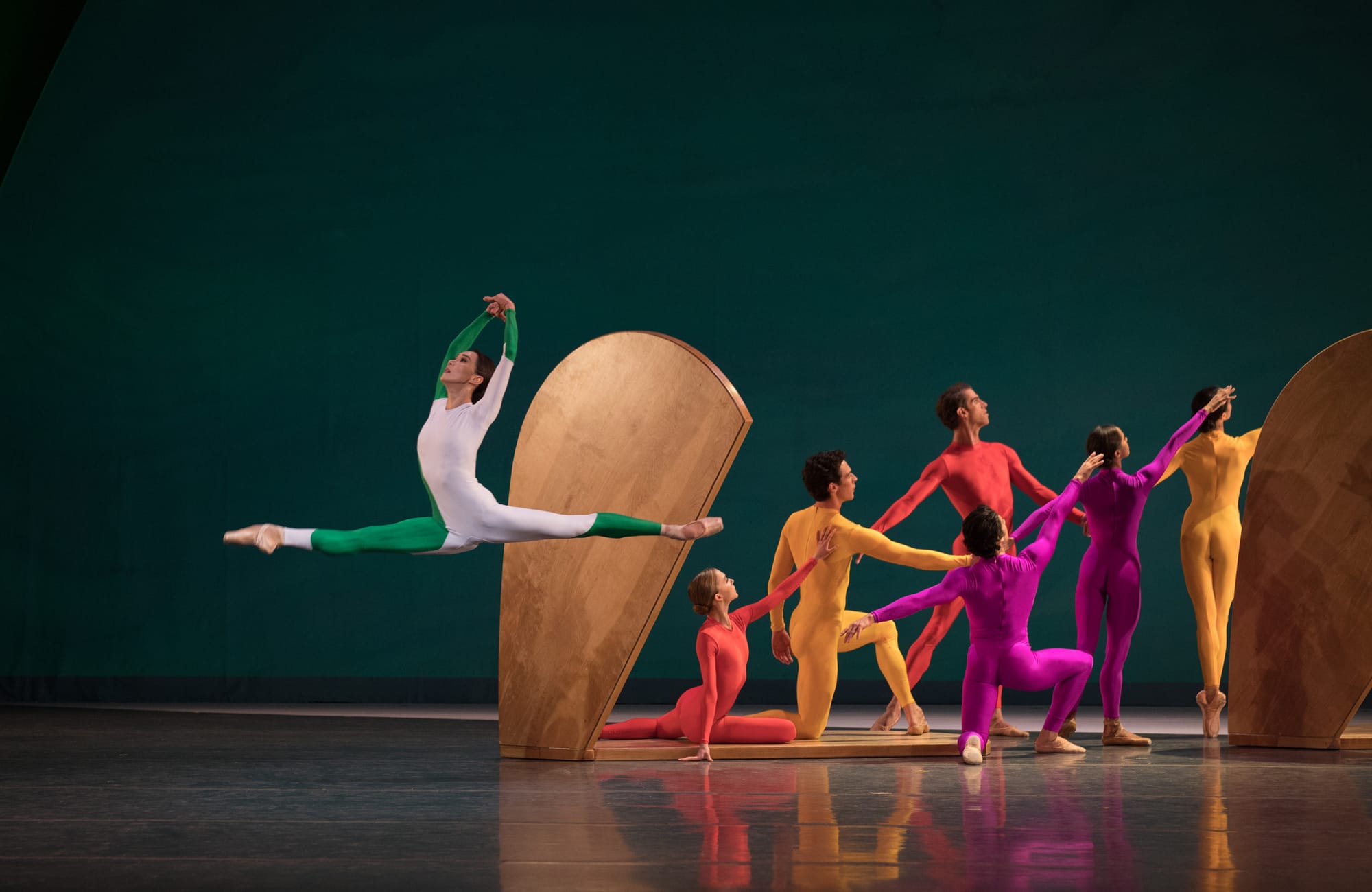
The problem with the ballet, it seems to me, is that it looks as if it had been created as a series of static images that were then animated, rather than as an arc of movement. The dancers are moved about like the objects they interact with. At times the movement becomes stilted, and in the duets there are a number of acrobatic poses that are awkward for the dancers to get out of. It is also difficult to understand how the performers relate to each other and to the soloist. Most of the time Seo wafts through the scene apparently unnoticed, until near the end of the ballet when she clings to one of the couples. Even here, though, they don’t react to her. One wonders who the people are that we are watching and what they have to do with their partners and with one another.
The one male choreographer on the program was Alexei Ratmansky, represented by his “Songs of Bukovina,” which ABT premiered last year. Its music, excerpted from 24 Preludes for Piano, is by Leonid Desyatnikov, with whom Ratmansky often collaborates. Like the Dvořák trio, this score also draws on Ukrainian sources, but unlike Lang, Ratmansky acknowledges these sources throughout the work. The ballet is set for a central couple, on Friday Christine Shevchenko and Calvin Royal III, and four supporting ones. The ballet is full of Ratmansky’s always interesting idiosyncratic movement. He invents steps that are unique to himself, infusing the classical vocabulary with choreographic ideas that expand it and keep it fresh to the eye.
As the ballet opens, the supporting couples enter and dance busily. Here and throughout, there are numerous references to Eastern European folk dance— flat and flexed feet, shaking heads, even in one moment a dreamy hand cupping the face, reminiscent of a pose the peasant women take in Nijinska’s “Les Noces.”
The opening dance is followed by a duet in a quieter, more meditative mood for the central pair, backed by the other couples. This mood doesn’t last, though. When Royal embarks on a solo, it quickly grows dark. He crouches with his hands gripping his head as if in anguish, and at the end he runs from the scene. The central couple’s next dance includes furtive glances and crouching positions, as if they are trying to escape an unnamed peril. It is only at the end of the ballet that some semblance of peace is recovered.
The agitated elements of “Songs of Bukovina” recall moments in Ratmansky’s “Shostakovich Trilogy” that also suggest human fear and a sense of oppression, something Shostakovich experienced in Stalinist Russia. Although we don’t tend to think of Ratmansky as a choreographer particularly concerned with current events, both he and Desyatnikov are from the Ukraine, which, since the invasion of Crimea, has continued to experience troubled times.
Tharp made “In the Upper Room” for her own group in the 1980s. It came to ABT when Baryshnikov led the company, so it has been in the repertory for thirty years. The dramatic smoke is still there, the dancers appearing out of it in Norma Kamali’s wonderful red, black and white costumes. But otherwise Friday’s performance was a faded sketch of what used to be. The work, driven by the Philip Glass score to ever greater intensity, demands energy and commitment. The minute detail of each movement, which is a large part of any Tharp work, is now gone. The dancers don’t have a firm grasp of her style, which can look loose and casual but which demands tiny differences of inflection — a bob of the head, a turn at the waist — to give the movement its full force. The joy is also gone. I remember Gillian Murphy as one of the first two girls (called Stompers) attacking the movement with glee. You felt she was reveling in its challenges. These dancers, which included some of ABT’s best, looked as if they had learned the ballet from watching a video. The life had gone out of it, which is a shame. When done right, “In the Upper Room” can be hugely exhilarating. It was a disappointing end to an evening where, ironically, it was the male choreographer who came out looking the strongest.
copyright © 2018 by Gay Morris