Friday Night Lights
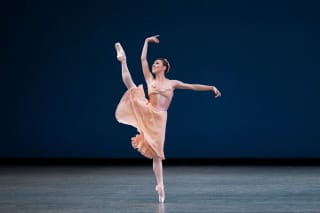
“Concerto Barocco,” “Tschaikovsky Pas de Deux,” “Stravinsky Violin Concerto,” “Symphony in C”
New York City Ballet
David H. Koch Theater
New York, New York
September 21, 2018
The first Friday night of the Fall season at New York City Ballet felt like a breath of fresh air. Not that everything was perfect – far from it, the principal dancing in particular alternated tours de force in some ballets with slack efforts or curious interpretations in others. But taken as a whole and particularly at the level of the soloists and corps de ballet, the company danced its core Balanchine repertory with a verve and attack that haven’t been consistently seen here in years.
“Tschaikovsky Pas de Deux” (just before the first intermission) and “Symphony in C” (closing the evening) provided the most thoroughly satisfying performances.
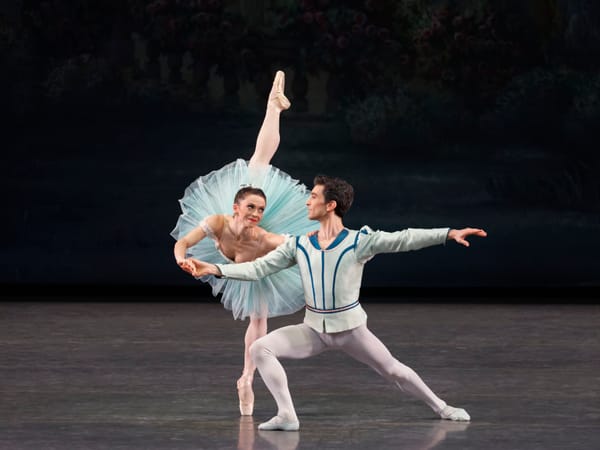
If Joaquin de Luz and Tiler Peck treated the first of these as a gala showpiece, punching out the material in a way you’d more expect to see at American Ballet Theatre than NYCB, the brief duet to music from “Swan Lake” well bore the emphasis. Closely examined, the score here is built around a series of highly dramatic climaxes as diagonals of grand jetés exiting the stage for the male principal culminate in a series of fish dives where he catches his partner repeatedly to circus-like crescendos. Emphasizing these elements, the Spanish born and trained De Luz - who is retiring at the end of the season – displayed his formidable elevation and Peck her equally well-developed instincts for the stage. The audience responded in kind in what was for many there a fitting farewell to de Luz in a role that won’t be in his retirement program on October 14th. Originally one of the smallest women in the company (before a growth spurt left her a middle sized dancer), Peck has danced with the shorter de Luz a good deal in her career. He has always forced her to dance on a smaller scale to match his height. But they’ve learned to compensate in their long experience together.
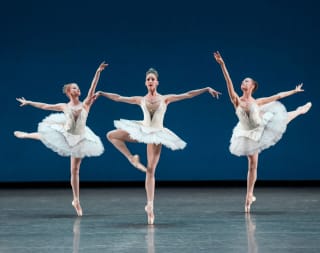
Ashley Bouder – another stagey dancer – led the crucial first movement of “Symphony in C” partnered by the young and attractive Joseph Gordon in his New York debut in the role. Originally titled by Balanchine “Le Palais de Cristal” (the “Crystal Palace”) when he first made the ballet for the Paris Opera in 1947, it indeed possesses an architecture such that the allegro first movement must be danced with a bright command for the entire work to succeed. So here once again – as with de Luz and Peck’s approach to “Tschai Pas” earlier – Bouder’s innate sense of the stage and habit of dancing towards the audience more than towards her fellow performers worked towards the ballet’s success.
Gordon, on the surface a dancer of more modest comportment, also possesses the strongest audience appeal. Of middle height, his boyish and self-effacing manner are coupled with an effortlessly fluid technique and elevation. On the stage there’s also something open about him the audience loves and here, from his first entrance, every solo passage summoned spontaneous bursts of applause. While he’s still inexperienced as a partner, this role doesn’t call for much tandem work.
Two other young dancers, Indiana Woodward and Sebastian Villarini-Velez, delivered equally, if not even more compelling performances, in the third movement. Woodward, now a soloist, has lengthened herself both physically and in the scope of her movements to the point where she’s poised to become the next full bore female star on the ballet stage in New York City, if not in America as a whole. All she lacks is the casting (and artistic direction has been curiously withholding of her this season) as she’s sure fire in anything right now, the kind of dancer you buy tickets to see no matter in what. She’s that good and that memorable. Villarini-Velez is less known but showed wonderful ballon alongside her here plus a lovely sense of musical flow in the chassées en tournant that form the backbone of the killer third movement. This was as good as you’ll ever see this danced.
Maria Kowroski had the elegant support of Tyler Angle in the ballet’s second movement. Erica Pereira gave a beautifully upbeat reading of the fourth movement, where she was particularly well partnered by Troy Schumacher in what was also a New York debut. With the ranks of the men at NYCB recently depleted by an unusual amount of attrition (some due to a recent and well-publicized scandal involving men texting inappropriate photos of women, some due to retirements and injuries), Schumacher should play an increasingly important role.
In comparison with these two ballets, the principal dancing in both “Concerto Barocco” and “Stravinsky Violin Concerto” was less artistically effective.
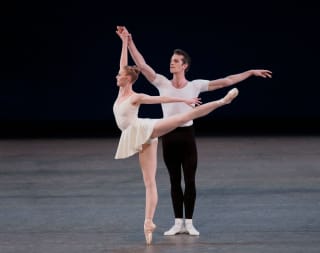
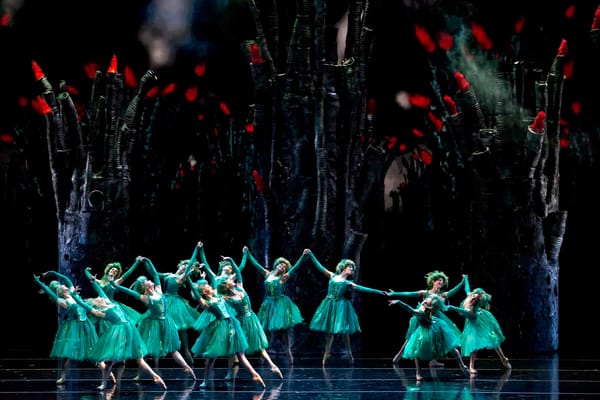
Teresa Reichlen led “Barocco” (partnered by Russell Janzen and with Abi Stafford in the second ballerina role) with her accustomed authority, flowing through the numerous promenades in both directions with musicality and using her tall physique to put across the ballerina’s memorable poses. Still her reading was somewhat soft and lacking in focus when compared with the stellar technique and rhythmic attack of the women’s corps de ballet and the superb violin playing of Kurt Nikkanen and Arturo Delmoni, under the baton of conductor Clotilde Otranto.
Laine Habony, Claire Kretzschmar, Meagan Mann, Miriam Miller, Mary Elizabeth Sell, Mimi Staker, Sarah Villwock and Lydia Wellington cannot be praised enough for the quality of their dancing in the corps here. On stage the entire time and on pointe for much of it, they were a consistent delight. The greatest riches at NYCB right now may well lie in the extraordinary depth of talent below the masthead in the ranks. All of them promise to get more opportunities to dance in the current atmosphere of change in artistic direction. But no one knows what will happen when the company finally appoints a new director and things quite naturally hit reset.
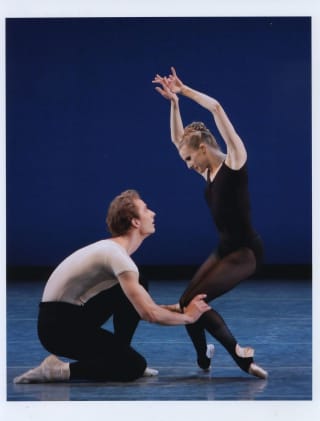
A number of the same women, along with principal dancers Sterling Hyltin and Ask LaCour also sustained a fine musical performance of “Stravinsky Violin Concerto,” in spite of a very strange reading of the first aria by Sara Mearns and Taylor Stanley. Where Hyltin and La Cour danced their second aria with a strong sense that their couple was carrying on an intimate dialogue, Mearns and Stanley were dissociated from each other on stage in Aria I.
Mearns gave her character an Amazon’s persona, like a warrior princess from Torquato Tasso. Meanwhile, Stanley, a terrific dancer, gave his an ambivalent gender, twisting and gyrating beside her in another world. It was as if, not only were they dancing a different ballet from the other couple, but were dancing different ballets from each other. This was unlike any previous interpretation I have seen of this couple. But as with “Barocco,” the company’s attack as a whole remained superb, spontaneous, and alive in this ballet. They pulled it off. As they did all night long, the company danced this ballet like it mattered and to us in the audience it therefore mattered supremely.
copyright © 2018 by Michael Popkin