For the Dancers
"The Dream", "The Seasons"
American Ballet Theatre
David H. Koch Theater
Lincoln Center
New York, New York
October 26, 2022
Frederick Ashton choreographed his version of "A Midsummer Night's Dream" as part of the 400th anniversary celebration of Shakespeare's birth. The ballet also celebrated the birth on one of the twentieth century's most noted partnerships, as it gave Antoinette Sibley and Anthony Dowell the starring roles and Ashton's Titania and Oberon are saturated with those dancers' qualities. Alexei Ratmansky's "The Seasons", set to Alexander Glazunov's luscious one-act ballet score, premiered in 2019 and celebrated Ratmansky's tenth year as ABT's Artist in Residence, and its cornucopia of dances, to quote the choreographer, "is a celebration of American Ballet Theatre and its dancers". But ballet dancers don't last forever and new dancers take over roles; fortunately both of these works can bloom with different casts.
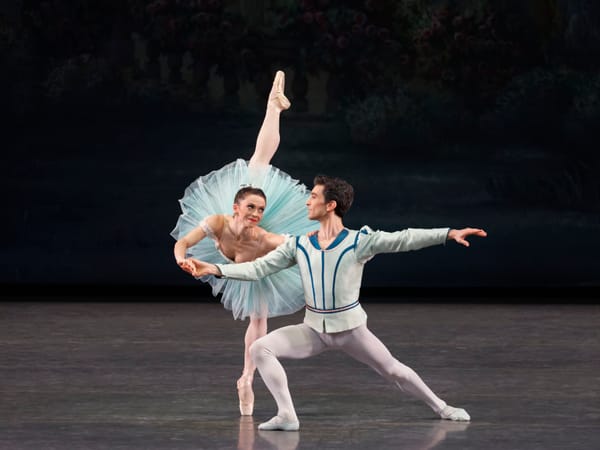
Gillian Murphy's Titania was originally scheduled with Cory Stearns, but his injury meant that Daniel Camargo, who joined ABT as a principal in September of this year, got an early debut; he had been scheduled to debut a few days later with another dancer. Despite the last minute substitution, the tricky partnering of the final pas de deux, while careful, went smoothly. (Unfortunately, the horn player wasn't as lucky, and there were some awkward sounds.)
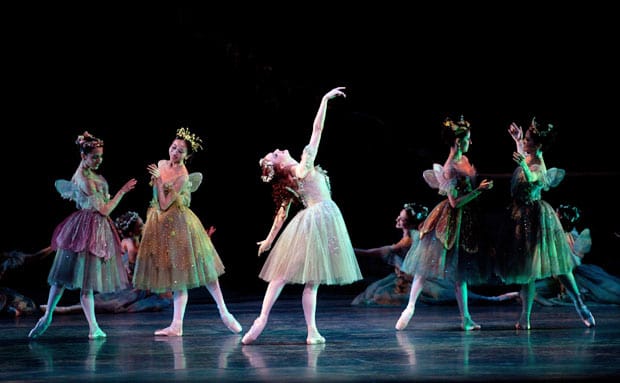
Murphy was an imperious Titania, proud and domineering; she wasn't as unpredictably wild as Sibley but had the same combination of pristine classical dancing combined with a dangerous edge--she was not a person to be crossed. The pas de deux with Bottom is one of Ashton's most ingenious. He used the sublime, shimmering Mendelssohn music to show the awe and magic of love, as well as its irrational blindness, combining a wry profundity with gentle humor. Murphy glowed with a rapturous joy, and the audience held its breath, remembering, perhaps, the donkeys in their lives.
Camargo lacked some of Dowell's lush line and effortless purity which gave Dowell's dancing its unearthly beauty, but Camargo was able to put his own stamp on the role. He used his powerful upper body so expressively as he summoned the magical fog to manipulate those foolish mortals (though the stage machinery did make some unmagical noises). He used his hands so clearly, making witty little asides--"No, of course I have no idea who this Bottom is, you must surely be mistaken" was clear from the rippling of his fingers. It was a very promising debut.
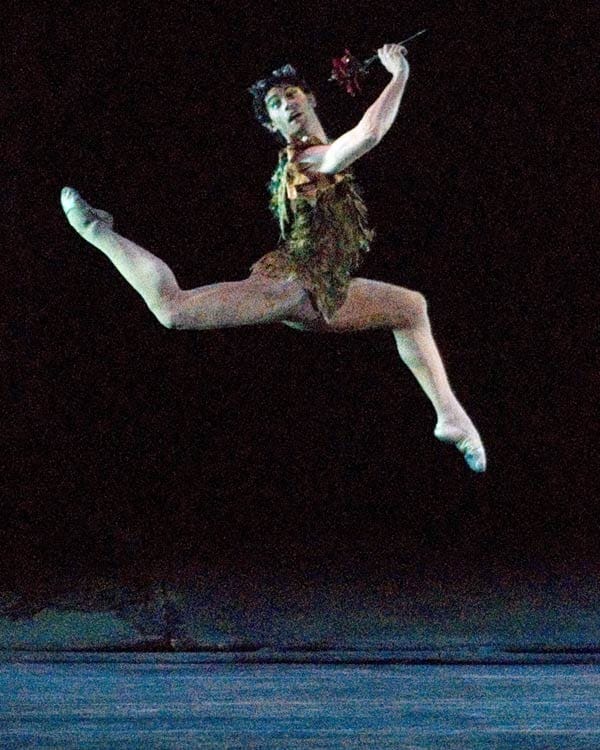
Herman Cornejo has been dancing Puck for twenty years and this may be his final fling, though with his airy jumps, wicked glee, and elegant turns he seemed indestructible. I did miss his final "twas nothing" little shrug at the end; instead he lifted his arms in a triumphant "V". His triumph was certainly well deserved, and he is a Puck for the ages.
Tyler Maloney's Bottom had no trouble with the point work Ashton used for the donkey's hooves and he sailed through the dancing with an endearing musical swagger. His mime scene, when Puck returned him to human form, was wonderfully clear and he gave it enough time to register. I did miss some of the awkward, embarrassed awe as he remembered the beautiful lady who loved him, but his little shiver of fear in his last look around that mysterious, haunted forest was heartfelt. How Ashton sympathized with rejected souls.
His comrades, (Jacob Clerico, Luigi Crispino, Cy Doherty, and Melvin Lawovi), all had distinctive characteristics, and were not the gormless collection of yokels that can pass as comedy. On the other hand, the four duped lovers in ABT's current production all wear shades of burnt orange, which makes it a bit hard to differentiate between them. Helena (Courtney Shealy) and Hermia (Claire Davison) wore "I'm a silly little ditz" wigs and they and their lovers (Duncan Lyle as Demetrius and Roman Zhurbin as Lysander) fussed and stomped, overacting a bit, so that the quarrel seemed to be a missing episode of "I Love Lucy". The audience, though, greatly enjoyed their, and Ashton's, impeccable musical timing.
"The Seasons" was originally choreographed by Petipa in 1900. None of the Petipa choreography has survived, and though Ratmansky based his ballet on the original scenario (including the star-lit ending) and though there are references to other Petipa works, this is not pastiche Petipa; the choreography is robustly Ratmansky. It is non-stop movement, with many different and challenging roles; at times it seems there are almost too many, as the constant flow of bravura dancing and shifting shapes makes it hard to focus. So many ideas and so much action, but they are wonderful ideas and the action is thrilling.
It is set against a plain backdrop with different colors for each season; the lighting, though, is a bit dreary and the many elegant corps formations would, I expect, look even more impressive with some scenery to set them off. The costumes, by Robert Perdziola, with the exception of the radiant white Winter outfits, seems mismatched and unflattering. The men, in Cubist chic unitards, are especially badly served.
Despite these reservations, the dancers looked electrified, bursting with energy. The seasons, starting with Winter, get their own sections, though Ratmansky, following the original plan, has them overlap and intermingle, until they all merge in the finale. The main couple, Summer's Spirit of the Corn ("corn" for Americans translates as "wheat"), danced with a bountiful generosity by Isabella Boylston, and the Zephyr, from Spring (Thomas Forster) danced a long, luxurious pas de deux. Discussing all of the highlights would basically be a cast list, but Joo Wan Ahn's fierce and powerful Winter, Chloe Misseldine's leggy, graceful Ice, the thrilling bravura of Carlos Gonzales' Faun, and Zimmi Corker's serene homage to the Rose Adagio were especially memorable.
The dancers' magnificent response to Ratmansky's challenges made it clear that he has been the best gift to ABT in recent years, and the opportunity to dance in works like "The Dream" certainly comes in second.
© 2022 Mary Cargill