Fall For Dance 4
“Rhapsody” (excerpts), “Canto Ostinato,” Petrushka,” “Rennie Harris Funkedified’ (excerpt)
Fall for Dance, Program 4
New York City Center
New York, New York
October 11, 2018
Fall for Dance is known for the variety of its programs, but Number Four, seen on Thursday, felt like whiplash as it changed from one offering to the next. Yet when all was said and done, there were relationships to be found among the works, which started with classical ballet and ended with hip hop.
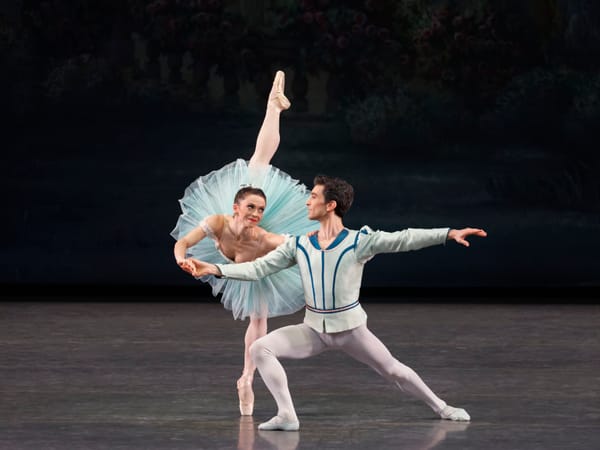
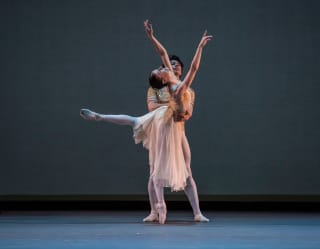
Frederick Ashton created “Rhapsody” in 1980 for Mikhail Baryshnikov. Excerpts from the ballet were danced by Herman Cornejo of American Ballet Theater and Alina Cojocaru of the English National Ballet. The work is set to Rachmaninoff’s “Rhapsody on a Theme of Paganini,” arranged by Kurt Crowley. Crowley was at the piano for the live music, accompanied by the Attacca String Quartet.
What we saw were male and female solos and an extended duet. It is difficult to know where these dances fit in the ballet as a whole, but they were presented here as something approaching a classical pas de deux. Although plotless, the male dancer, on several occasions, mimes playing a violin, which suggests a theme of artist and muse. Paganini was, of course, a virtuoso, and Ashton gave Baryshnikov a ballet equivalent of musical fireworks in steps of technical brilliance. Cornejo was equal to every demand, which included many fast changes of direction, and pirouettes and tours en l’aire to the right and left. Cojocaru’s dances stressed liquid port de bras, subtle épaulement, and fleet footwork.
I wish we saw Cornejo and Cojocaru together more often. They could be one of the great ballet partnerships, since they are so perfectly matched physically and artistically. She is long legged, delicate and small, which complements his elegant but somewhat short stature. The duet is typical of Ashton in its intimacy and flowing movement, and the dancers were superb interpreters of his choreography, brilliant but at the same time modest. Anyone familiar with the Rachmaninoff score knows that after a whirlwind of sound it ends quietly with five notes. Ashton had the dancers take a fourth position with one foot forward, then the other, then end simply standing and holding hands. It is a superb moment that encapsulates the atmosphere of the whole dance.
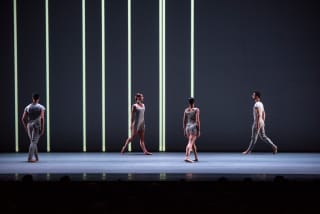
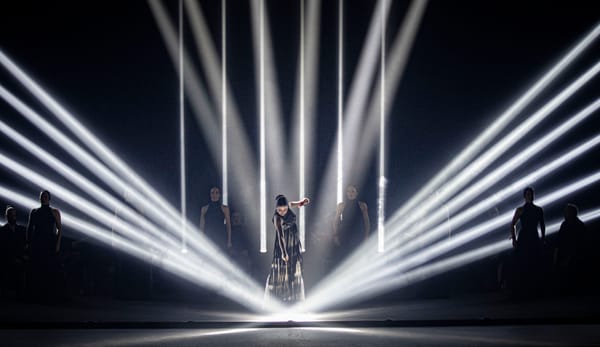
From the world of classical ballet and technical fireworks, we suddenly moved to cool postmod- ernism in Lucinda Childs’ “Canto Ostinato,” danced by Introdans of the Netherlands. The work is set to Simeon Ten Holt’s hypnotic minimalist score of subtly changing rhythms. Sets, lighting and costumes by Dominique Drillot, included a video backdrop of shifting vertical lines. Drillot’s lighting and silver-gray costumes gave the stage a celestial feel that mirrored Childs’ choreography. The dance is calm, the bodies held upright, the steps balletic while eliminating any trace of flamboyance. The dancers appeared like celestial beings, or like planets slowly revolving in outer space. The four artists, Vérine Bouwman, Salvatore Castelli, Kim Van Der Put and Pascal Schut were exactly right, precise but not tense, calm but not cold. “Canto Ostinato” is an exquisite work in which all the element — music, lighting, sets and dance — merge in quiet harmony.
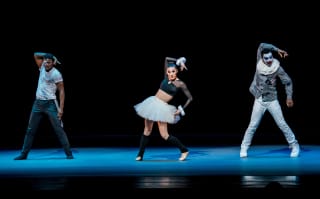
What a shock, then, to go from this dance to the grand guignol of Jennifer Weber’s “Petrushka.” For the piece, Weber, who is a hip-hop specialist, brought together ballet dancers Tiler Peck of New York City Ballet and Brooklyn Mack of the Washington Ballet, with jookin virtuoso, Lil Buck. She drew on Stravinsky’s score for Mikhail Fokine’s “Petrushka,” which he choreographed for the Ballets Russes in 1911. Here we see just the three main puppet characters: Petrushka (Buck), the Moor (Mack) and the Ballerina (Peck). Their interaction is violent as Petrushka, in love with the Ballerina, attempts to intercede in the Moor and Ballerina’s duet, only to be beaten and broken.
Weber’s choreography is an interesting mix of hip hop and ballet that sometimes looks like neither, but rather emerges as something altogether original. She controlled Lil Buck’s sometimes over-the-top performance style, while occasionally allowing him to indulge in his signature toe dancing in sneakers. Mack was a solid presence, while Peck, who seems to be up for anything new, committed herself completely to the unfamiliar movement vocabulary and pretty much conquered it. Weber’s choice of subject matter seems strange at first, but when you consider how often “The Rite of Spring” is reimagined, such a rethinking of “Petrushka” is not so strange after all. And Weber made it work, expanding the horizons of hip hop while demonstrating its relationship to a more traditional form of western dance.
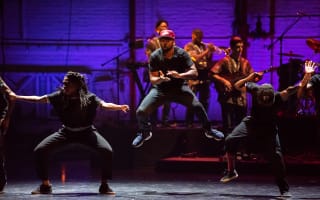
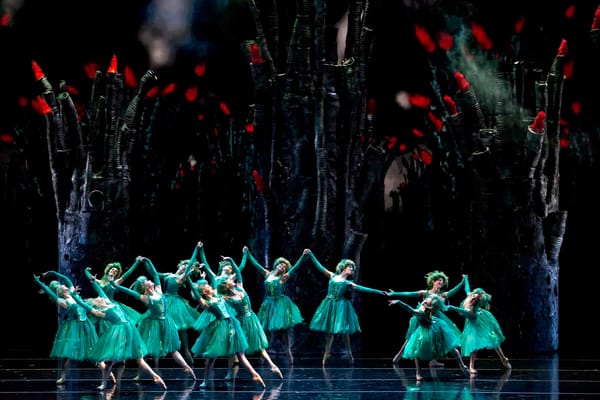
It shouldn’t have been too great a leap from Weber to another hip hop choreo- grapher, in this case Rennie Harris and his company Pure- movement, but it was. Harris, who is based in Philadelphia and has been a fixture on the dance scene since the early 1990s, offered excerpts from “Rennie Harris Funkedified.” It included occasional voice over, presumably by Harris, recounting how he got into dancing. But mainly it was a wild ride with twelve bravura dancers and a live band led by Mathew Dickey. The dancers performed in synchronized groups and in solos that showed the body can be formed and twisted in ways hardly imaginable. The knees especially came into play, sometimes with a force that looked damaging, as the dancers threw themselves to the stage. I was thinking about a whole company of knee replacements. In all, though, the Harris piece looked conservative compared to Weber’s. She was taking hip hop to new places while Harris remains in a more established groove, both in terms of vocabulary and dance structure.
Fall for Dance is over for this year, but 2019 will undoubtedly bring more intriguing mixes of dance that aren’t normally seen together, and that will give audiences new experiences, as well as food for thought.
copyright © 2018 by Gay Morris