Do You See?
“Ebony Magazine: to a Village,” “Clear As Tear Water,” “Gatekeepers,” “Upside Down”
Ronald K. Brown/EVIDENCE
The Joyce Theater
New York, NY
February 25, 2026
Program A of Ronald K. Brown/EVIDENCE's weeklong run at The Joyce Theater was, at its heart, a celebration – of collaboration, of community, and of Wunmi Olaiya (who goes by Wunmi), the London-born, Lagos-raised musician and designer whose music, costumes, and creative vision have been woven into the EVIDENCE aesthetic for decades. The evening honored women broadly, and the synergy and friendship between Wunmi and Brown was everywhere evident in the work.
Brown founded EVIDENCE in Brooklyn in 1985, driven by a desire to tell stories about people -- stories rooted in faith, community, and the African American experience. Over forty years he has built a choreographic language that draws primarily from West African movement traditions, principally those of Senegal, Guinea, and Côte d'Ivoire, with Caribbean forms — Haitian and Cuban — as secondary, more distant influences. It is not a fusion so much as a conversation: traditions in dialogue with present-day expression, never collapsing into one another.
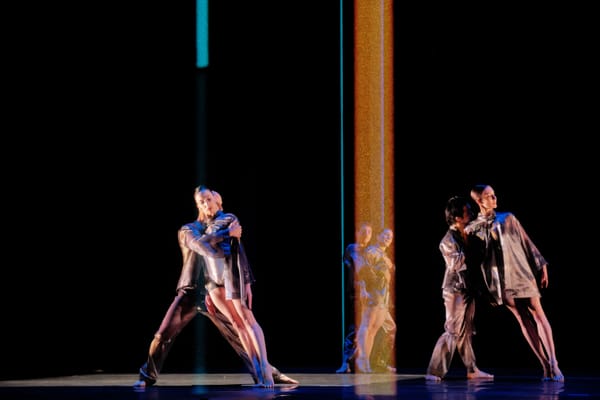
"Ebony Magazine: To a Village," set to Wunmi's music, began the night as deceptively formal: two men in suits lying on the ground as proper-looking men and women in black evening dress walked on and off. But even within that studied propriety, Brown was already asking something. Women commanded the stage – every drop of the hip deliberate, every wrist flick a question. The often repeated "Do you see?" of Wunmi’s song was everywhere: one woman seemed to ask it as she wrapped her hands around her own body, another’s gestures translated the phrase as a call to look deeper at the dance. The work was structured, even restrained, but never cold. Heavy beats drew lunges that resonated up through the shoulders of the women; the men found an easy, rolling rhythm with each other – same-sex partnership presented matter-of-factly, warmly. As the evening gowns gave way to more colorful dress, the formality peeled back and what was revealed was community, ceremony, and finally – as there seems to be in many Brown works – death.
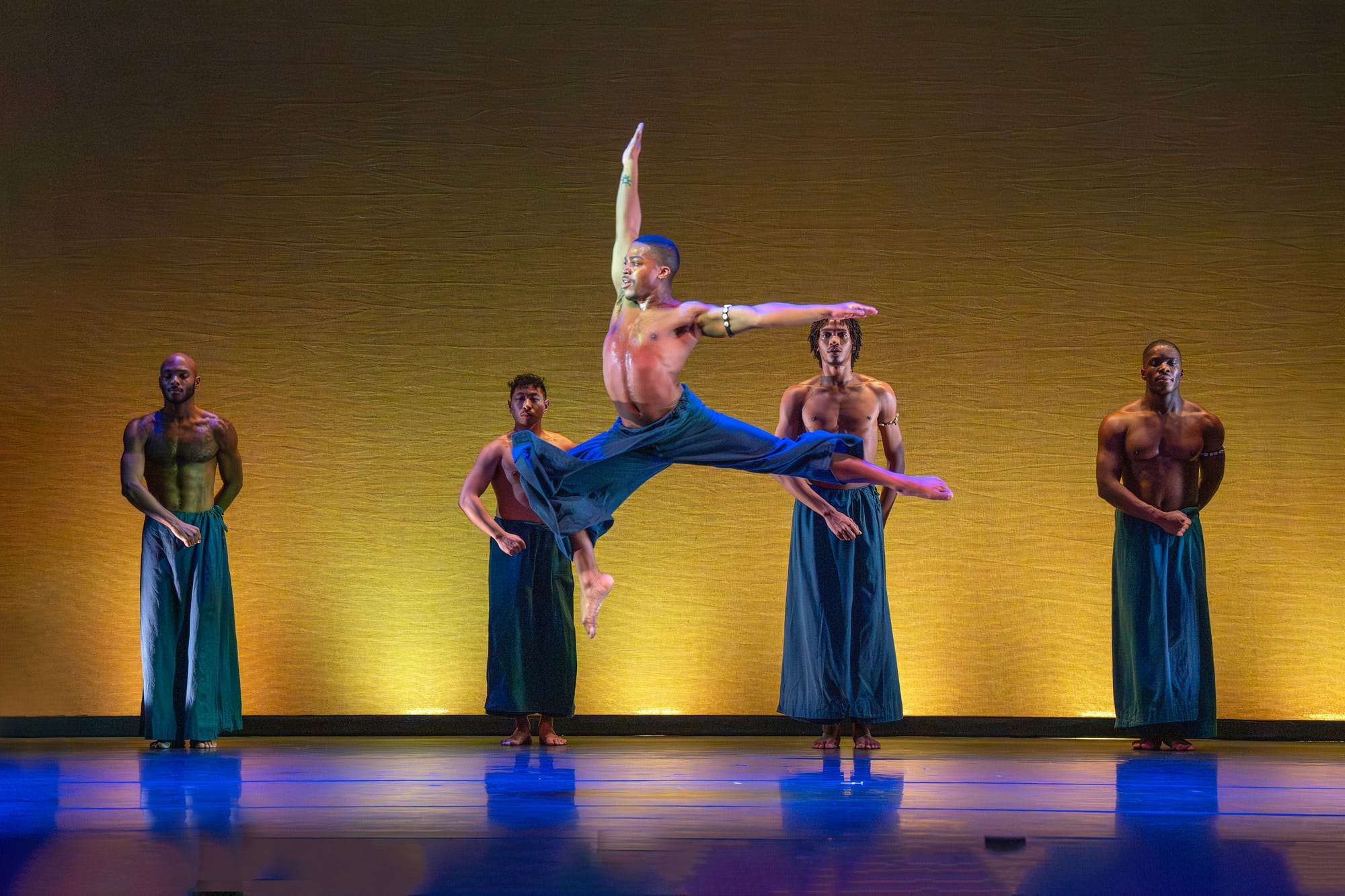
"Clear As Tear Water" came next. Created in 2005, on this night it was danced by Khalia Campbell, a Bronx-born dancer with a presence that filled the stage quietly before it filled it completely. Campbell is tall and elegant, and her sharpness of turns gave way to fluid, perfectly timed stops that didn't look like stops at all – so organically placed they felt like breath rather than punctuation. Transitions from turn to accented leg kick were impeccable: arms lifting, leg rising, and then both dropping in a single phrase of movement economy.
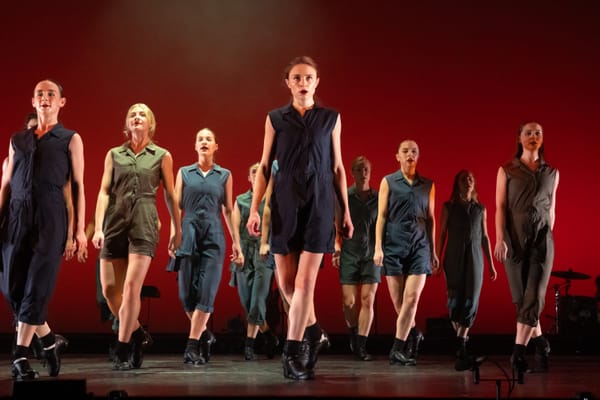
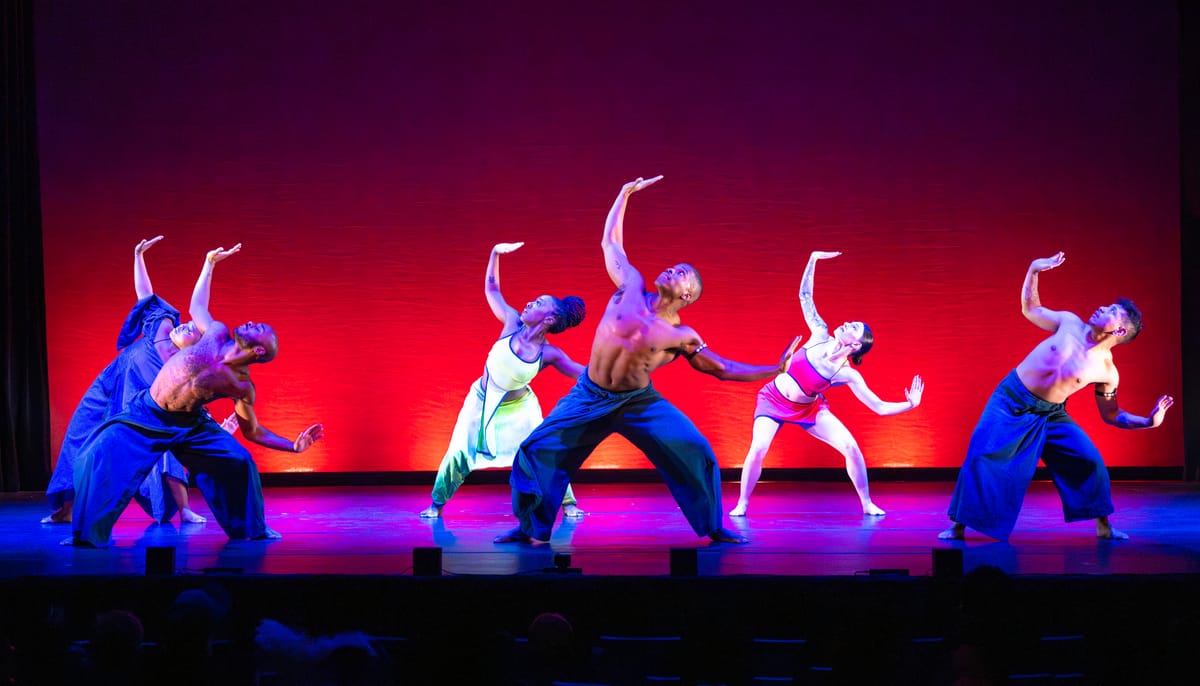
Then came the meticulously structured "Gatekeepers,” with dancers deliberately placed in patterns that occupied the stage while still letting the space between them breathe. In one section, two dancers stage right, four on stage left sloping toward the downstage corner, one before them: there was clearly a diagram somewhere, but you wouldn't have known it from watching. Much of the movement drew the eye toward the back and its red wall, as if the dancers were in conversation with something just out of reach, and there was a great deal of stillness — not emptiness, but people genuinely listening, noticing. When the drums shifted and the movement opened up into something more Afro-diasporic — step-step, look right and up to the sky, jump-jump, a turn back to check the audience — it felt like a release. And the ending: each dancer looked left, back, right, and upward as light rose slowly to illuminate their faces. It was one of the most quietly moving images of the evening.
The program concluded with "Upside Down," performed to Wunmi's music played live and featuring the singer herself — an added and welcome presence. The piece began and ended with the same image: a death, a carried body, a community bearing witness. Two groups of five worked opposite sides of the stage in a structure that mirrored and converged, punctuated by women's solos in which legs vibrated at the knee and tempo shifts caught the breath. Like everything on this program, it felt built from the same deep well of tradition and lived experience that animates all of Brown's work — an expansive, generous, deeply rooted vision of what dance can carry and what it can heal.
copyright © 2026 by Marianne Adams