Depth of Field
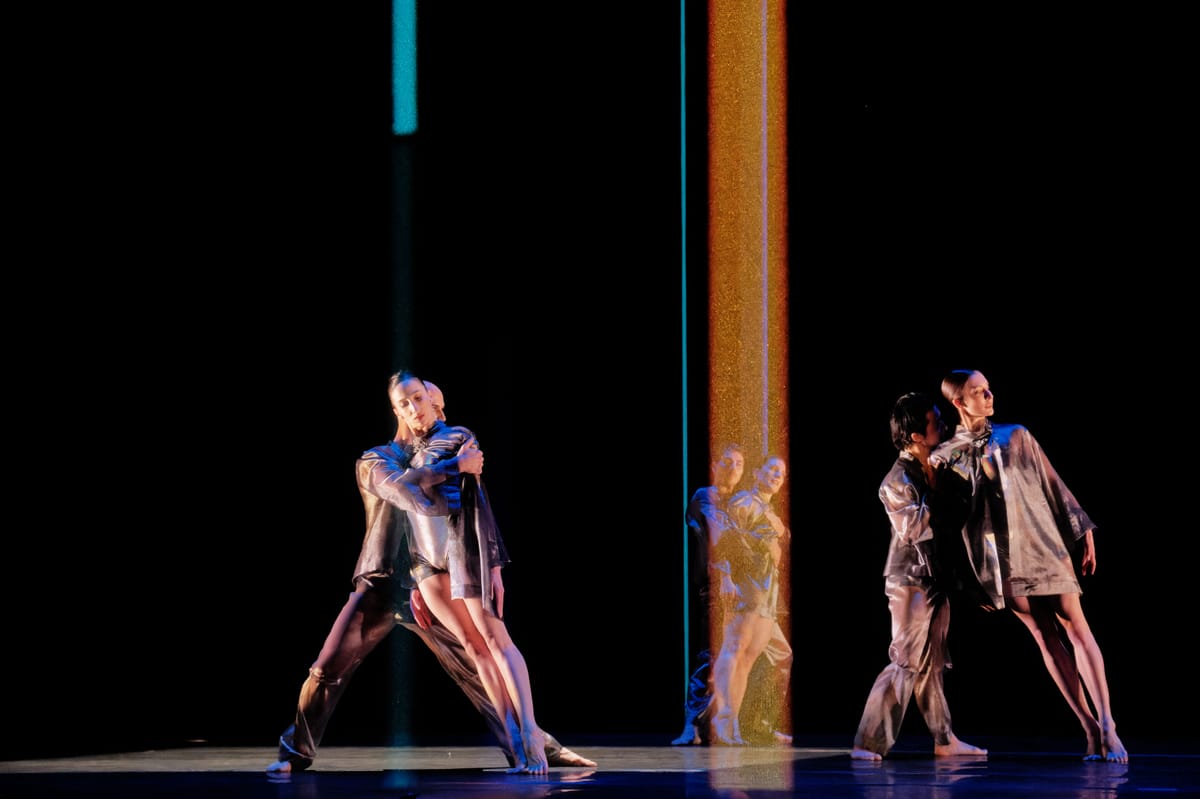
“BIPED,” “Mycelium”
Lyon Opera Ballet
Festival: Dance Reflections by Van Cleef & Arpels
New York City Center
New York, NY
February 21, 2026
In a three-night engagement at New York City Center, Lyon Opera Ballet presented two substantially contrasting works that nonetheless formed an unexpectedly coherent program: Merce Cunningham's landmark "BIPED" paired with Christos Papadopoulos's "Mycelium" – works opposite in structure, atmosphere, and era, yet united by a shared exposition of what happens to the human body when it is asked to disappear into something larger than itself. The evening was the opening offering of Dance Reflections by Van Cleef & Arpels, a sublimely rich month-long festival of modern dance.
“BIPED” was considered revolutionary at its 1999 premiere, above all for its groundbreaking use of digital projection. Cunningham choreographed the work using DanceForms software, then collaborated with digital media artists Shelley Eshkar and Paul Kaiser, who used motion capture technology to transform dancers' movements into abstracted, hand-drawn animated figures, projected onto a transparent downstage scrim. Today, some of those elements have aged: projected movement imagery and architectural lighting design are so commonplace that one occasionally longs for the austerity of a bare stage. In fact, a young patron seated near me commented that the projections were distracting from the dancing. That reaction is understandable, yet in this particular iteration, while certain aspects of the concept feel of their time, the execution still read as singular.
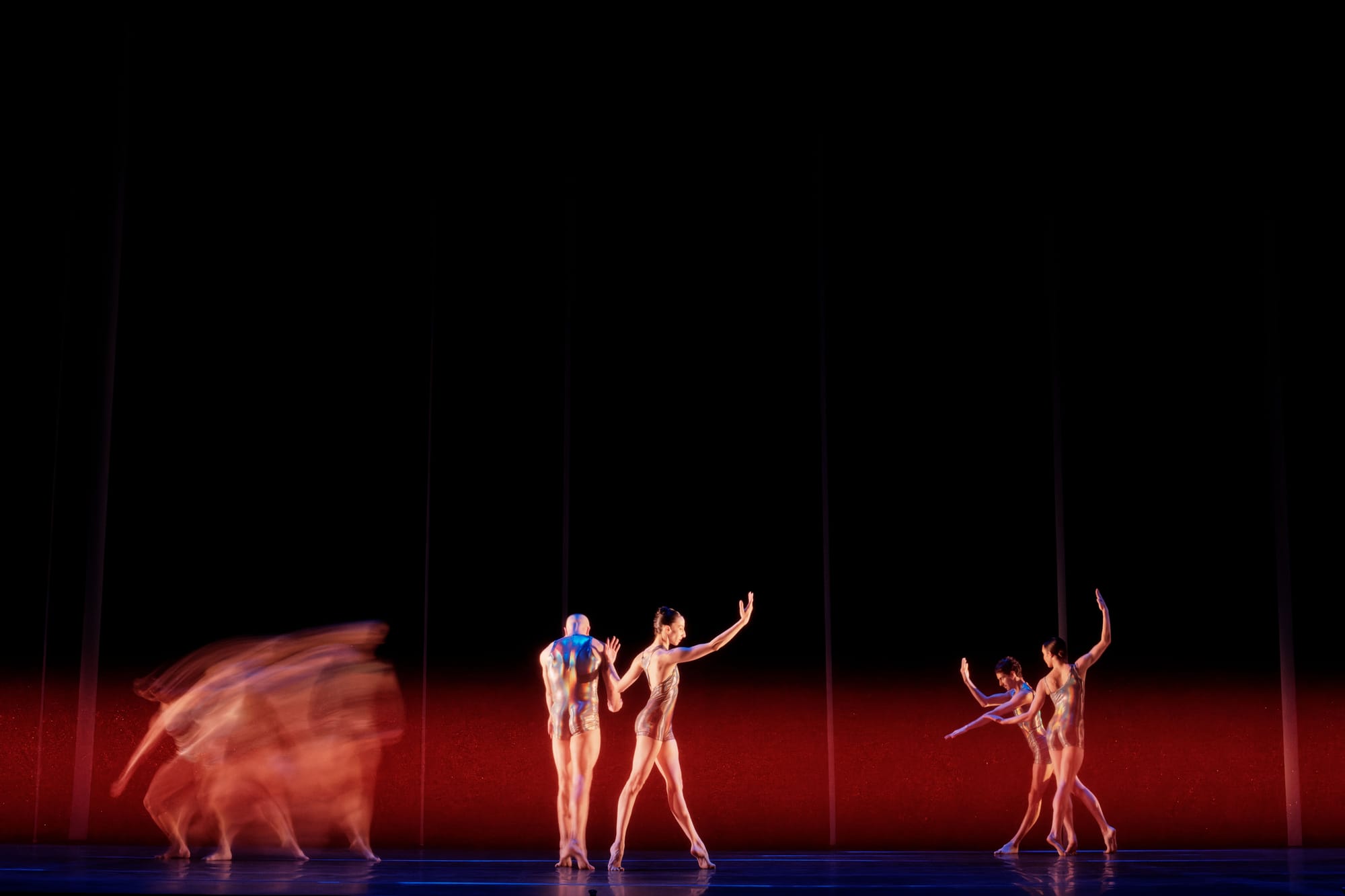
The work as presented was fundamentally a study in dimensionality: a dialogue between the three-dimensional bodies of the dancers and the two-dimensional animated figures and shapes projected on the scrim between performers and audience. Both fully exploited the space they occupied. What was projected was designed to inhabit specific areas of the screen, calibrated to enhance the total composition. The dancers, for their part, acknowledged the entire stage: movements were made not only for the house but turned toward the wings, toward upstage, repeated in different directions. At one point a dancer pivoted in place, spotting to each corner, his presence a deliberate claiming of the space. With such spatial awareness, even though the work was designed for a traditional theater, it could fare quite well even with a 360-degree audience configuration.
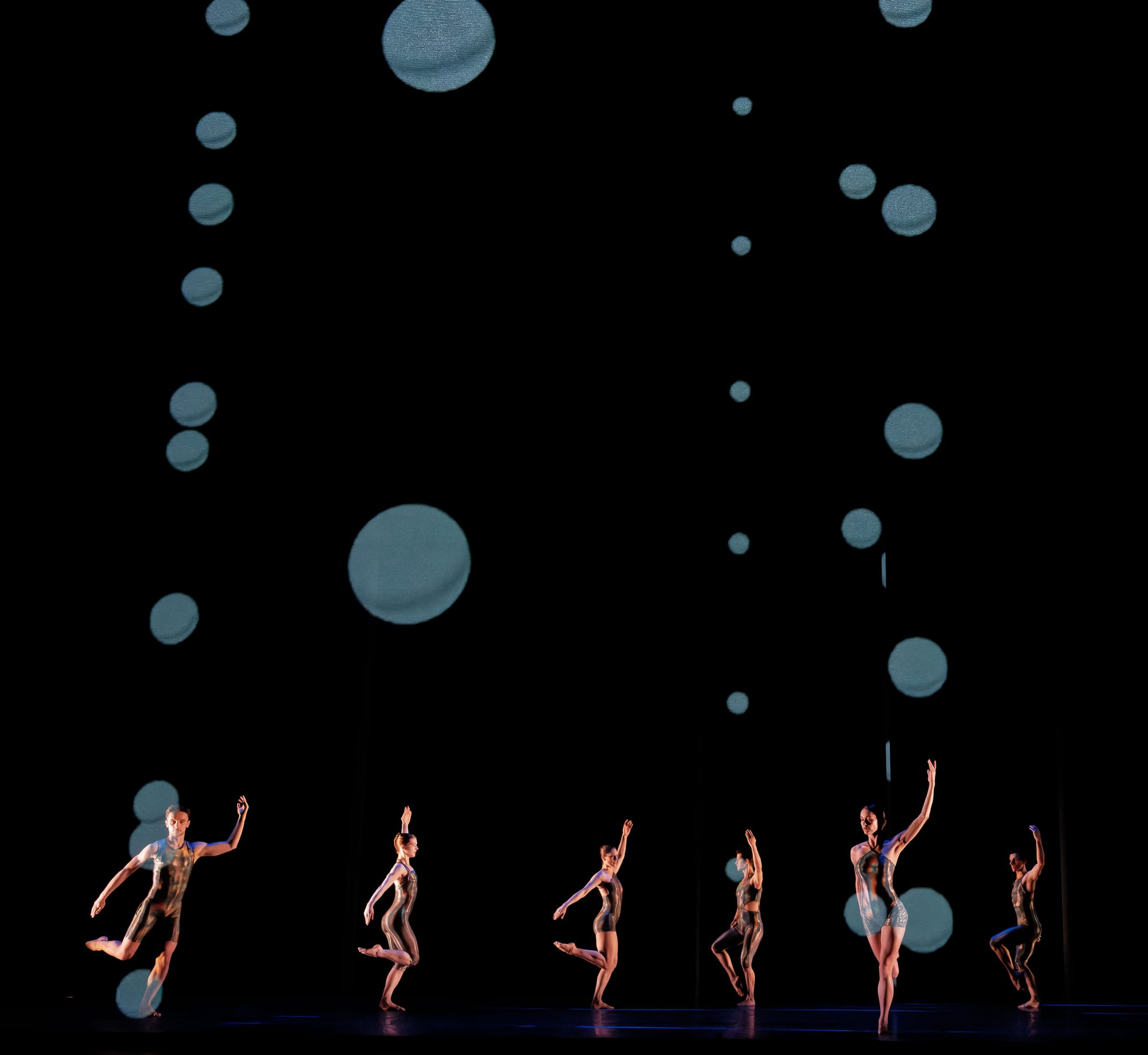
The movements themselves were focused on suspension and its interplay in space. The work opened with a lone dancer whose body tested, relinquished, and reclaimed parts of the stage as he traversed it. He soon gave way to a duet and then a fuller ensemble, the stage gradually peopled with bodies coming on and off, feeling out the space. At moments, admittedly, the hesitancy in their dancing seemed less choreographic intent than minor lapses in execution, but the work's meditative pace made the distinction largely irrelevant — to many in the audience it likely just echoed the piece's spirit. When the digital projections shifted to dots suggesting droplets, the movements grew correspondingly heavier, as if the dancers had entered a denser medium. And such textured dancing pervaded the closing scenes as well, where sleeved tops allowed the dancers to use their arms in a wing-like manner, the fabric finding its own movement and lending the closing a quiet grandeur.
It is worth noting that "BIPED" entered Lyon Opera Ballet's repertory only in 2024, and the performance occasionally showed the seams of a company still internalizing a complex inheritance. At a press event, festival curator Serge Laurent – Director of Dance and Cultural Programs at Van Cleef & Arpels – and the company's artistic director Cédric Andrieux have spoken about the importance of transmitting great works of modern dance to new generations. Lyon Opera Ballet’s commitment was evident, and the stewardship, while still maturing, was genuine.
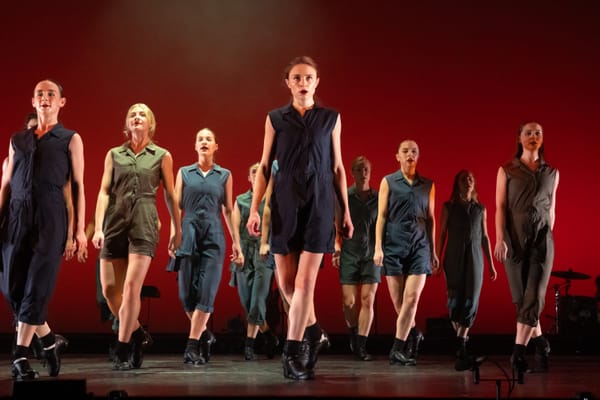
The evening's second work, Papadopoulos's 2023 "Mycelium," was a longer, more brooding piece and in many ways the polar opposite of the Cunningham. Like the first work, it began with a lone figure traversing the stage, but these movements – driven by short heel-to-toe shuffles – rendered him almost cyborgian, floating through the space while his arms swung rhythmically side to side. Soon more dancers emerged, then more, growing into a mecha-physical collective that gradually flooded the stage. One arm always lifting, they swayed side to side until they clustered and their movements synchronized into an erratic, concentrated whole. For the remainder of the work they traversed the stage as a single organism.
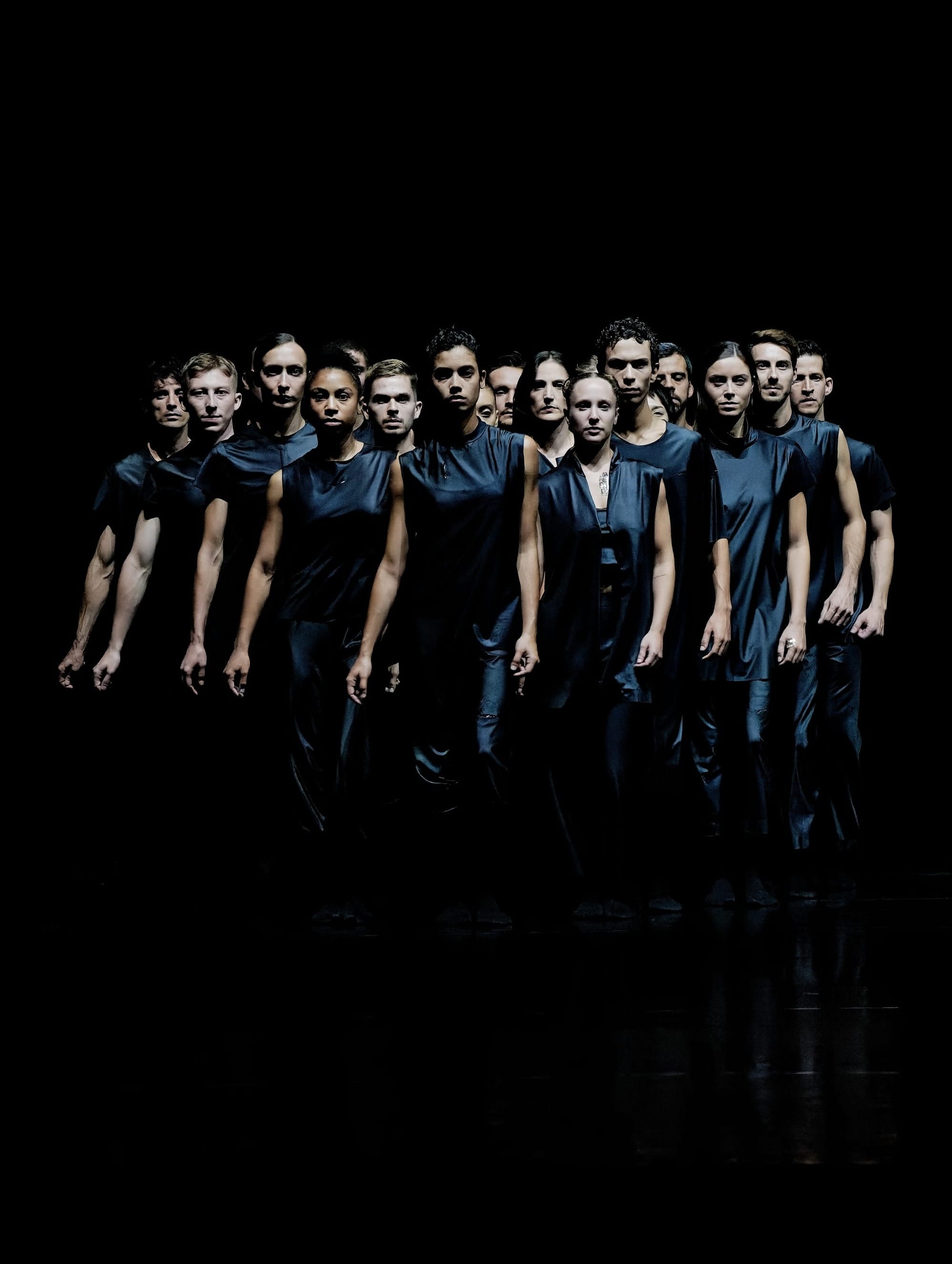
Papadopoulos drew inspiration from the electrical interconnectivity of fungi – the network of impulses and communication that runs beneath the forest floor. Yet paired with Coti K.'s insistent electronic score, the effect read less biological than technological, evoking the pulse of a server farm as much as a root system. That the work conjured both simultaneously was its own provocation, and running at sixty minutes "Mycelium" afforded plenty of time for contemplation of the embedded similarities and differences, and so much more. The longer the trance-like uniformity of movement extended, the more difficult it was not to start looking at each face, noticing each idiosyncrasy in the movements, finding the concealed sparkly pins that adorned the all-black costumes – each dancer wearing one in a slightly different place – elements large and small asserting human individuality within the collective.
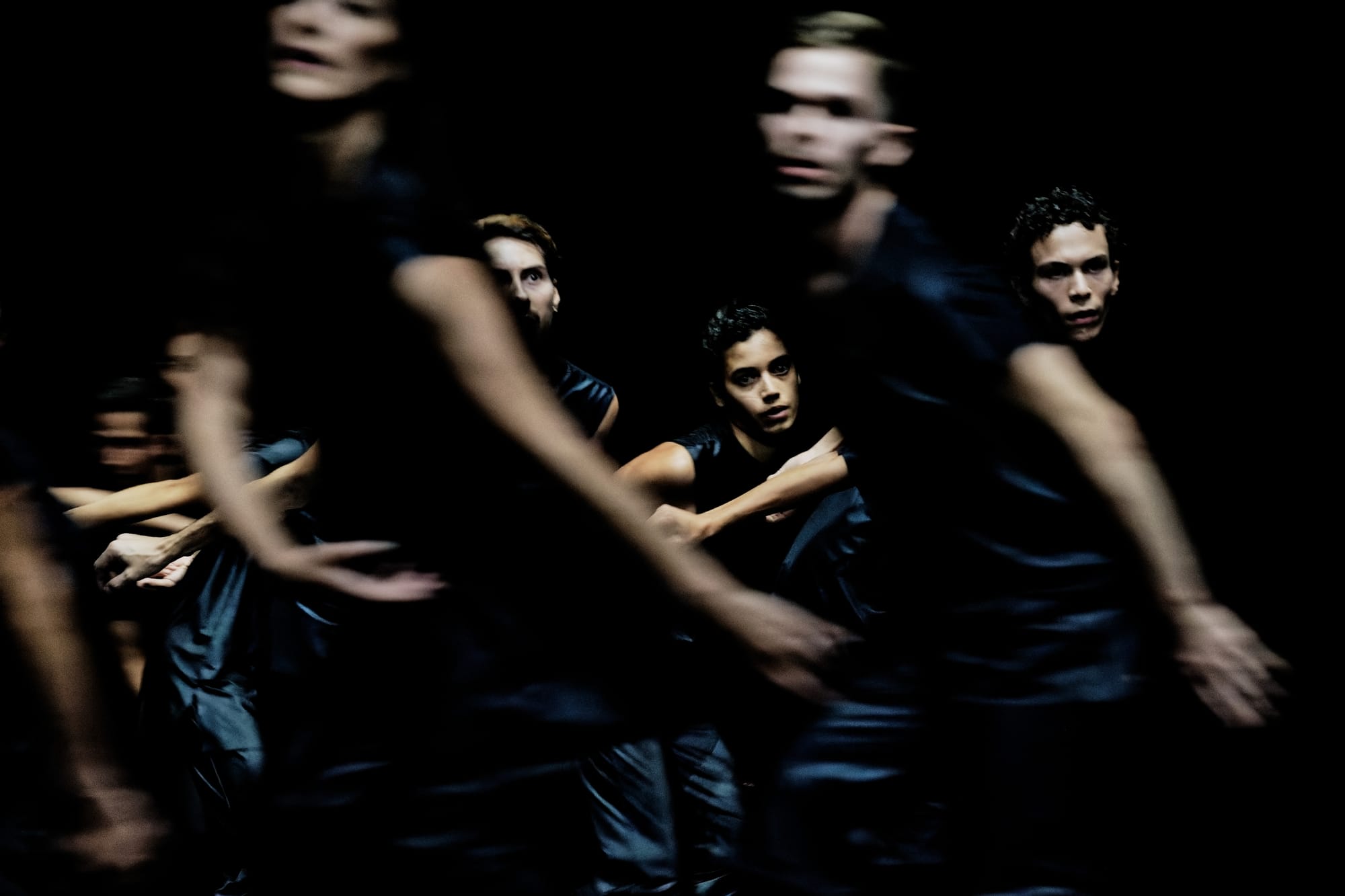
Eventually the shuffles and micro-twitches gave way to runs that swept across the stage in waves — the company splitting, surging, and regrouping as if driven by some unseen atmospheric pressure. The image recalled murmurations, those startling formations of starlings that seem to move as a single mind, and collective natural systems have been a recurring source of inspiration for Papadopoulos (ocean undulation in "Elvedon," flocking birds in "Ion"). But "Mycelium" arrived at it late. After the work spent the better part of an hour committed to something genuinely strange and hypnotic, the sudden pivot felt less like organic evolution than a thematic rupture with the subterranean world so meticulously established.
At least it stayed true to the evening's takeaway: no matter the technological integrations or robotic resemblances, these choreographic worlds rely utterly on the stubborn materiality of the human body to exist at all. A limb's arc breaks the digital line; a face's flicker asserts individuality amid the collective sway. In these performances, there's reassurance: even as virtual worlds encroach, onstage the human form exceeds the frame.
copyright © 2026 by Marianne Adams