Deep Blue Sea

“Deep Blue Sea”
Bill T. Jones
Drill Hall, Park Avenue Armory
New York, New York
October 3, 2021
When, on Sunday, the audience entered the Park Avenue Armory to see Bill T. Jones’ latest work, “Deep Blue Sea,” Jones was already there. He slowly moved through various patterns, as people flowed past him. Then he shifted to another part of the enormous space of the Drill Hall to go through more patterns, actions which he continued to execute in different parts of the space as the lights went down. Jones is nearing seventy, but he still moves with cat-like grace, and as “Deep Blue Sea” testified, he has lost none of the forceful energy for calling out racism that he exhibited in his early dances more than forty years ago.
“Deep Blue Sea” was originally scheduled to open at the Armory in April 2020, but the Coronavirus prevented its premiere until last week, on September 28. It may be Jones’ most ambitious work to date. Commanding the Armory’s vast space, which looks as big as a football field, cannot be easy. The Arnie Zane Bill T. Jones Company is a mere ten dancers plus Jones, himself, who acted as both dancer and narrator. A handful of singers, elevated at one end of the room, augmented the company. Despite these modest numbers, Jones had no trouble controlling the space, aided by choreographic, musical, and lighting collaborators.
For “Deep Blue Sea” he drew on Herman Melville’s nineteenth century classic, “Moby Dick,” and the words of Martin Luther King, to create a verbal narrative centering on Pip, a black cabin boy in the Melville saga who is left behind in the ocean by the crew of the Pequod and goes mad before he is rescued. Jones intertwined his own experience within this narrative, telling how he, too, forgot the character of Pip after reading “Moby Dick” in school. Forgetfulness is a recurring theme in “Deep Blue Sea,” as are King’s words on blacks being characterized as “a problem.” “How does it feel to be a problem?” is asked throughout the work. “Deep Blue Sea” communicates the fear, sense of abandonment, and loneliness of an entire people who historically have been left behind, forgotten, ignored, or viewed only in problematic terms.
As for dance, Jones has long integrated a postmodern sensibility toward movement into a larger vision of total theater. Consequently, dance in “Deep Blue Sea” is not a means of story-telling; that is left to the spoken word. Dance remains abstract, its task to act as a vehicle for unifying the various elements of the work and for energetically driving the action forward. Dance was manifested particularly through circles and extended lines, the dancers’ movement often synchronized and derived from the patterns Jones executed as the audience was entering. One pattern in particular stood out, in which
undulating arms, like a swimmer moving beneath the surface of the water, gave way to one hand pointing downward accompanied by a snap of the fingers.
“Deep Blue Sea” consists of a complex collaboration of elements, directed by Jones. In addition to creating the narrative, he produced the choreography in concert with Janet Wong and the dancers of the Bill T. Jones/Arnie Zane Company. Music director and composer Nick Hallett worked in cooperation with Hprizm aka High Priest, Rena Anakwe and Holland Andrews, who were responsible for the electronic score. Sound consisted of both the singers performing a variety of genres from gospel to rap, and electronically produced sounds that included the sighs and lapping of ocean waves.
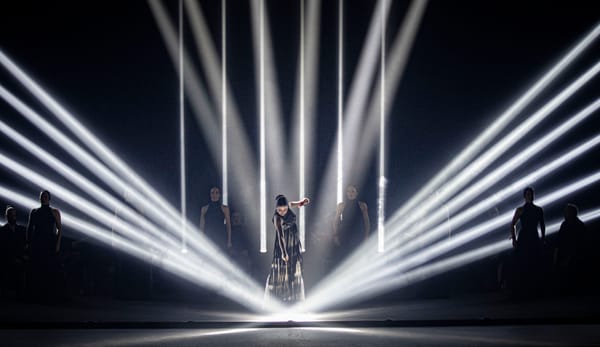
Lighting, too was multi-creative. Designer Robert Wierzel worked alongside Elizabeth Diller, DS+R, and Peter Nigrini who created the visual environment and extensive video project. The resultant lighting produced constantly changing effects, such as written sentences from Jones’ text that moved across the floor. In several amazing moments the entire floor became a sea, rippled with waves, or green and cloudy like the ocean depths. Spotlights also were used in a variety of ways throughout the production, sometimes peppering the entire performance space, or suddenly turning to black at critical moments in the narrative.
“Deep Blue Sea” is almost two hours in length without intermission. For most of that time it preserved its energy and focus, lagging only in the final segment when the company was joined by nearly a hundred people from the community. This marked a turning point in the work, as each person approached a microphone and announced, “I know” followed by a personal proclamation. These statements, although undoubtedly important to the participants, were rarely profound or even, in some cases, to the point. After that, Jones invited the audience to, in his words, “hang out” with the company to discuss the performance and its themes. It is understandable that Jones would want to bring “Deep Blue Sea” into the present, but his answer seemed less a communal gesture and more an abrogation of authorial responsibility, which resulted in a dissipation of the work’s dramatic power. Ending “Deep Blue Sea” earlier might have made a more potent statement, not only about past iniquities but about present injustices.
copyright 2021 by Gay Morris