Create and Recreate

"Handel", "Common Ground"
Alonzo King Lines Ballet
Yerba Buena Center for the Arts
San Francisco, CA
October 11, 2018
The Kronos Quartet and Alonzo King’s Lines Ballet call San Francisco home. Both have pioneered new perspectives in their fields, making them core values of their work. The Kronos was established in 1973, Alonzo King Lines Ballet in 1982. So you wonder, what took them so long to finally get together? For “Common Ground”, their first collaboration, King chose five composers from the Kronos Quartet’s “Fifty for the Future: The Kronos Learning Repertoire” with which these musicians hope to set sign posts for how string quartet repertoire might evolve in the years to come. King, drawing on the quietly meditative quality of these selections created a choreographic, in many ways quite traditional trajectory. It started with the almost imperceptible, built into splendid Pas de Deux and than returned to darkness. It almost looked like rondo form. “Common Ground” is superb, mysterious, transparent and, perhaps, even ineffable. It approached something like a reflection of cosmic processes.
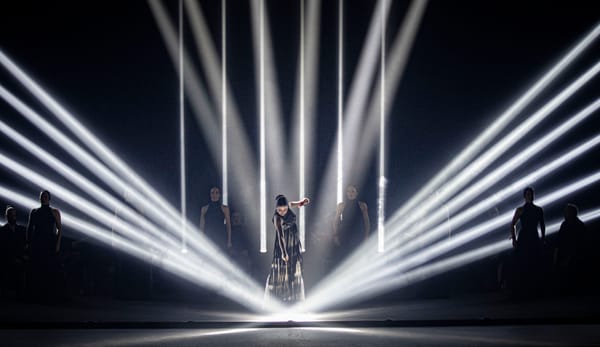
The piece opens with a video (by Jamie Lyons) of a huge blackened rock - apparently part of the ruins of the Sutro Baths, a popular, late 19th SF recreation area. It sits in a pond of still water, but beyond it you see the Pacific’s preternatural waves. Their sound mixes with those of a few birds. Jim French’s lighting set the scene in soft, misty, barely predawn light that gradually revealed the musicians upstage with the dancers in front.
“Common Ground” embraced unisons, more so than I seem to remember from some of King’s other works. The first section looked almost like old-school ballet: four women shadowed a male dancer, and then the roles were reversed. Walking patterns connected into a chain with a hand on a colleague’s shoulder. Then, as the music picked up, the musicians enhanced it with foot stomps and clapping, inspiring quasi-folkloric serpentines and circles. A lovely melodic conversation between the first and second violin eventually joined forcefully by the viola, engendered a lyric duet between Madeline DeVries and lanky Jeffrey Van Sciver that burst away from and re-condensed into a group of seven.
The major Pas de Deux, almost as central in King, as in classical ballet, now paired DeVries with the dramatic Shuaib Elhassan. With flying limbs, theirs was a contentious relationship between equals yet -- as always in King –- the man did the lifting. Elhassan hoisted his partner in huge overhead travels which eventually left him spent. In the last movement, dusk ever so slowly descended, encouraging us one more time to watch choreography that embraces the body’s individual elements in the way they cooperate but also create tension. It’s a constant questioning and embracing of oneself and others. The process was slow, long and mesmerizing. All I could do was hold my breath.
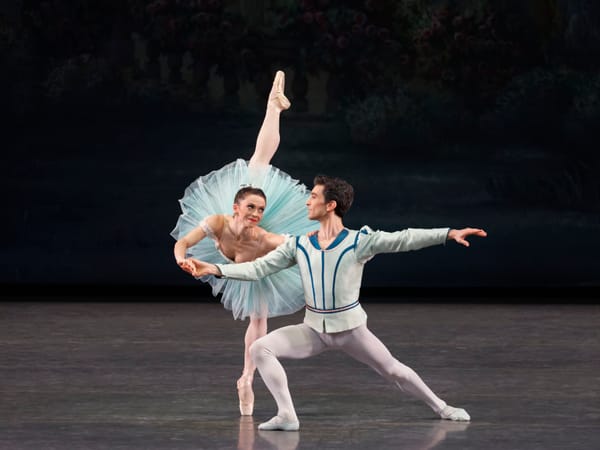
The evening started with a reprise of the 2005 “Handel” with the women in point shoes. King used them frequently early in his career, but these days on rare occasions only. Set to excerpts from the composer’s organ concertos and concerto grossi, its suite of eleven dances showcased the company’s individuals without necessarily trying for a cohesive perspective on the individual excerpts. It’s a problem that plagues suite forms.
Good to see was that King’s choreography played against the propulsive beat of much of the Handel. Ilaria Guerra, a majestic new dancer, was a pleasure to see in partnership with Lines’ ever so different men. The opening section also introduced a very young James Gowan, a whirlwind, yet also detailed dancer, in a give-and-take with the forceful Babatunji. Guerra out-danced both of them. Maybe the danciest baroque-inspired choreography came from Yujin Kim and Elhassan’s take on the familiar ‘Watermusic’. In his adagio solo, to a violin sonata, Robb Beresford, an elegant but underused company member, one more time I wanted to see more of him.
copyright © 2018 by Rita Felciano