Brand New and Re-thought
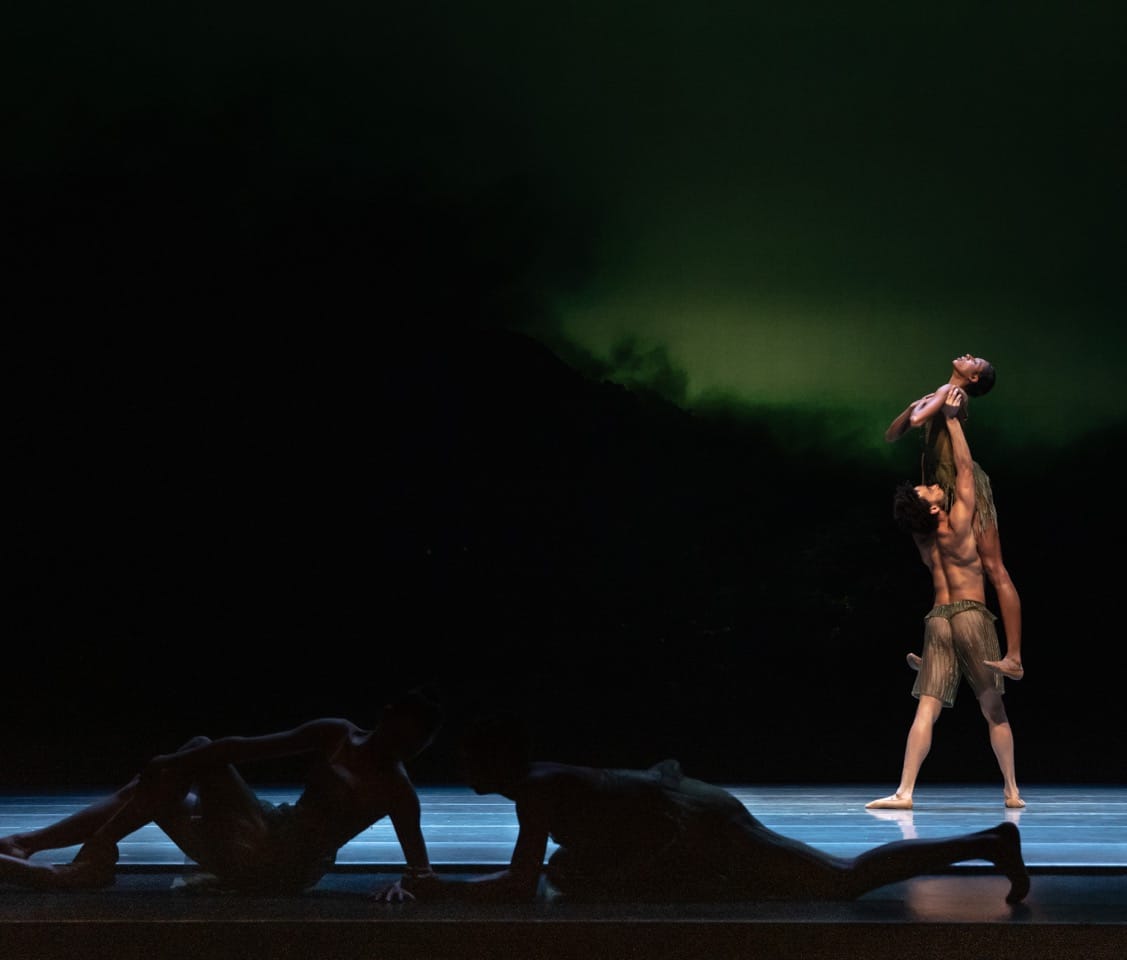
“Art Songs” “Pole Star”
Alonzo King Lines Ballet
Yerba Buena Center for the Arts
San Francisco, CA
April 12 and 17, 2019
Misreading of curtain time made me miss the major part of Alonzo King’s reworking of his 2016 “Art Songs” which opened the company’s spring season. I thought it necessary to return since a partial perspective of a work never makes sense. Also, the new “Pole Star”, with original music, performed live by composer Van-Anh Vanessa Vo, offered enough intriguing material to warrant a second viewing. So an unfortunate mistake actually became a welcome opportunity. If only that kind of faux pas would turn out this way more frequently.
The premiere suggested that King has entered territory that in his over thirty years of dance making has proved to be somewhat elusive. The great number of his works feature small units, duets, trios who sometimes overlap and/or spool off each other. The dancers may come together at the beginning or the end to tie a piece together. But until now ensemble choreography seems to have had little interest for King. In that respect “Pole Star” is unlike any other – and a welcome development
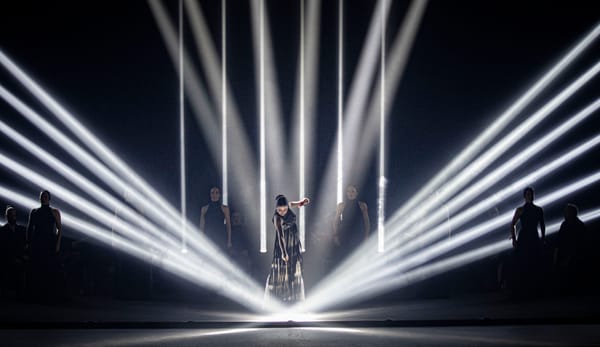
“Pole Star’s” solos and duets take place within the context of the group. Dancers watch colleagues from the sidelines; they circle around center space; drop to floor to rise and step into quasi military formations. When for some reason a trio literally takes the measure of two colleagues, the rest watch and all of them break into raucous laughter. Robert Rosenwasser dressed them in shimmering transparent outfits, with the women, except the regal Madeline DeVries,in pointe shoes. This is, you feel, a cohesive group engaged in a common enterprise
Yet Babuntji is the outsider. In a billowing yellow skirt, he tears around the stage in huge leaps and barrel turns. Sitting cross-legged, he impassively watches male dancers and a quintet of women that melts into the floor. But then the yellow skirt is passed on to DeVries and James Gowan -- he who, throughout this evening, showed us how strong, nuanced and attractive an artist he has become.
Vietnamese composer Van-Anh Vanessa Vo wrote a score for zither, bells and electronica. Inspired by that country's culture, its many details drifted softly and mysteriously not unlike the wispy fog that shaded and revealed Jamie Leon’s film of Réunion Island’s luscious landscape.
In the final scene Adji Cissoko and Michael Montgomery’s tortuous duet was watched over and encouraged by a ragged group of downtrodden figures which dragged itself along the apron. But almost miraculously they to pulled themselves up and became of part of the hymn-like Going Home. Vo had adapted the tune from Dvorak. It’s “Pole Star’s” most explicitly emotional section, maybe even a tad too explicit. But it surely spoke for all the people who long for a way home.
Giving up live music — in this case also a spectacularly puffy gown for the original singer — is always regrettable, but the inclusion of some additional material and two violin interludes by composer Lisa Lee gave King’s 2016 “Art Song” air and a smoother trajectory. Since the vocal selections are stylistically and chronologically so distinct, it made good sense to have them interpreted by four different singers. The choice of Jose Van Dam’s badly amplified booming bass for Schumann’s delicate Stille Traenen, however, seemed a distinctly odd choice.
Andreas Scholl’s sweet counter-tenor in Handel’s Dove Sei Amor Bene inspired an elegant Beresdorf and the unbeatable Montgomery into an at first shadowing support of Gowan. I couldn’t help but think that they were initiating a colleague.
In his solo to Lee’s Interlude #2 Shuaib Elhassan’s sense of space’s multi-dimensionality was so physical that you could almost touch it. His enormous leaps suggested power and yet energy also flowed through his torso like melted butter. This new solo became one of “Art Song’s” highlights.
In the final tension-filled duet DeVries and Montgomery pushed, curled, embraced and rejected each other. Serpentine and straight-up lift alternated. At one moment she grabbed him by the waist to hoist him a bit. “Art Songs” was fun and at times even tender to watch. But please not to Dido’s Lament. That is sacred ground.
copyright © 2019 Rita Felciano