Beauty in the Simple Unexpected
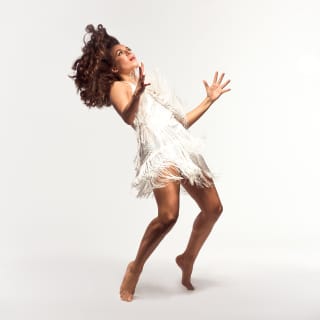
“Make Believe”
Rosie Herrera Dance Theatre
Dance Place
Washington, DC
September 15, 2018
As a choreographer, Rosie Herrera never fails to surprise. Her past creations range from melting a chocolate bunny with a blowdryer to throwing a girl into a birthday cake. In her company’s most recent performance at Dance Place, an inflatable bounce house takes over as an unexpected but welcomed element, representing the innocent ease that characterizes a child’s ability to believe. This past Saturday, the Rosie Herrera Dance Theatre presented original imagery in "Make Believe," exploring how a relationship with faith can change drastically over time.
Before the show, Christopher Morgan, Dance Places' newly appointed executive artistic director, introduced Rosie Herrera as “an artist who is always in pursuit.” He praised Herrera’s work as masterful in configuration and visually potent. She earned her BFA degree in Dance Performance at New World School, and her company has presented work at many notable venues including the American Dance Festival and Focus Dance at The Joyce NYC. As a Cuban-American artist and performer, Herrera drew heavily on her cultural heritage and Catholic upbringing for inspiration when envisioning “Make Believe.” This personal connection gives the piece’s impact significant value.
The choreographic process for “Make Believe” began when Herrera came to Dance Place to develop a new work for a week-long Alan M. Kriegsman Residency. Over two years later, this performance looks nothing like it did initially, but Herrera believes her revisions have made the work more transparent and poignant than ever.
For this latest rendition of "Make Believe," Herrera and costume designer Haydee Morales beautifully employed the power of imaginative costuming, assembling a look which reinforced the topic of faith plainly. When the lights first illuminated the stage, six dancers stood in solidarity, clad in bright white sequins with gold trim. A few moments later, their hands slowly inched up their bodies, the sequins flipping upward to reveal the blood red coloring hidden underneath. These deep blotches marring the costumes' angelic quality was both shocking and intriguing upon the first encounter. As the dancers continued to move during the show, fragments of red would make a reappearance, visibly representing how life experience can have a lasting impact on someone's spiritual identity.
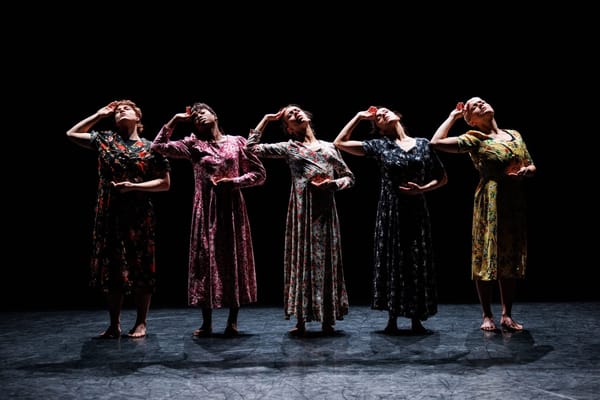
“Make Believe” is defined by moments. The performance is a long journey punctuated by striking and explicit images that reveal a more profound clarity. Herrera’s style encourages simple movement progressions that often do not immediately appear relevant but later circle back around proposing a greater tangible worth. Although the dancers intersected occasionally, each performer expressed themselves differently throughout the show, speaking to the dependency of faith upon an individual’s personal experience. They followed their own path, encountering varying forms of adversity.
Expressing struggle was an overarching, constant theme that tied the piece together. Early on the dancers paced back and forth in a square formation, their footfalls marching in perfect unison. To contrast the reliable, comforting walking pattern, their arms froze in distressed gestures clutching their torsos, desperately attempting to hold themselves together. This segment established a ghost of an image which returned stronger than ever later on with Ivonne Batanero’s solo — struggling, whimpering, her limbs flailing wildly, with feet glued solidly to the floor. Another moment of clarity emerged when Loren Davidson appeared from behind a curtain far upstage, painstakingly dragging the 200-pound deflated bounce castle across the floor. The burden of the weight was apparent on her face, etched in agony. Nevertheless, she persisted onward.
When the time finally came for the bounce house to reveal its true form, it quickly surpassed all other performers in its symbolic significance. The concluding segment of “Make Believe” featured only the bounce house and Katie Stirman, the invisible performer manipulating its air flow. With Stirman’s aid, the castle ballooned, sagged and trembled to the melodious notes of an epic love song. Herrera’s idea to include such a feature was nearly ridiculous, yet undoubtedly creative, giving an inanimate object a living, breathing role in the performance. Herrera idolizes the bounce house as a monument to the mind of a child, where a bouncy castle is a magical playground, and having faith is as natural as breathing.
copyright © 2018 by Arielle Ostry