Balanchine's School, His Style, and His Aesthetic

“But First A School: The Making of a Balanchine Dancer”
Studio 5
New York City Center
New York, New York
Oct. 29, 2018
New York City Ballet’s first home was New York City Center, and as part of the Center’s seventy-fifth anniversary, it is featuring a George Balanchine celebration, which is going on this week in the main auditorium. Meanwhile, upstairs in Studio 5, a less formal celebration took place on Monday evening. It was a demonstration of how Balanchine sought to develop dancers, and how what has become known as the Balanchine style is instilled in dancers today.
When Lincoln Kirstein brought Balanchine to the United States from Europe in 1934 to start a company, Balanchine famously said, “But first a school.” He wanted to develop dancers who could perform his choreography in the way he wanted it done. The School of American Ballet was the result, and it continues to promulgate Balanchine’s vision through a strict curriculum that takes a student through about seven levels, and about eight to ten years of study, from beginner to professional dancer.
Monday’s program began with Kay Mazzo, the Chairman of Faculty, giving a brief introduction before turning things over to Katrina Killian, an SAB faculty member, who was joined by ten children from the first through fifth divisions of the school. Two children from each level demonstrated barre and center steps according to how they are executed at each level. The steps were done by all the children at the same time, so it was possible to see, for example Olive Omelchenko and Kensei Gunji from Level One, doing demi-plié with both hands on the barre, while students in each higher level added another element to the plié. By the fifth level Mia Fernandes and F. Henry Berlin were doing grand plié with the use of arms and head. It was a surprise to learn that first level students work only with two hands on the barre. Placement, correct position of the feet, legs, and head, a lifted torso, and musical sensitivity are the focus. It is only when these very basic elements are fully incorporated into the body that the student advances to the next level. At each new level, slightly more complex elements are added to the vocabulary, but the attention to detail never wavers. When you think of the usual children’s ballet class, the training is astonishing.
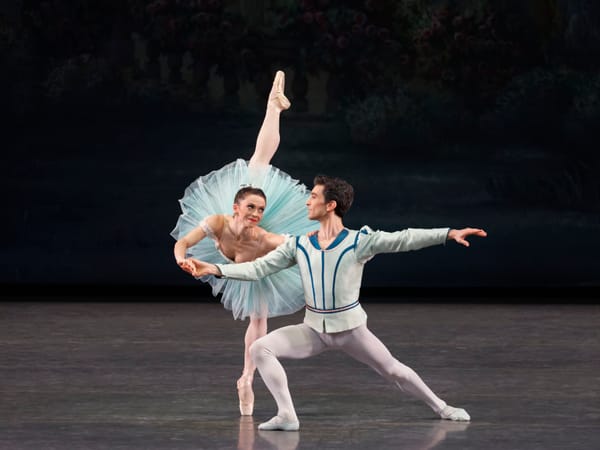
After Killian’s segment of the program, Mazzo took over to show what she called the Balanchine aesthetic. At her direction, two advanced students, Emma Brinton and Rommie Tomasini, showed how SAB students and NYCB dancers execute certain steps, while another student, Shelby Mann, demonstrated a traditional approach to the same steps. The difference was extremely enlightening, although Mann (a granddaughter of NYCB former star Jacques d’Amboise) occasionally struggled with the unfamiliar traditional form. The main difference between the two styles is attack and speed. We are used to hearing these things about Balanchine technique, but to see the two approaches demonstrated side-by-side was instructive. The Balanchine style is harder, brighter, and more dynamically varied than the traditional one, which is softer, more even, and perhaps more lyrical. LaJeromeny Brown joined the girls for a demonstration of pas de deux, showing, among other things, how Balanchine wanted the girl’s arm supported in a slow promenade, and how he wanted the boy to stand back and only support the girl at the last minute in pirouettes.
Lauren Collett, Savannah Durham and Uma Deming, from the most advanced class, showed how speed, scale and balance, and musicality are emphasized in Balanchine choreography and taught to students. Collett danced a variation from “Tchaikovsky Pas de Deux,” Durham from “Divertimento No. 15” and Deming the ‘Bransle Gay’ variation from “Agon.” Each looked like a fully professional dancer.
The evening finished with another fascinating demonstration of two styles, with side-by-side performances of the “Nutcracker” pas de deux. The duets were performed by NYCB company members and explained by Suki Schorer a long time faculty member and, like the other teachers, a former NYCB dancer. Lauren King and Daniel Applebaum danced the duet as Alexandra Danilova and Frederick Franklin danced it in the Ballet Russe companies of the 1930s and ‘40s. At the same time Erica Pereira and Joseph Gordon danced the Balanchine version.
As Schorer pointed out, the traditional duet is formal and gracious. It gives ample time for poses to be seen and registered by the audience before the dancers move on to the next step. In comparison, Balanchine’s version incorporates far more steps, is uniformly more dynamic and builds to a crescendo of movement that better reflects the passion of the music.
Schorer quoted Balanchine as saying that if you see something you like, use it. She showed how Balanchine took specific steps from the traditional pas de deux, such as a supported pirouette ending with the woman facing her partner in a back-bend. But he put the step in a different place in his own dance. He used other steps from the older dance in a similar fashion, repositioning them, and combining them in new ways to serve his own purposes. In the end, both dances feel elegant. The dancers in both enter together and acknowledge each other with a gesture, and their attitude throughout maintains a certain formality. But there is simply far more going on in the Balanchine duet. The audience has no time to leisurely observe the individual movements. Everything flashes by in a whirlwind that demands full attention.
The Studio 5 series is proving to be a very fine addition to City Center’s programming. It is always extremely informative and far more imaginative than the usual lecture/demonstration. It’s popular, too. Every one I have attended has been sold out. People obviously like to know what goes on behind the art they see from in front of the curtain.
copyright © 2018 by Gay Morris