Bach to Offenbach
"Cascade", "Sunset", "Offenbach Overtures"
Paul Taylor Dance Company
David H. Koch Theater
Lincoln Center
New York, NY
November 23, 2025
The final program of the Paul Taylor Dance Company’s 2025 Fall season was an all-Taylor afternoon ranging from the pristine classicism of his 1999 Bach-inspired “Cascade” to the 1995 “Offenbach Overtures” raucously comic send up of ballet cliches, with a detour to “Sunset”, Taylor’s 1983 lyrically mournful picture of young sailors set to Edward Elgar. The program was a vivid example of Taylor’s emotional range, and the dancing was a welcome proof of the current company’s power.
Taylor used selections of Bach’s 4th, 5th, and 7th concertos for “Cascade”. The work opens with be dancers in silhouette in front of the burnished bronze backdrop and complex black and bronze costumes by Santo Loquasto. The costumes hinted at an Elizabethan atmosphere, and the dancers moved with a courtly graciousness (lots of gentle bowing) combined with Taylor’s stylishly exuberant, open armed leaps. There were hints of drama, with two couples (Elizabeth Chapa with Lee Duveneck and Kristin Draucker with John Harnage) echoing each other’s courtly, stylized moves, circling each other carefully and dancing side by side before switching partners. The dancers seemed to be having a private, slightly melancholy conversation, before returning to their original partners; Taylor’s sculptured shapes seemed to emerge from the music.
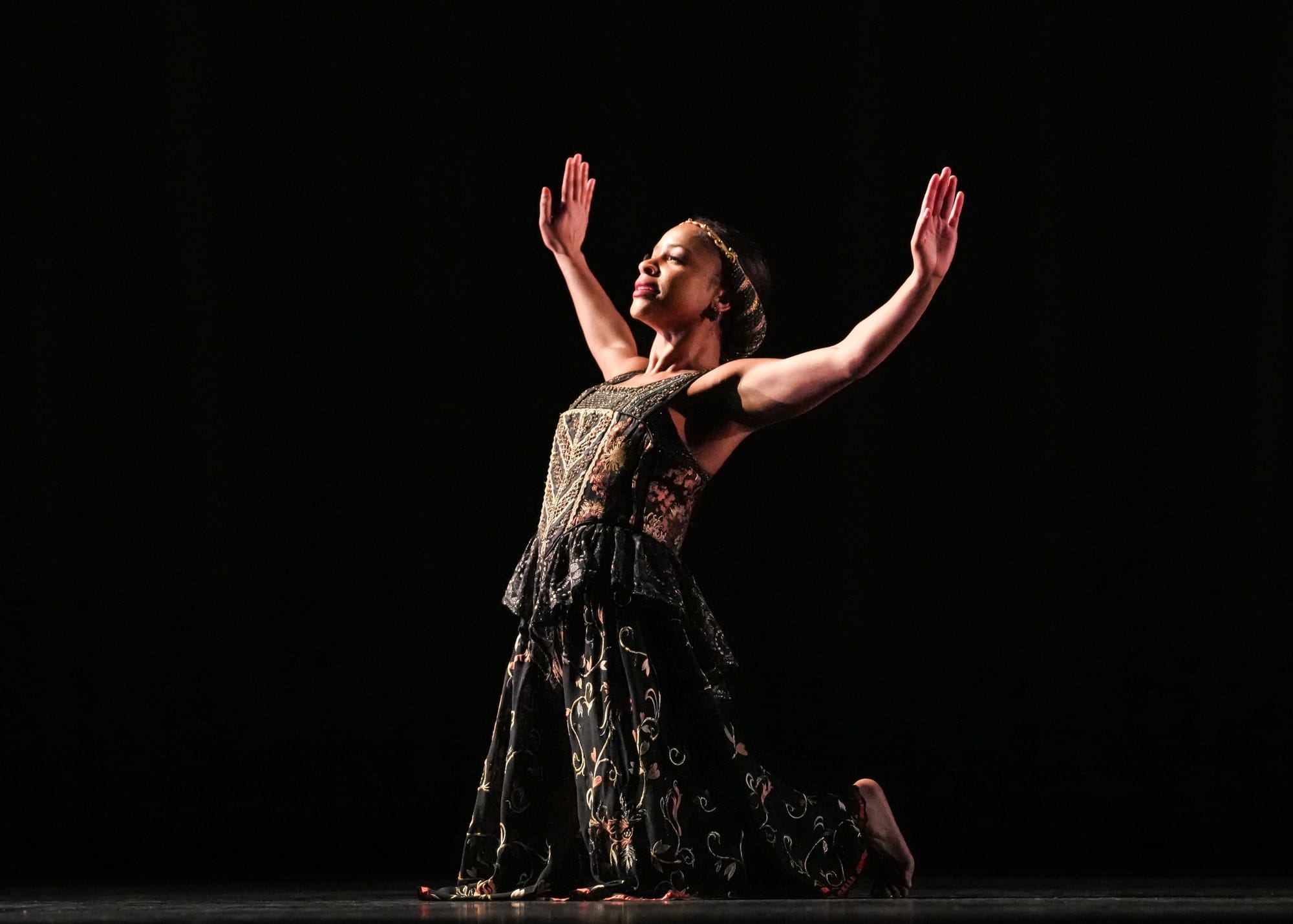
Jada Pearman’s solo was especially powerful; Jennifer Tipton’s lighting seemed to turn the backdrop into a dark wintery forest as a wary Pearman, falling and rising, her arms seeming to reach for something unattainable. She danced with a concentrated dramatic power and was both delicate and overwhelming. But as in so many Taylor works, there was light mixed with dark, and the dancers gave the formal, almost Baroque shapes a sense of a bright community, as the men, led by Harnage, leapt through the Presto, tossing moves back and forth. Even the restrained final pas de deux, danced by Jessica Ferretti and Devon Louis, ended with a calm rapture, as they leaned their heads so calmly and confidently on each other’s shoulders.
There were moments of quiet rapture as well as “Fancy Free” hijinks in “Sunset”, as the opening group of soldiers in an abstract park designed by Alex Katz danced and flirted with the four women in white to Elgar’s “Serenade in E minor for Strings”. Alex Clayton was a dancing dynamo, tossing off one handed cartwheels and soaring jumps as he tried with a vulnerable bravado to impress the girls. Taylor used the soaring, almost introspective music rather like Sir Frederick Ashton did in his “Enigma Variations”. Both choreographers have two companions (here, Duveneck and Harnarge) move through the music in a conversation, mixing in everyday moves (Taylor’s soldiers tie their shoes, straighten their ties, put their hands in their pockets, while Ashton’s Jaeger cleans his glasses) before being joined by a woman (a lyrically innocent Pearman), and who turn their backs to the audience, link hands, and rush to the back of the stage, catching the crest of the music. I don’t know if Taylor had seen “Enigma Variations” (choreographed in 1968), but both works use Elgar to glowing effect.
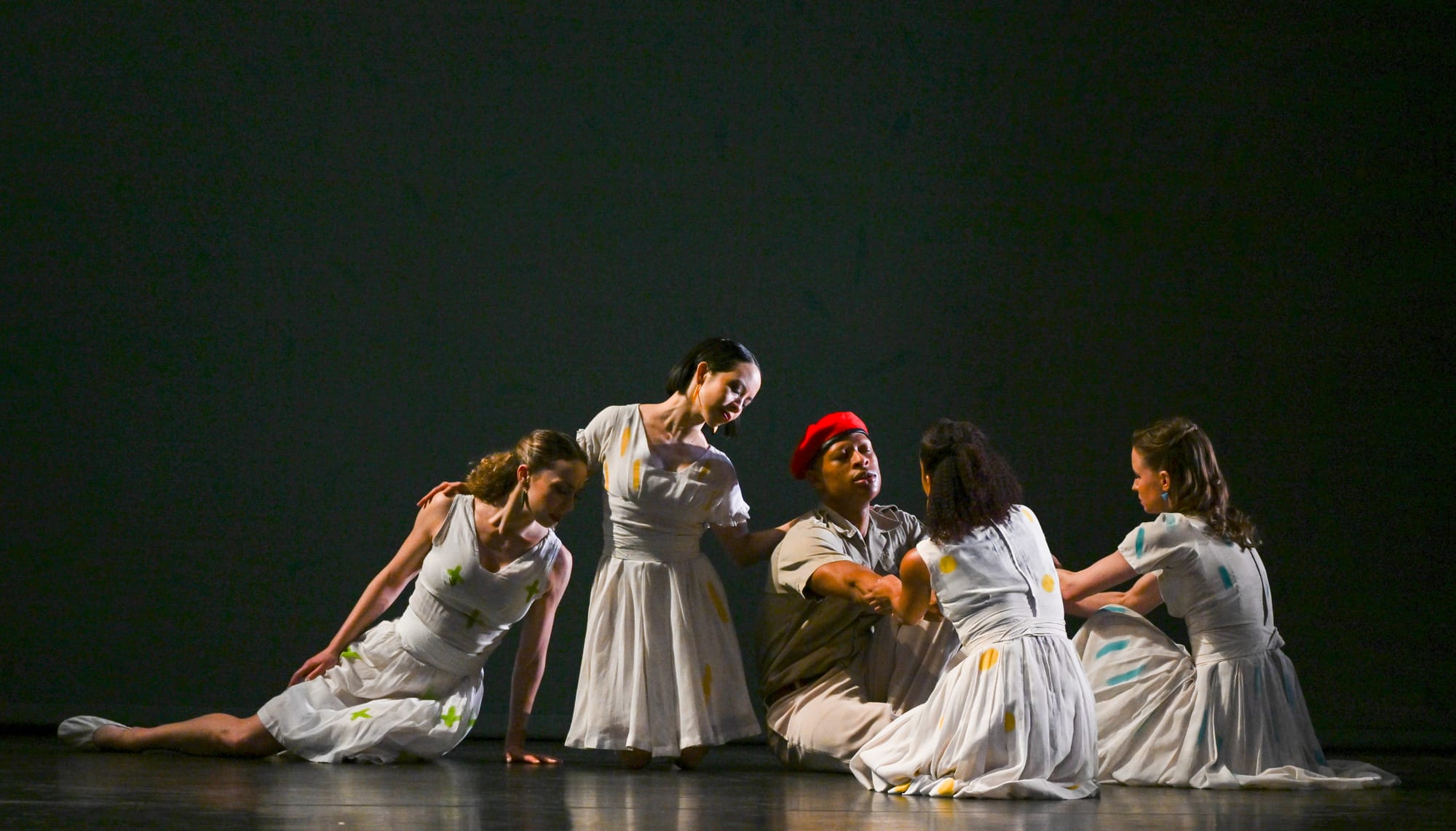
The middle section of “Sunset” also uses sounds as atmosphere, in this case recordings of loon calls to create an uneasy, dangerous place where the soldiers fall and die, comforted by the ghostly women in white. The final section, set to Elgar’s “Elegy for Strings”, returned to the park with the women watching the men depart; Clayton dropped his red beret, which Pearman picked up, another simple gesture which encapsulated all the boys who were sent off to die like men.
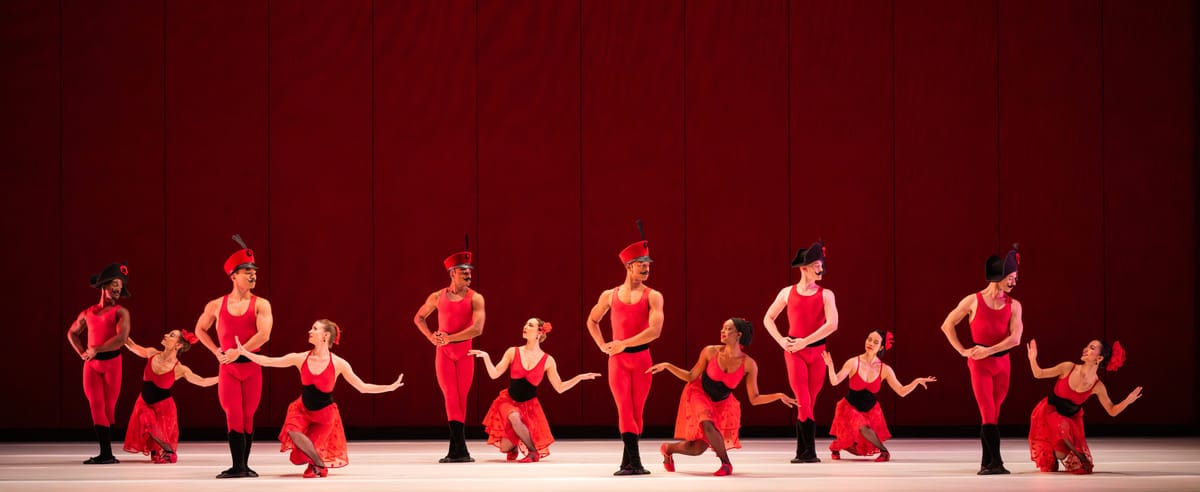
There are soldiers, and sailors too, in “Offenbach Overtures”, but they would rather prance than fight. Like “Cascade”, the work opens with the dancers in dramatic silhouette, but as the lights came up they appear ridiculously posed in Loquasto’s bright red costumes, the men showing off exquisitely curled mustaches and the women in can-can attire. Their exaggerated courtesy, their deep bows, and oh la la ogles place the work firmly in comedy land, but Taylor’s craft gives the work a lasting fascination; like Balanchine’s “Stars and Stripes”, the jokes are in the steps, not in the steps being done badly.
The steps were done very well indeed, and the dance-off between the army (Devon Louis spitting split jumps out like a machine gun) and the navy (Duveneck showing off astoundingly controlled attitude turns) both very funny and very impressive. Meanwhile, as they kissed and made up, their seconds (Harnage and Austin Kelly) were busy knocking each other out.
Besides technical show offs, Taylor skewed other ballet conventions, and the can-can girls, bouncing into splits at the sight of a mustache, morphed every so often in to very daffy sylphs, with droopy arms and even droopier expressions. Emmy Wildermuth was the klutzy one, originally danced with devastating humor by a deadpan Lisa Viola who had clearly had an extra tipple; Wildermuth was a bit too broad, telegraphing the jokes and exaggerating the silliness. But the goofy humor and sturdy construction of the piece was absolutely winning. And so was the program.
copyright © 2025 by Mary Cargill