An Untitled Love

“An Untitled Love”
A.I.M. by Kyle Abraham
Jacob’s Pillow
Beckett, Massachusetts
July 17, 2022
Kyle Abraham’s “An Untitled Love” is dedicated, in his words, to “Black love,” as evoked through the music of R&B artist D’Angelo. Abraham has been a fan of D’Angelo’s music since his college days. He developed his choreographic response to it over the last four years, which included two residencies at Jacob’s Pillow.
As a white woman, I can’t speak for black love, per se. Yet what emerged from “An Untitled Love,” at least for this viewer, was that the emotions involved in love are universal. Whether it be anger, hurt, and jealousy, or comfort and joy, all of those are on display in Abraham’s dance work.
“An Untitled Love” takes the form of a house party. People enter, chat, gossip, argue, flirt, and, above all, dance. A plastic-covered living-room sofa plays a leading role. It’s where guests settle, like restless birds, before fluttering off into new conversations and relationships. Abraham has included numerous verbal elements, which, coupled with D’Angelo’s lyrics, create a multi-layered narrative. In some instances these can be very funny, as when a young man tries to impress a handsome woman. Through the course of the evening, as he brags about himself, and conversations and dancing whirl around them, he works up to asking her out. But then he confesses his car is in the shop and she will have to drive. She is incensed, wondering if everything he has said is a fabrication. Does he even have a car? Would she end up paying for the date?
Other interactions include a guest who drinks too much and has a tussle with the sofa, eventually losing to the immovable object, and landing on the floor. There is a romantic duet for one couple (Tamisha A. Guy and Claude Johnson), a solo with breakdance moves for a man (Logan Hernandez), and a sinuous, powerful solo for a woman (Catherine Kirk). These are interspersed with dances for varied groups in a range of tempos and moods. Although mostly upbeat, at one point things turn dark when the police arrive. The event is related through the musical lyrics, while the dancers lie on the stage with their hands behind their backs and we hear the words, “why do we keep loving this country and this country does not love us back?” So love’s absence plays its part, as well. The party winds down and the guests disperse as the evening ends on a quiet note.
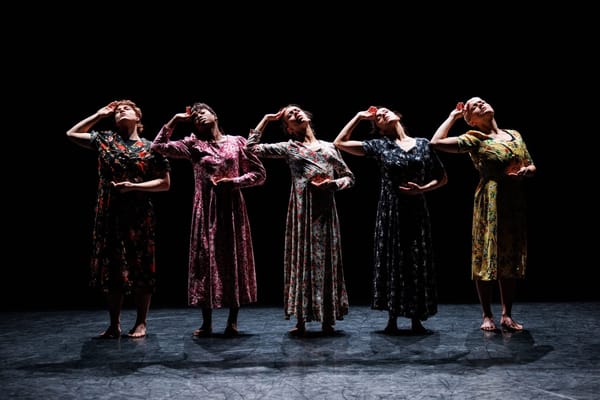
Abraham has described his choreography as “postmodern gumbo,” inspired by sources ranging from ballet, modern and postmodern dance, to social and pop forms. However, it would be wrong to think his dance is simply an eclectic mix of vocabularies and genres. Although an arabesque may appear here and a sway of the hips there, what unites the disparate elements is an overriding fluidity that is maintained throughout. It is what makes Abraham’s dance beautiful and uniquely his own. To create this kind of totality, Abraham has chosen his dancers carefully and instilled in them exactly the movement quality he wants. Each is a virtuoso with particular attributes that make them stand out. But all move with a liquid power that gives the group its unusual degree of unity that is a statement in itself/
“An Untitled Love” offered Jacob’s Pillow audiences a little joy in what are otherwise pretty joyless times. It was a gift, and it was rightly recognized with an ovation.
copyright © 2022 by Gay Morris