An Extraordinary Ordinary
“Körper”
Sasha Waltz & Guests
Zellerbach Hall, Cal Performances
Berkeley, CA
Oct, 20, 2018
If the body is both the object and the subject of Dance, you can stop worrying about Sasha Waltz’s “Körper” being dance or not, because it is. Waltz made her reputation for making work about the ordinary, the everyday, and she makes us look at it through a prism that enlightens and entertains simultaneously. The human body is about as basic an object to become the subject of inquiry for a choreographer. In ninety minutes Waltz examines, dissects, muses on and questions the human body through the human body, and they way it has established itself in our consciousness. A brilliant set of moving images shifted our awareness, reconsidered common knowledge, questioned our perceptions, our memory and treatment of this most quotidian and yet most personal part of our lives. “Körper” started out as an anatomy lesson but became a meditation on what being human can and sometimes does entail.
Because of traffic difficulties, I missed the beginning of the show. I just sat down when two dancers paraded an invitation across the stage to shut down our mobiles. That’s the last time something on stage was crystal clear. Hans Peter Kuhn’s fractured sound score, emanating from the stage and sides of the hall, insistently invited us to break down the fourth wall since what we saw was ourselves and, then of course, it wasn’t.
When a dancer plucked on a colleague’s skin and dragged him along the floor, we recalled the skin as the largest organ, but we also shivered in the way it was used and abused. Calling one body part by another’s name became an amusing game but also shone a spotlight on the power of labeling. The slapping sound made by the price tags two women attached to each others body part became louder, and perhaps, more accusingly with every gesture.
One of the most stunning and yet ambiguous sections occurred in what looked like a shop window or empty picture frame. Gradually, all fourteen dancers squeezed themselves, or least body parts, into the confined space. I first thought of college students in the proverbial phone booth, then a beehive, but as the crowding intensified with empty-eyed bodies and slow upward propulsions, it began to look like a Boschian hell. The two piles of discarded bodies, even though the imagery looked all too familiar, still managed to stab itself into our consciousness.
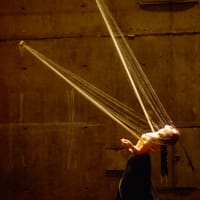
Images appeared and dissolved impersonally. It didn’t make any difference whether a dancer was lifted diagonally like a stiff board or carried horizontally like a corpse. The carriers were as neutral as their cargo. Some sections puzzled more than others. The skier down a vertical wall released an almost catastrophic event. (On stage timing is everything!). Was it the result of thoughtless human action? A butterfly effect? It certainly became was one of the evening’s most impressive coup de thé·â·tre. And what about the woman whose individual braids, attached to poles, suggested, maybe, sails. They certainly made sure that we remember hair as being a body part. All I could think of was heavenly harps.
My suspicion is that, mesmerized by particular images, I failed to capture all of their complexity. Did stacks of clattering dishes - -banalities? - - on octopus arms or, perhaps, spider legs, suffocate one’s humanity? Sitting dancers in spooning position looked as if their motions were controlled by conveyer belts. Or perhaps they were on roller coasters.
It was also strange -- actually, a rather refreshing experience -- to look at “Körper” in the context of just about every new “experimental” work seen on local stages that deal with gender, race and identity, as dance in which an individual’s identity was immaterial. Waltz sees the big picture.
The production was impressively spare. The topless dancers, wore primarily black or identically white shorts; the women a few times were nude. We could see these bodies in detail. Yet not a whiff of eroticism or even gender were on display. Not even when they danced a waltz.
A few times, Waltz broke into “Pina” mode when dancers verbally recounted individual experiences: one attempted to stop smoking, another feared a cancer diagnosis. To me these looked like gestures towards the audience that these “bodies” had personalities. We were allowed to smile at them.
copyright © Rita Felciano 2018