Ambitions

“Défilé" “Reverence”, “Delusional Beauty”, “Racecar”
The Washington Ballet’s Next Steps Program
Harman Hall
Washington, DC
October 24, 2019
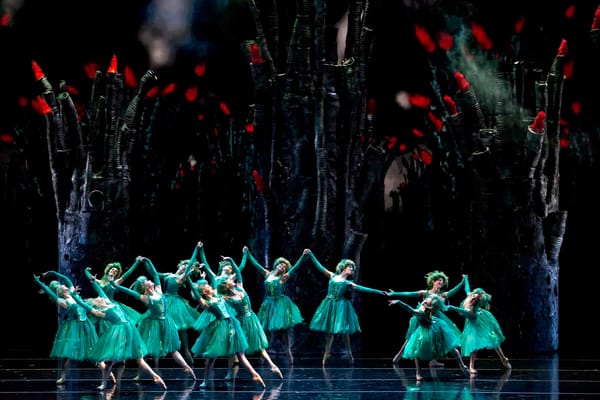
The next steps danced are not necessarily new ones. Instead, they can stir memories. This program began with silent video clips of dance and short messages before the company’s director, Julie Kent, stepped in front of the curtains to welcome her audience. The former ballerina looked trim on high platform shoes with tight, light trousers and a top that resembled a feather duster. The audience had been expecting three new ballets but not a fourth, the opener – Kent’s own défilé for 25 young pupils of The Washington School of Ballet, which is celebrating its 75th anniversary. This ballet’s title, of course, derives from the Paris Opera’s historic défilés, or filings by, in which the dancers walk, just walk, over the stage. Also, Kent may have been prompted to mount her work by the recent hit made by 20 children from Russia’s Vaganova Academy in the Mariinsky Ballet’s “Paquita”. Our local kids, girls and boys, hadn’t the polish and push of the Russian pupils yet presented more than just promise. Their persistence in skipping, jumping and keeping order created an awesome mood as pianist Glenn Sales supported them with Leo Delibes music. The next ballet, Jessica Lang’s “Reverence”, seemed to have evolved from défilés.
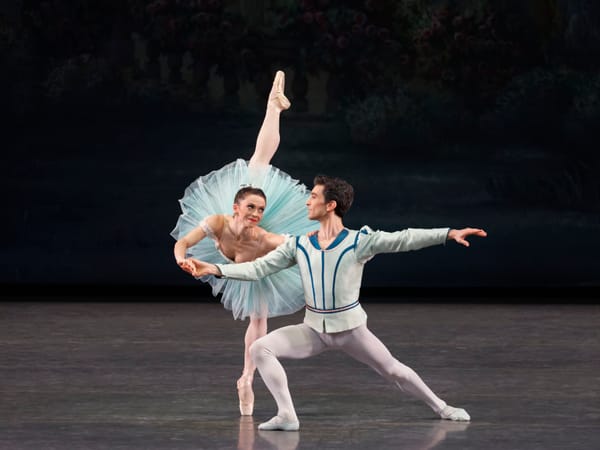
“Reverence” consists of wisps of dance, many of them. Some are ballet technical, some are dramatic and others seem architecturally formal. All these fragments are incomplete, as if Lang was engaged in re-dreaming several nights of fantasy. It is the incompleteness, the abruptness of these images that gives them their power and the feeling that everything happening is transitory. The cast has four women (Eun Won Lee, Adelaide Clauss, Ayano Kimura, Tamako Miyazaki) and four men (Corey Landolt, Gian Carlo Perez, Alex Kramer, Lope Lim). Schumann’s Opus 13 is played by Sales. The ephemeral nature of “Reverence” gives it its power yet also robs it of greater relevance.
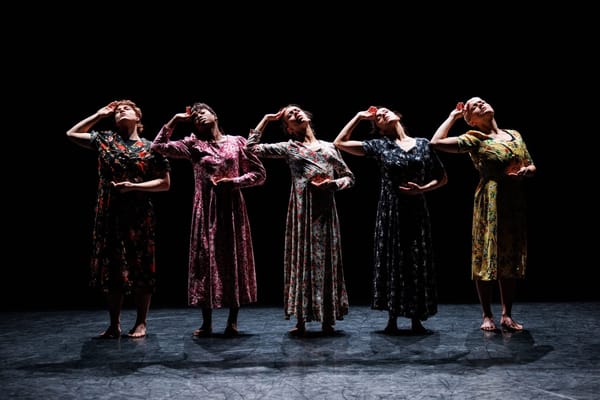
Is there a story to “Delusional Beauty” by Columbian/Belgian choreographer Annabelle Lopez Ochoa? I couldn’t figure it out, even though the cast of characters is quite distinct. There is a woman with a bouquet of flowers where her head should have been. She does Oriental snaking motions from curtain up to curtain down. Another dancer, a ballerina, displays her bravura as a soloist, as a man’s manipulated partner and as the leader of a small female corps. The leading man had the chance to not just handle the ballerina but also show off a bit by himself.. All the males wore short skirts. Almost a character was a tree that bore golden fruit (balloons). Diverse music for this enigma was by Christen Lien, Aaron Martin and by guitarist-singer Zoe Keating. Sona Kharatian as the Oriental figure, Ayanao Kimura as the ballerina and Gian Carlo Perez as the principal male deserved more imaginative movement. Salvador Dali was credited for the image of the bouquet- headed female.
With the program’s closing work, “Racecar”, its dominant thematic returned to défilés. The piece hasn’t much to do with automobiles. However, the work’s title is a palindrome; it reads the same spelled forward and backward. It is this peculiarity that seems to have fascinated modern dance choreographer John Heginbotham. Sometimes he deals with hepped-up défilés and at other times he slows them down or otherwise deconstructs them. The 16 dancers wore red shoes – another memory stir. Whatever happened – speeding up, slowing down, stopping, restarting – had an experimental air. The music, composed by Jason Treuting, and provided by 4 percussionists of the So ensemble, was anything but raucous.
With three of these new pieces, The Washington Ballet has indicated its ambition to participate in the on-going dialogue about what is significant in dance.
copyright 2019 by George Jackson