Air Boxing in Brooklyn
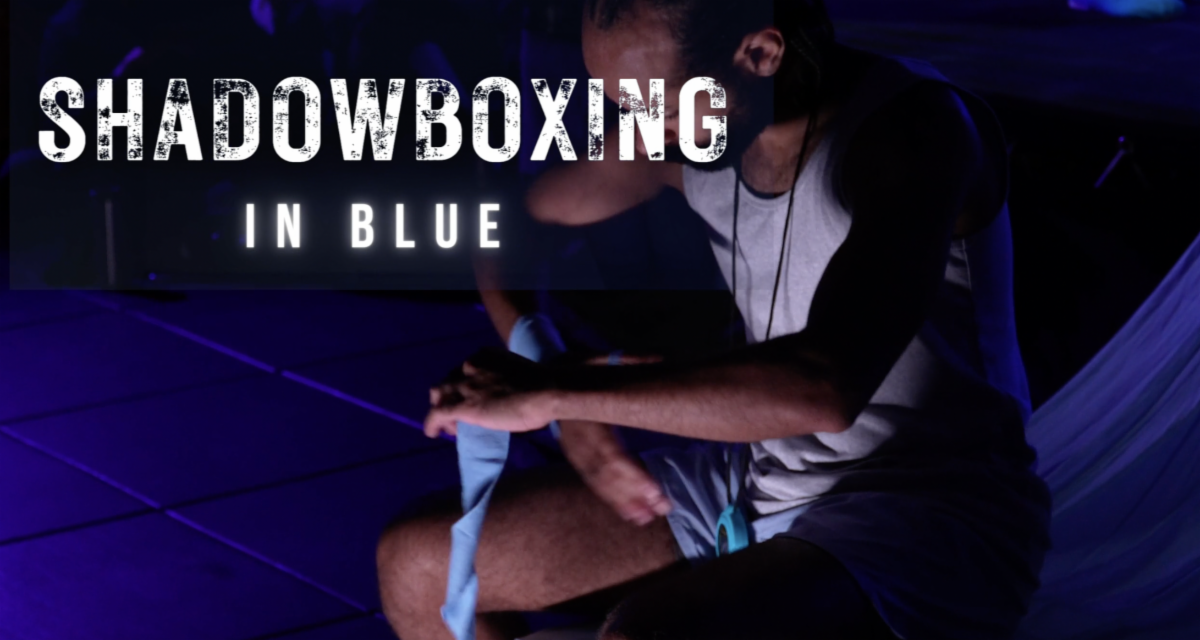
"Shadowboxing in Blue"
Danse Theater Surreality
Directed by Lauren Hlubny and Kyra Hauck
Haven Boxing, Brooklyn
October 4, 2025
No one who has watched a championship boxing match, and seen the fighters fall into each other's arms at the final bell, can doubt the emotional range and depth of boxing. No sport is a better metaphor for life, in all its glory and humiliation.
Shadowboxing is something else. It's punching the air, the only target being an image of yourself. In boxing, it's an essential training exercise. As a metaphor for life, it runs the risk of self-obsession. That seems to be case with "Shadowboxing in Blue," an all-female production of music, dance, theater, boxing, and psychology, that will disappoint fans of all five disciplines.
The setting, at Haven Boxing in hipster Brooklyn, looks promising— a smallish boxing ring draped with blue fabric and bathed in blue light. In the corners are four women in boxing trunks, holding a violin, a flute, a tenor sax and a jump-rope. And front and center, then somersaulting over the ropes, is Gaby Machuca, a tiny, wiry ball of energy who looks like a flyweight boxer. A ringside announcer identifies her as "the ever-surviving present," and the four corners as the near future, the far future, the recent past and the distant past. The announcer invites the audience to come and go as they please, because "these battles never end." Hmmm.
For the next hour, Machuca contends with each of the four -- flailing and reeling, touching and feeling, bouncing off the ropes --and though no one actually hits her, she falls down about twenty times, usually with a loud crash. Ultimately she lies crumpled under the ropes in fetal position. There she is helped up by her former antagonists, set on a stool in a corner of the ring, where they rub her shoulders, squirt water in her mouth and encourage her to go out and do it again. This time she takes up the blue fabric like a robe, and dances dreamily a few turns around the ring, then exits as she entered, vaulting through the ropes.
Nobody wins, nobody loses in this solo boxing match. As a work of art, it's a good advertisement for the woman-owned and operated boxing gym, where they treat boxing as a path to self-healing. The best part was a pre-performance workshop where one of the owners taught the essentials of boxing. I learned how to throw a left hook, a punch I'd always wondered about.
In the show, nobody besides Machuca really knows how to dance, or box, or even act. The musicians could play their instruments, but they mostly just doodled. The script is just as sketchy. "We need to talk," they say, but they never do.
This is the second production I've seen recently in which an all-female cast struggles through an hour of conflict and confusion which seems destined to "go on forever." (The first was "Escape from the House of Mercy." about forced labor in a prison-like laundry. Contrary to the title, no one escapes.)
OK, shoot me, but let me first ask: This flailing at phantoms in a closed space, this cycle of tormenting and comforting each other -- is this an image of feminine psychology in our apocalyptic times?
Copyright 2025 by Tom Phillips