A Tribute to Jerome Robbins at Jacob's Pillow
Stars of American Ballet
Ted Shawn Theater
Jacob’s Pillow Dance Festival
Becket, MA
August 26, 2018
New York City Ballet has spent much of 2018 celebrating the centenary of Jerome Robbins, who was long associated with the company as a choreographer and ballet master. It is not surprising, then, that Daniel Ulbricht, a principal NCYB dancer, would want to continue the celebratory mood when he took his concert group, Stars of American Ballet, on the road this summer. The fourteen dancers appeared this past weekend at Jacob’s Pillow in an all Robbins program that included some of the choreographer’s lesser known works, as well as “Interplay,” one of his most famous.
The program was interesting in that it showed, in condensed form, Robbins’ strengths, which grew out of a sensitivity to gesture as a means of expression. Robbins was often called a theatrical choreographer, usually in opposition to Balanchine’s neoclassicism. But it was his use of gesture that set him apart and gave his best works a sense of drama. “Interplay” (1946), which was one of his earliest ballets, is a case in point. Made for Ballet Theater when Robbins was still in his twenties, “Interplay” has no plotline but suggests youthful high spirits and competition. It is set to Morton Gould’s “American Concertette” and is jazzy and lighthearted. Robbins captured a sense of youthful energy not only in the fast moving steps, but in what might be called movement slang, gestures of shrugging, clapping, finger snapping, and flipping the arms down in front of the body while turning away, a gesture for “get out of here!” or “forget it!” In “Interplay” he also used movement from African American social and jazz dance, including crouches and jutting hips, which he often emphasized by placing the dancers in silhouette. All these elements gave color and meaning to an otherwise casually executed classical vocabulary. In the 1940s and ‘50s, “Interplay” was viewed as quintessentially American, reflecting the way the United States seemed to want to see itself: youthful, energetic, informal and innocent. These teenagers were the younger siblings of the good natured, gum chewing sailors of Robbins’ “Fancy Free” and “On the Town,” also made in the 1940s.
It is impressive that the NYCB dancers can still dance “Interplay” with a sense of innocence and fun that we imagine characterized adolescence seventy years ago. They dispel any dated quality the work might otherwise possess. Sebastian Villarini-Velez led the group with a series of show-off feats, including a pirouette that seemed to go on forever. Unity Phelan, a soloist with NYCB and Peter Walker, a corps member, danced the sweet duet.
Robbins’ use of gesture wasn’t confined to Americana. He turned to Slavic folk dance in “Dances at a Gathering” (1969) and “Other Dances,”(1976) both to Chopin piano pieces. It is gesture that gives emphasis to the dances and imbues them with a sense of place, while avoiding narrative. Gesture, rather than choreographic patterning, also holds things together and makes the parts relate to each other. Here four male solos and a duet were taken from the two ballets to make what was listed on the program as “Chopin Dances.” The various dances, taken out of context, worked better than might be expected because the music and the flavor of the choreography are related in both ballets. Nevertheless, for anyone familiar with “Dances at a Gathering” and “Other Dances” it was a little disconcerting to see individual items transposed in this way.
“Chopin Dances” was performed by Ulbricht, one of NYCB’s most extraverted dancers, and Anthony Huxley, one of its least. It made for a very odd couple. Huxley danced the pensive “Brown Boy” solo from “Dances at a Gathering,” which was a reminder, once again, of how pristine his dancing is. He seems to hold a jump in the air until it creates an indelible image in the viewer’s mind, before he moves on to the next step. Each movement he makes is that crystalline. The solo suits his serious nature, and in it he gave the most remarkable performance of the day. Ulbricht took the fast, virtuosic solo Robbins created for Baryshnikov in “Other Dances,” with its bravura jumps and its many Slavic references in crossed arms, clicking heels, and hand to hip. The men each had a second solo, then came together for a duet from “Dances at a Gathering.” The dance should have been droll and lightly competitive, but Huxley doesn’t do insouciant or teasing, and the two never connected.
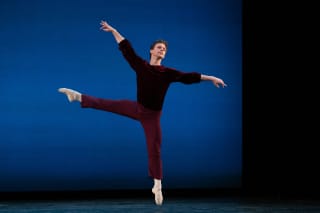
The first half of the program was devoted to lesser known Robbins works. Ulbricht performed, “A Suite of Dances,” which was included in NYCB’s spring season. This work, set to unaccompanied Bach cello pieces, was created for Baryshnikov in 1994. Set for solo dancer and cellist (here Ann Kim), it is a meditation on movement and music. The two performers interact throughout, as if exploring together. When I saw Ulbricht dance the ballet in New York I was impressed by the seriousness with which he approached it. He was more mature man than his usual mischievous boy. There are amusing bits in “A Suite of Dances,” but if you watch Baryshnikov dance the work on YouTube, you see that they aren’t stressed. A somersault is part of the whole, so is a shrug and, once again, Robbins’ “forget it!” gesture. At the Pillow, Ulbricht was back to his accustomed persona, emphasizing the humor and playing to the audience. It didn’t do the work any good, but it got some laughs, which seemed to be what he wanted.
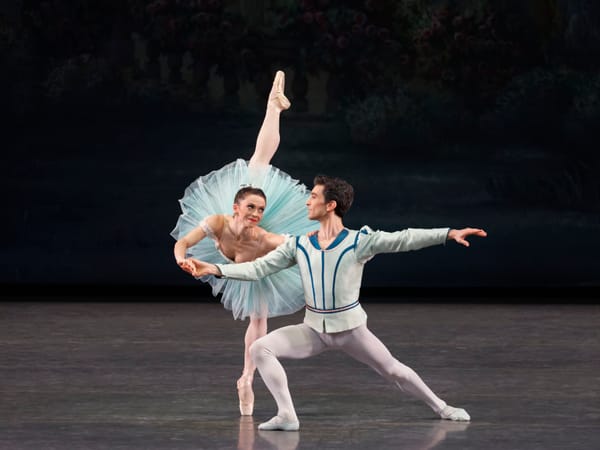
Robbins made the duet “Andantino” for NYCB’s Tchaikovsky Festival in 1981. It originally featured a seventeen-year-old Darci Kistler and the Danish dancer Ib Andersen, who was twenty-seven at the time. At the Pillow it was again danced by a rising youngster, Indiana Woodward, recently promoted to soloist, and the more experienced Gonzalo Garcia, who is a company principal. Garcia offered secure partnering that let Woodward shine. She danced with luxurious amplitude, making the most of every sweeping lift of the leg and swooning bend. The duet shows Robbins working in a purely classical mode. However, without any particular gesture to anchor it, the dance seems little more than a trifle. That is perhaps Robbins’ weakness, an inability to give a dance strong visual and emotional interest through choreographic invention in the classical vocabulary alone.
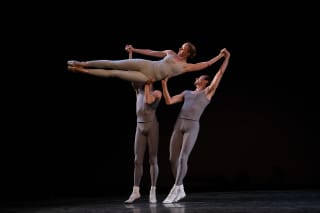
“Concertino” (1982), like “Andantino,” is slight and is rarely performed. It was created for a NYCB Stravinsky centennial celebration, and was originally part of a group of unrelated dances set to Stravinsky music. “Concertino” is a trio, danced on Saturday by Daniel Applebaum, Teresa Reichlen, and Andrew Scordato. Performed in gray leotards and tights, it is all angular movement contrasted with curvy squiggles, often of the hands and arms. Although it occasionally has inventive moments, especially in the lifts, ultimately it resembles any number of other dances set to “modern” twentieth century music.
Daniel Ulbricht has done audiences a favor by organizing and curating Stars of American Ballet. One of its purposes, stated in the program, is to take some of the best ballet and ballet dancers to places in the country that rarely has a chance to see them. Jacob’s Pillow, being close to New York, isn’t one of those places, nonetheless, I am very glad Ulbricht made the Pillow a stop on this year’s tour.
copyright © 2018 Gay Morris