A Quarter of a Century
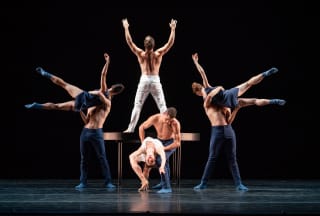
"Schubert Scherzo," "The Eternal Idol," "Sinfonietta" "Echo," "Merely Players" "Blue Until June"
Smuin Contemporary Ballet
Palace of Fine Arts
San Francisco, CA
September 30, 2018
Smuin Contemporary Ballet, as it is known today, is that rare story of a company surviving without missing a beat even after the unexpected death of its founder. Michael Smuin in this case. Less than a decade after his acrimonious departure from San Francisco Ballet, with which he had been associated off and on since he had joined the company at age 15, Smuin went out on his own. He had work to do, dancers who wanted to dance and a faithful audience who appreciated his concept of ballet at home somewhere between the opera and the Broadway stage. Today, under the leadership of Artistic Director Celia Fushille, the repertoire has improved, audiences have been growing, and the company has just acquired its own home. So happy 25th birthday to a survivor.
It would be satisfying to have seen a truly excellent first of two anniversary concerts. While the fostering of new ballets, and the development of young talents from within ballet companies is more than worth pursuing, some of the new work is better served under less glaring limelights.
Of the three “new” works -- they had been work-shopped in 2016 -- only company dancer Ben Needham-Wood’s lovely “Echo” spoke with a clearly-articulated personal voice; it evoked the myth of Echo and Narcissus cogently within a sense of a dreamy reality. Newcomer Peter Kurt towered over Valerie Harmon’s lithe and very young Echo. Four corps member cowered in the shadows below a revolving platform. The simplicity of the solo piano score by Nicholas Britell appeared to grow out of the choreography and yet stood on its own. "Echo" is a fine work,
“Merely Players,” by company dancer Nicole Haskins, featured two couples (Terez Dean/ Robert Kretz) and (the exquisite yet fiery Alysia Chang/Mengjun Chen’s with remarkable ballon) and a small corps of six dancers. Haskins' varied score came by way Vampire Weekend, Fleet Foxes and Ben Iver. It’s a piece in which she works with a common multi-language vocabulary but its good-humored energy needed a fresher sense of articulation to avoid blandness. Maybe the title said it all.
Contemporary composer Boris Tchaikovsky is experienced in writing dance scores. So I wondered by Rex Wheeler had chosen his Sinfonietta and then mostly gnored the first movement’s trajectory. The ballet, fortunately, picked up some energy but ultimately failed to show some individual understanding of what neo-classicism can be.
The company also is committed to maintain Smuin’s heritage. The 1969 “The Eternal Idol” a tribute to Rodin and choreographed for American Ballet Theatre, has not survived well. Though danced decently by Erica Felsch and Kurtz, it looks more like a parody than homage.
The 2007 “Schubert Scherzo” for an ensemble of two (Dean and Needham-Wood) and an octet is a pleasing, buoyant response to the music, enjoyed by dancers and audience alike. It made me want not to dance but to sing along.
Trey McIntyre’s “Blue Until June” closed the program with a resonant embrace of theatrical dance in many colors. It is a skillful work by a musical choreographer who has a flair for popular as well as classical music. If sometimes, especially early in his career, he tended to be too easily pleasing, Etta James, whose own music spans a wide variety of styles, seemed a felicitous challenge. So somewhat disappointing was that the choreography’s underplayed the darker side of her artistry. It is almost always there.
The Smuin dancers, with five new members (Ian Buchanan, Kurta, Tess Lane, Mattia Pallozzi and Max van der Sterre), two guest artists (Maggie Carey and Chang) and apprentice Jonah Corrall looked at home in this work. It is well crafted, musical and not burdened with false complexity.
In the opening, ‘You Can’t Talk to a Fool,’ excellently danced by Haskins with flailing limbs and frantic shifts in direction, McIntyre gave her much put upon character an identity that was both ridiculous and desperate. The quintet ‘If I Can’t have You’ (danced on point) was heavy on the rock beat but smiled on the question of who wants who. Corrall was the newcomer learning the game. As a dancer Corrall already looked as having more than what it takes.
‘One for my Baby’s’ mix of balletic bravura and more expressively dramatic gesture gave Needham-Wood the opportunity to shine as the fine dancer he is still is. What the whole ballet lacked until 'Fool that I Am' was a sense breath; not everything has to be packed with action ‘Fool that I Am’, an adagio traced the up and down of a romance. Danced simply but clearly by Ian Buchanan and Kurta, the duet acquired additional poignancy by the dancers distinct physicalities. Both joined the company this year yet looked as if having coming from different worlds.
copyright © Rita Felciano 2018