A Noble Memento Mori
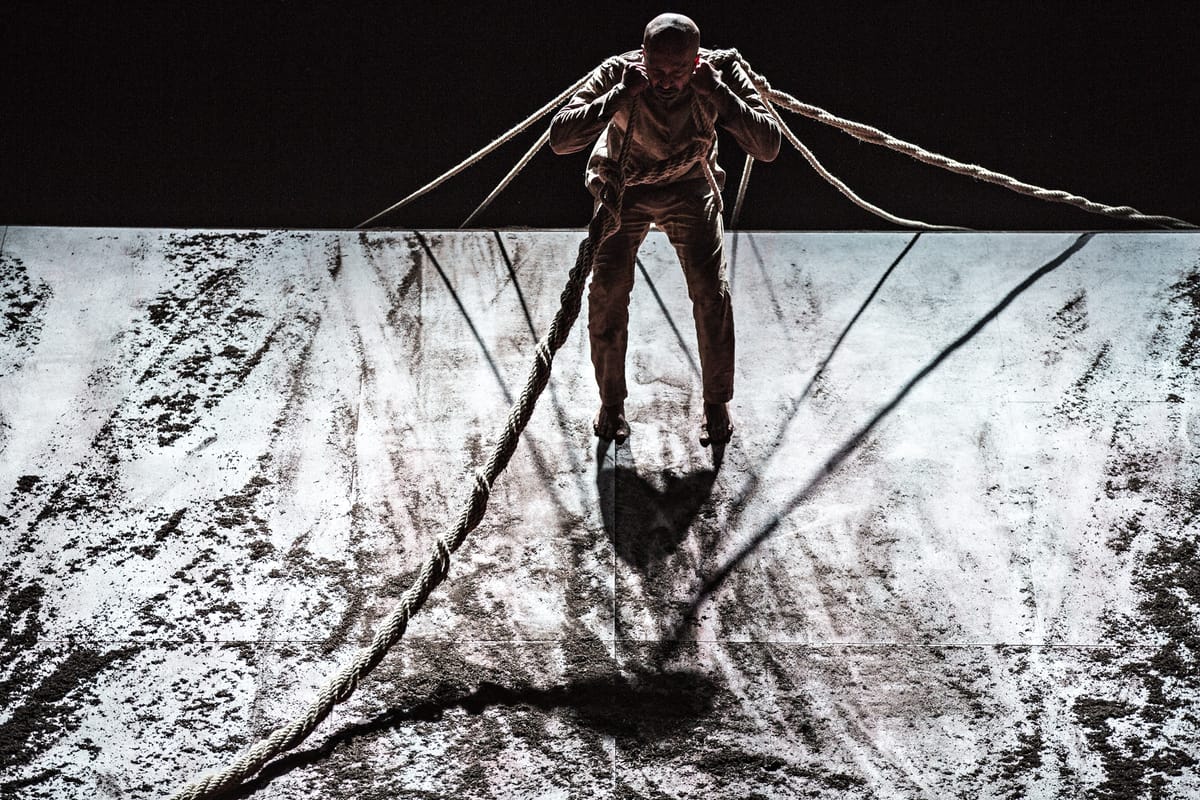
"Xenos"
Akram Khan Company
Zellerbach Hall, Cal Performances
Berkeley, CA
March 2, 2019
When last Saturday night the stage went dark at the end of Akram Khan’s “Xenos,” nobody moved in the near-capacity audience of the 2,600-seat Zellerbach Hall. The silence was deafening. Finally, a small, dirt-covered figure walked downstage, and the hall exploded. “Xenos” supposedly, is Khan’s last solo performance. With his first-rate collaborators he created a haunting meditation on what it means to be human in an inhuman world. A letter from an Indian soldier conscripted into World War I proved part of the inspiration for this very fine work. “This is not war,” the man had written, “It is the ending of the world.” The sentence resonates throughout “Xenos.”
And yet the two-act piece started so gently. Seated in front of a colorful tapestry and simple furniture, including a row of chairs, BC Manjunath and Aditya Prakash Kathak’s vocalizations and percussive rhythms welcomed the audience. Khan enters, dragging a huge heavy rope behind him. Oddly, it withdraws on its own. His solo, so wondrously responsive to the music, belies the fact that, apparently, his body tells him that solos are no longer possible. He is exquisite with firm footwork, whipping turns that slow and speed up at will, and arms that rise like flames and spread like ocean waves. Idyllic as this is to watch, you can’t miss rumblings that interfere with the dance: ominous sounds, gunshots, lights that flicker and move, dark clouds rising on the horizon. So fast that you have barely time catch it, the scenery is whipped away as if by a tornado, and we are left with some dead dry earth and a sloping wall. (Scenery is by Mirella Weingarten, Lighting Design by Michael Hulls.
The second part of this sixty-five minute, astoundingly conceived and magnificent one-man teatrum mundi sent Khan’s Everyman soldier clambering the walls of this trench, falling to “gun shots,” wreathing and twitching in pain. More often than not his body looks torn apart. But also, in all this pain and desperation, he still attempts to hang on to something of his essential identity. He sends Kathak arms spiraling upwards and out, yet steps fail him when the wall starts to crumble. The rope wound around his head becomes a sepoy’s headdress, and the removed ankle bells a munitions belt around his chest.
But to Khan “Xenos” (outsider, stranger) also recalls the titan Prometheus, who enraged Zeus for having created man. Zeus never forgave him. Stretched against the trench you can almost see the eagle coming for Prometheus’s nightly mutilations. Yet even in the hell of war Khan tries to shape humans out of the crumbling earth.
Khan is stunning as a performer but he also has about as good a musical score from Vincenzo Lamagna as he could want. It includes electronics and live music, mixing original material with what sounded at least once like a folksong. The chorus from Mozart’s ‘Lacrimosa’ floats in only to be torn apart by the sounds of war. A lovely image, the five musicians seem to float above the ramparts. An emblem of art defeating hate? I wish it could be so.
War is always horrendous, but rarely has there been one as stupid and senseless, inflamed by personal and national egos, as World War I. Khan’s wanting, perhaps, to inject a sense of hope, painfully tries to climb up that wall of destruction at the end. Yet still the dead kept falling. It was an odd decision, perhaps an attempt to give the audience something akin to hope to take home. What preceded suggested this was an act of futility.
copyright © Rita Felciano 2019