A Mixed Bill in Every Way
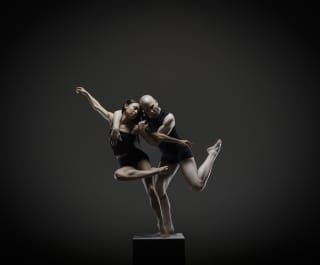
"Stabat Mater" "Mad Brass"
Garrett + Moulton Productions
Yerba Buena Center for the Arts
San Francisco, CA
September 6, 2018
Using less experienced dancers as a backdrop to soloists can boast of a long tradition in Ballet. But when Janice Garrett and Charles Moulton, each after long independent careers in contemporary dance, decided to bring a "movement choir" of not-yet professional dancers to their co-choreographies, they stepped into unknown territory. Former tapper, theater director and Merce Cunningham dancer Moulton was best known for the intricacies of his Ball Passing projects; Garrett for richly textured and musically responsive choreography. Between them they have created works both haunting and hilarious. In their most recent premieres, the Janus-faced double bill of “Stabat Mater” and “Mad Brass”, they offered both. One looked at suffering and longing for a reprieve; the other celebrated individuality and light-hearted togetherness.
Both pieces showcased the five soloists (Carolina Czechowska, newcomer Gretchen LaWall, Nol Simonse, Haiou Wang and Miche Wong) at their most intense and nuanced. The individuality of these dancers and yet the ensemble's cohesion continues to impress. The eighteen-member movement choir valiantly stepped into disciplined but never rigid patterns. Yet for the first time I felt that the two formal components at times did not always coalesce to enhance expressivity. Too often moving the podiums to rearrange the groupings disrupted the flow; a couple of times the choir’s busy, intricate unions also interfered with the clarity of the fore-grounded soloists.
Pergolesi’s exquisite “Stabat Mater” is based on a medieval poem that contemplates and empathizes with Jesus’ mother Mary, her life and suffering as she stands under the cross. It’s a work that is more meditative than dramatic despite a bow towards the operatic. Yet the (uncredited) recording that the choreographers used sounded oddly dry. Fortunately, it didn’t keep everyone from giving full-bodied, detailed and crystalline performances.
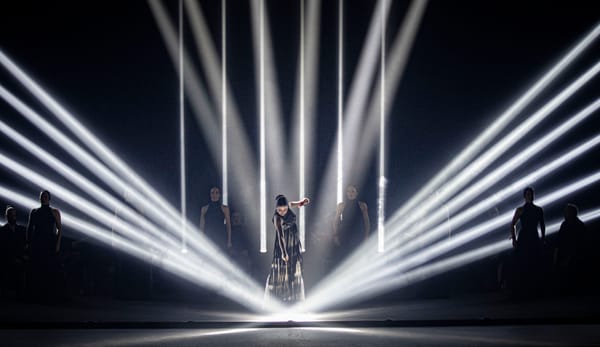
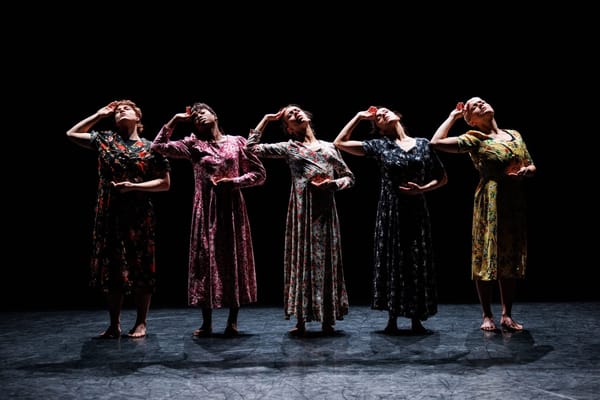
The choreography went beyond the specificity of the Palestrina and suggested a probably universal longing for something beyond. The choir and the soloists beautifully collaborated, starting with the dancers shooting up like rockets out of the larger unit and subsequently being absorbed into it again and again. Arms stretched to the periphery and towards the light, torsos twisted and contracted as cupped hands turned into broken wrists and lifts soared and crumbled. Czechowska flew across the stage like an arrow while Simonse despaired over limbs that seemed to have lost their function. The most explicitly iconic image came from a corner in which a small group, Deposition-like, raised and supported the arching Czechowska and LaWall. Still for all its power, at forty minutes the choreography pushed its limits.
After intermission Fanfare Ciocárlia’s infectious beats raised the temperature on stage by multiple degrees. It also did what an old theater adage says: send them home happy. No wonder, the two choreographers were taken with these Romanians’ ideas of a good time. The music was assertove, shrill yet often rhythmically intricate. Above all, it was fun to tap your foot to. Eventually however, it did not support the extended attention that “Mad Brass” promised. Placards with a various messages suggested perhaps different trajectories. Some of the humor of this traveling circus was too easy even though the dancers shone as somewhat individualized characters.
Most refreshing was the movement choir’s tightly bunched partner dancing, much enhanced by Julienne Weston’s uniformly blue garments. The performers called up a rollicking sea of humanity. As for the company dancers, Wang and Wong pulled into different directions; one wanted soar, the other to slump. LaWall, as a would-be vamp in skintight red, trembled with excitement at what might happen; she added dramatic flair to her impressive dancing. Yet she failed at seducing a self-absorbed twitchy Wang who usually sails through the air like no one else. Simonse’s sad clown seemed tailor-made for this fine veteran of the company. But other sections, such as a belly-rubbing exchange failed to communicate with me. On any level.
copyright © Rita Felciano 2018