A Mermaid from Korea
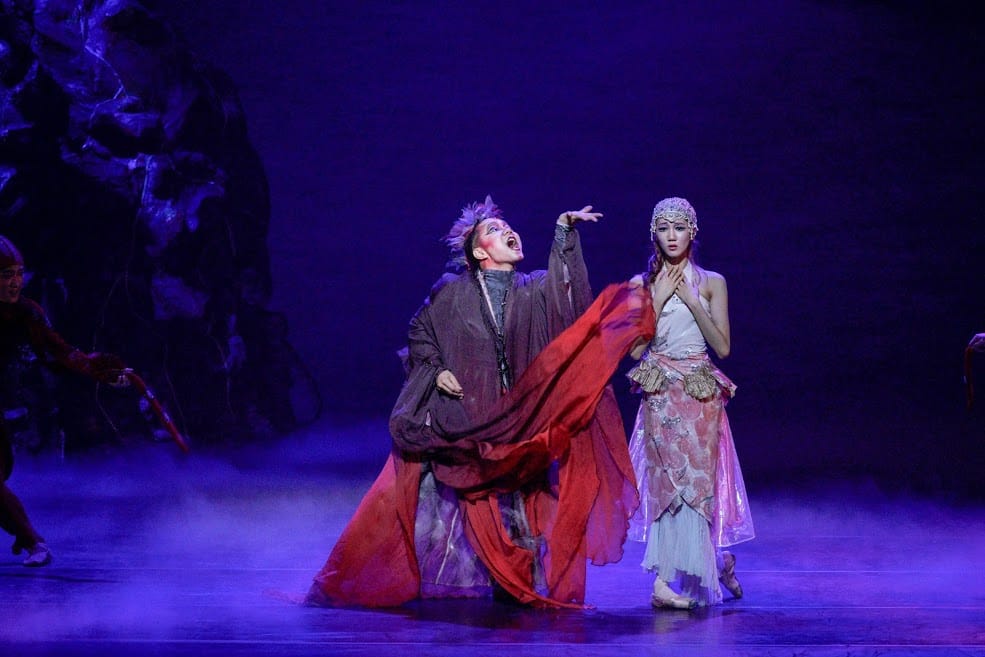
Song of the Mermaid
K'Arts Dance Company
New York City Center
New York, NY
October 20, 2018 evening
"Song of the Mermaid", choreographed by Sunhee Kim, has as its source Hans Christian Andersen's "The Little Mermaid". The Mermaid, the youngest of six daughters of the King of the Sea, falls in love with the prince she has saved from drowning. To act on her love, she seeks help from a Blanket Octopus who covets her father's throne. Her wish is granted. In exchange for her voice (here the ability to play a coral pan pipe) she will grow legs making her look human. The bargain is struck with the understanding that failing to win the prince's love will be fatal.The Mermaid cannot know that her nemesis has stacked the deck. Just as her dream is about to come true, the Blanket Octopus marries her prince off to a princess from a neighboring land. Her sacrifice was for naught.
The ballet had two things going for it: its first scene and its villain. It opens with gray, angry looking waves projected on a scrim, perfect conditions for a shipwreck. The kingdom under the sea, however, is full of light and color and life: red fish, blue fish, starfish, shrimp, crabs, overflowing with marine life, all of it dancing. That transition, and the beginning of the scene had me hooked, a tribute to the power of theatrical illusion and the power of sets and costumes. Perhaps it was over the top, and awash in sequins. But it was another new and different world. The prince's ballroom in act two was arid and seemingly panelled in balsa wood. Perhaps the contrast was intentional, but shouldn't the prince have more to offer his future wife and more to lose had he died in that wreck?
The other ace is the role of the Blanket Octopus as danced by Hoiwoong Ryu. It melds the glee and spite of the Wicked Witch of the West with the acidic hauteur and the rage of Carabosse, the swagger of a general and the seductiveness of a vamp.Turning downstage under a deep red spot, his skirts parallel to the stage, this villain was almost immaterial, consumed both by flames and by rage and the more dangerous for it.
There should have been one more in Kimin Kim, imported from the Mariinsky to play the prince. He appeared first sprawled on stage, waterlogged and one step short of a corpse, then in a painting unearthed by the Mermaid. Only in act two was he vertical and breathing. Kim is a real danseur noble with long limbs and a gorgeous line as well as a sympathetic partner, but he looked cramped here and reined in. What an unfortunate waste of a marquee name. Soobin Lee, his Mermaid, has beautiful legs and yearned on cue, but had a slightly hard edge. Many of the dancers have won competitions -- they're listed next to each headshot. Their dancing is clean and clear but doesn't radiate much inner drive or curiosity.
As the evening went on, pacing also proved to be a problem. Much as I enjoyed the first scene, it did not need to go on for twenty minutes. The same held true for the corps' divertissements with which the second act began. Sunhee Kim was inspired by all the right sources ("Raymonda", "Sleeping Beauty" acts two and three, "La Bayadère", "Swan Lake") but didn't penetrate what makes them tick. Far too much of both acts felt like filler with the plot in act two almost an afterthought to be dispensed with as quickly as possible. But the moment that divorced the story from all logic, even fairy tale logic, was when the Mermaid in her own home, executed arabesques on pointe across the stage. She already had legs, so what was her bargain for?
copyright © 2018 by Carol Pardo