Winter Season
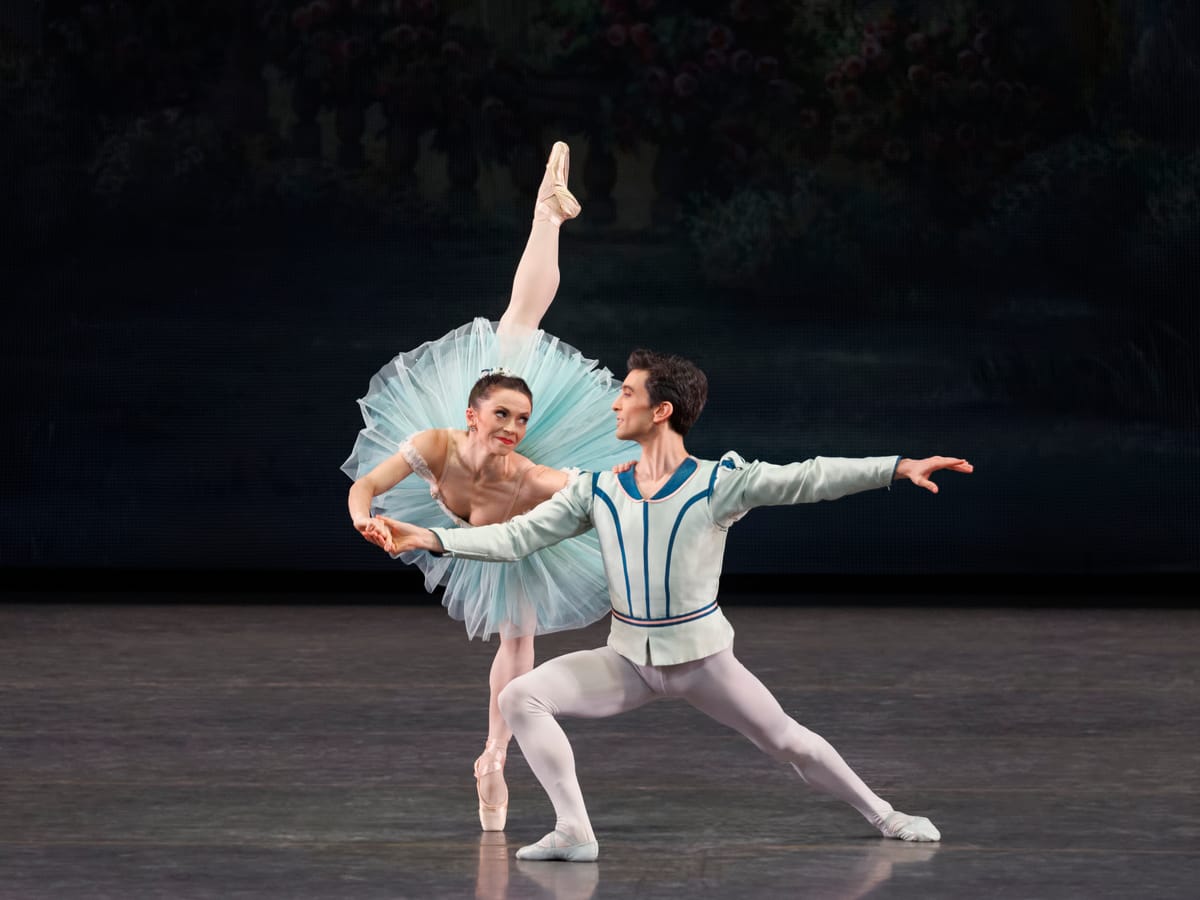
Winter Season
New York City Ballet
David H. Koch Theater
New York, NY
Balanchine, Robbins, Peck and Ratmansky in Repertory
January 21, 24, 29 and February 1, 5, 12, 18 and 27, 2026
Originally established at City Center in 1955, seven years after the company’s founding, Winter Season is a special time, the heart of New York City Ballet’s year. The long nights are good for the theater and as it is for nature itself, this is a time for the company to return to its roots. The season just ended continued that tradition with the company’s characteristic mix of the new choreography and historic repertory.
Forty-one performances, extending over six weeks, hit their high points but also illustrated the paradox of NYCB continuing to dance newly commissioned work more successfully than it does Balanchine and Robbins. “The Naked King,” a new ballet by Alexei Ratmansky, and another work by Justin Peck entitled “The Wind Up” were highlights. A thirteen-performance run of Peter Martins workhorse production of “Sleeping Beauty” featured strong performances by a number of young principal dancers. The company nailed a couple of its Balanchine ballets, “Kammermusik No. 2” and “Raymonda Variations,” which both looked better than they have in years and featured Megan Fairchild, retiring in the Spring, anticipating nostalgia and saying goodbye to “Raymonda” in a most expansive performance.
More negative, however, were the spottiness and inconsistency of classical technique, training and even in some cases physical conditioning displayed elsewhere in Balanchine and Robbins. Besides “Sleeping Beauty” and the two new ballets named above, twenty-one programs remained, heavily weighted towards these choreographers, and precisely here the deficits were felt. While a more casual audience does not generally seem to notice – the reception to shows in the theater has been if anything even more enthusiastic since the end of the Covid hiatus – the trend bears examination.
But first, consider the two ballets where the dancers looked most alive.
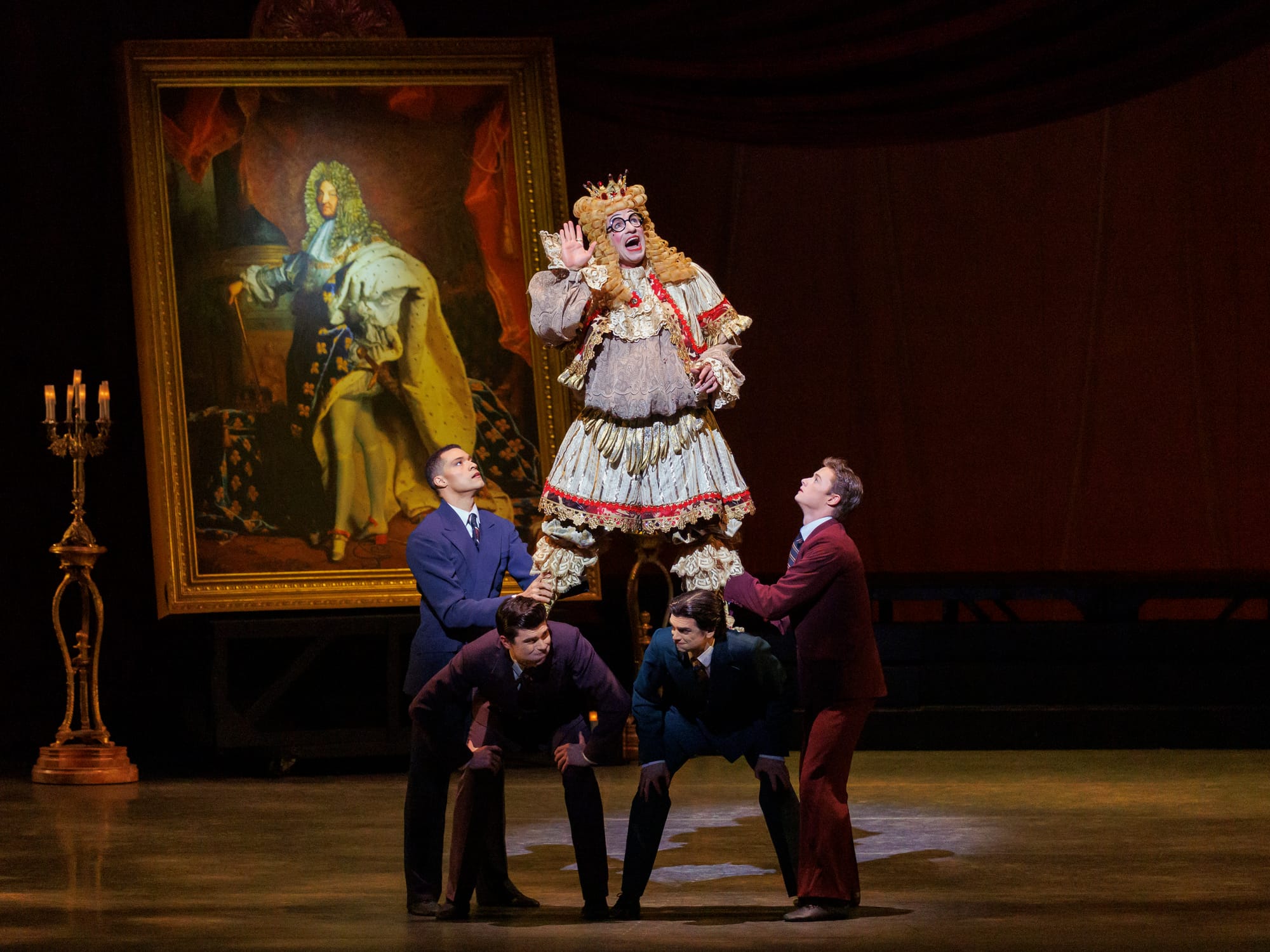
Ratmansky’s “The Naked King,” is based on Hans Christian Andersen’s story “The Emperor’s New Clothes.” In a contemporary twist, the satire of a tyrant so flattered that even when he’s naked his courtiers praise his clothes, becomes a metaphor for the age of Donald Trump. Ratmansky makes the emperor an obese “King” coiffed by an orange wig, displays him in a naked fat suit, replete with a prehensile penis, and pairs him with a garish wife who wears sunglasses indoors, Melania-style, throughout. But aside from having made immense physical fun of him, the ballet is actually good-natured, comic and not dark.
Three wackily dressed swindlers convince him to buy the clothes; his unfaithful wife dances a series of burlesque duets with her Lover, and this all takes place in a court of six buffoons called the King’s Entourage surrounded by a corps de ballet of 12 exuberant Townspeople. The King is swindled, the Queen and her Lover dance their duets, the Entourage and Townspeople have wonderful group entrances, until in the end a young boy enters loudly declaiming, “The king is naked.”
Santo Loquasto’s inventive costumes dressed everyone in a motley mix of zany flea market retro apparel, wigs and hats, hilariously comic but also wonderfully flattering. Grace Scheffel in cowboy hat won’t soon be forgotten. The King, danced on opening night by retired NYCB principal Andrew Veyette, is entirely a mime role and played deadpan to perfection. In Ratmansky’s telling, the King – besides being a fool – is an otherwise innocent and entirely stupid character, stupidly gulled and not malicious.
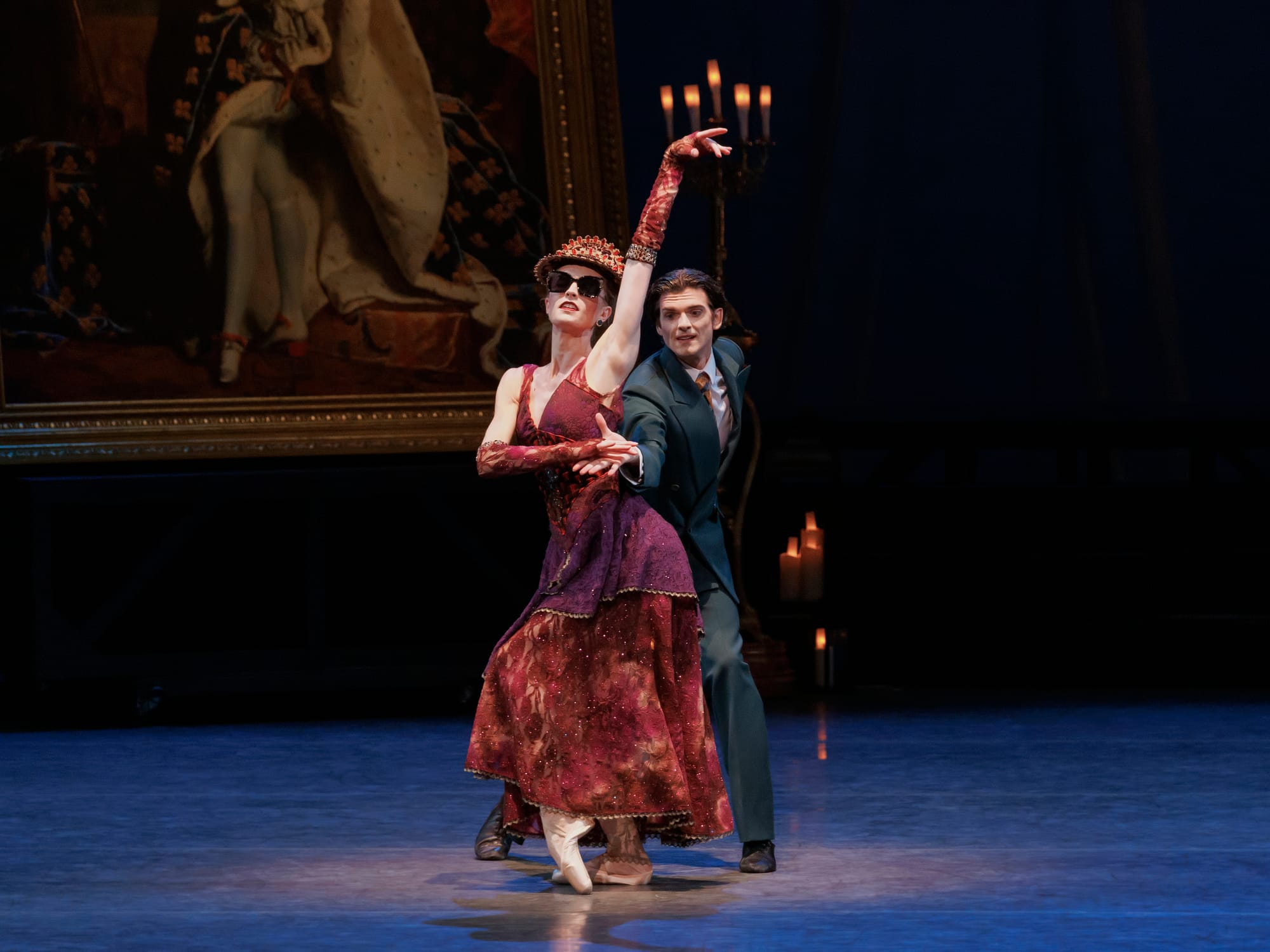
The curious thing about the ballet is how implicitly the redemptive quality of comedy and of ‘La Danse” become the theme here. Ratmansky, with his Soviet Russian upbringing and Bolshoi training and association, is strongly grounded in character and national dance, and these wellsprings provide the flow. The duets between Miriam Miller, glorious as the Queen and Peter Walker, superb as her lover, were the main narrative elements apart from the brief mime of the King being swindled. Several irresistibly rhythmic group dances for the Entourage and Townspeople then drove the action with exuberant energy.
The score – “Le Roi Nu” by Jean Françaix – is a 1940’s Paris Opera commission for the original ballet staged by Serge Lifar that provided a strong rhythmic base for the group dancing, where the ensemble stole the show. You would need to name everyone in the cast to do them justice. That said, memories stick of Meaghan Dutton-O’Hara and Owen Flacke, Ruby Lister and Preston Chamblee, Mary Elizabeth Sell and Jules Mabie among the Entourage; David Gabriel, KJ Takahashi and Daniel Ulbricht as the Swindlers; and Lauren Collett, Scheffel, Devin Alberta and Mckenzie Soares among the Townspeople.
In contrast to the 25 dancers in this cast, the Winter’s other premiere – Justin Peck’s “The Wind-Up” – employed three couples in an all soloist ballet that might have seemed a more modest effort. But in no way was this so. With the opening of a grandiose Beethoven symphony for a score (the first movement of “Eroica,” No. 3 in E-flat Major, Op. 55) and Tiler Peck with Roman Mejia, Mira Nadon with Chun Wai Chan, and the very young Mia Williams with Daniel Ulbricht as the couples, the work was highly ambitious and played at the equivalent of balletic full volume. The cast was highly-powered, dramatic and performative and the choreography used the music’s galloping background of repeated crescendos as a platform for an impressive series of duets, individual entrances and groups.
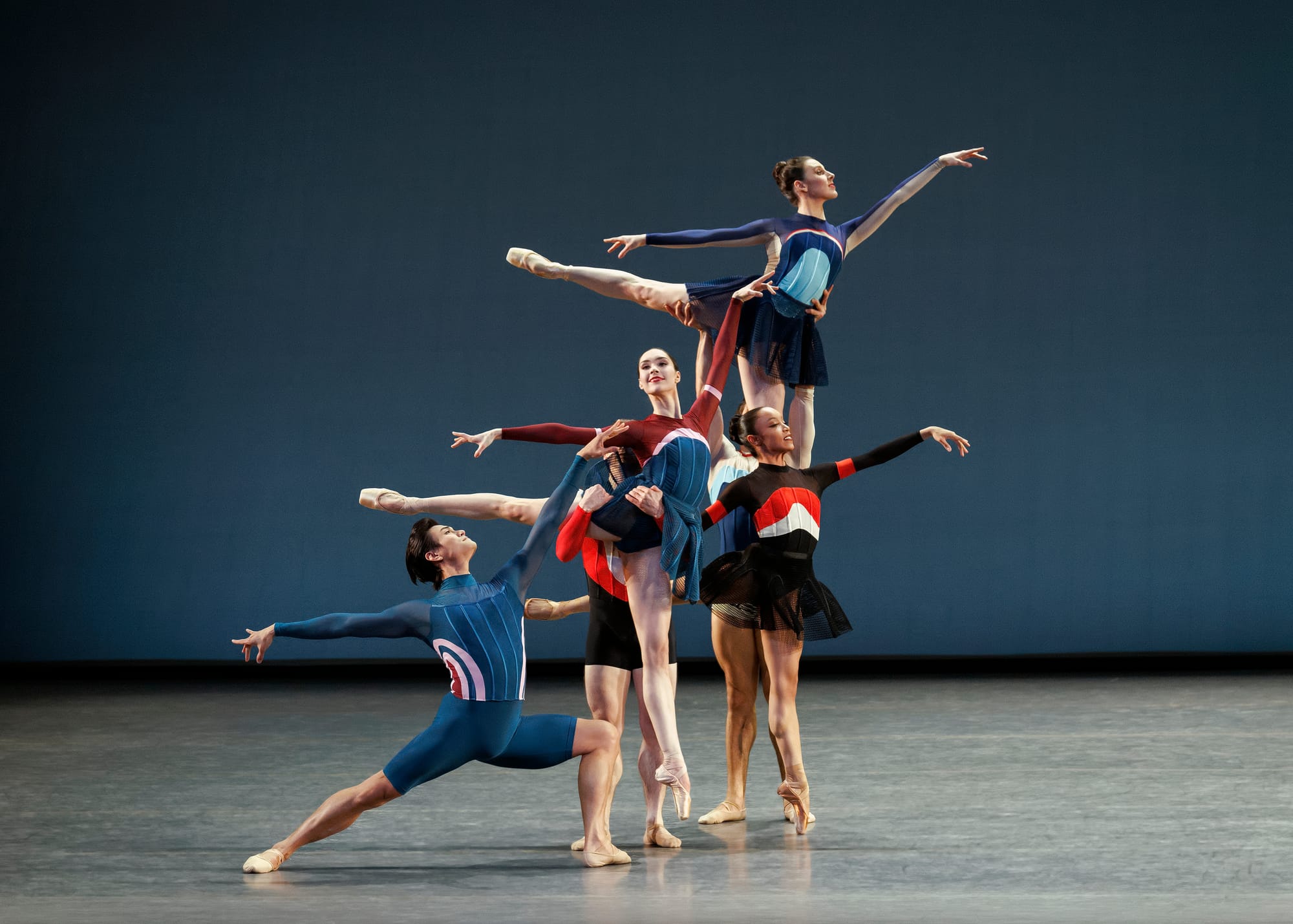
A repeated sequence had the entire cast deploy in a simultaneous pose that displayed Nadon in a flattering arabesque allongé that turned her out brilliantly across her torso, showing off her magnificent long limbs and radiant expression, looking straight into the audience, while at the top of the group Mejia held Peck in a press lift. This use of lifted dancers against a posed group on the floor recalled Peck’s work for Broadway, particularly his “Blow High, Blow Low” ensemble of men in “Carousel.” Like Christopher Wheeldon at a similar point in his career, Peck has discovered how to make his dancers look their individual best while covering up what’s hard for them. Here, for example, compensating for Nadon’s occasional lack of turnout by repeatedly having her held in a beautifully outward rotated pose.
The costumes by Reid Barteleme and Harriet Jung were of strong primary colors; Brandon Stirling Baker’s lighting was even and bright, the music of course stirring and the dancers beautiful. What wasn’t to like? While one can’t accuse the ballet of too much depth, it was brilliant as far as it went, highly polished and the best thing Peck has done for the company in some time. He often succeeds best with ballets to classical pop music, here Beethoven, and in his last big company success, Aaron Copland. A strong emotional content animated the duets of this ballet, particularly those between Peck with Mejia and Nadon with Chun. Notable here was how this content has become fuller and more interesting.
Tiler Peck also starred among the principal dancers in “Sleeping Beauty” during its two-week run towards the end of the season. Nadon and Peter Walker made important debuts in one of the five other alternative casts. Both couples gave compelling performances.
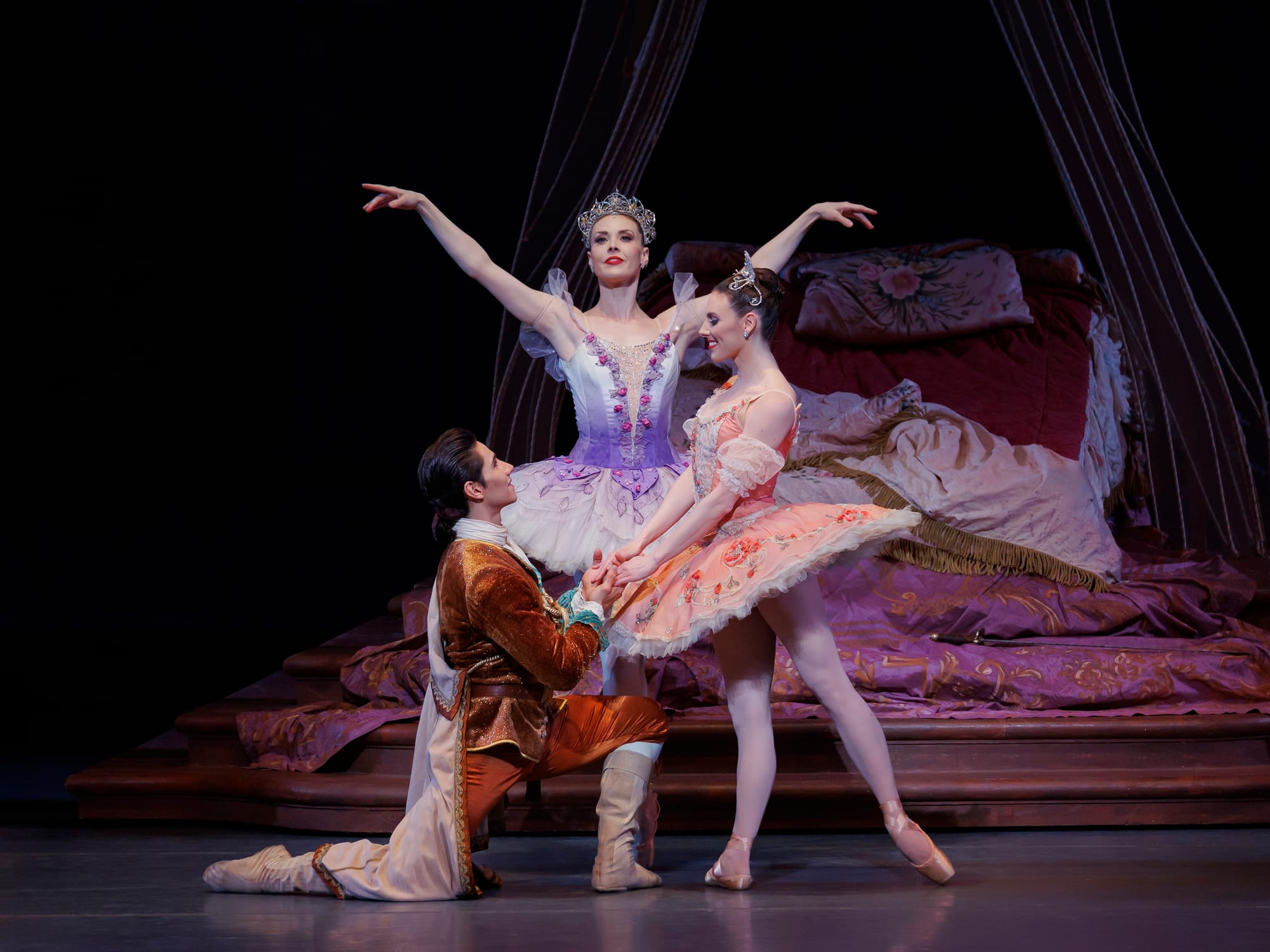
Married last summer, Peck and Mejia’s emotional and dance rapport made them naturals as Princess Aurora and Prince Désiré, notwithstanding how the roles push their physical types to the limit. Mejia is not tall enough to be a traditional prince while Peck has the physique of a jazz dancer rather than a classical ballerina, though she has lengthened her line as her career has progressed. Nonetheless, Mejia is compelling on stage for his personal beauty, warm and human expression and powerful technique, while Peck is among the most coordinated and rhythmically musical dancers ever, besides being as intelligent (if not the most intelligent) a performer you will see in knowing how to make a role work for herself by utilizing her talents and masking any limitations. She has an uncanny sense of figuring out how she needs to do things and here, while her Rose Adagio was perhaps too carefully thought out, once Mejia joined her for the Vision, the performance elevated beyond the usual.
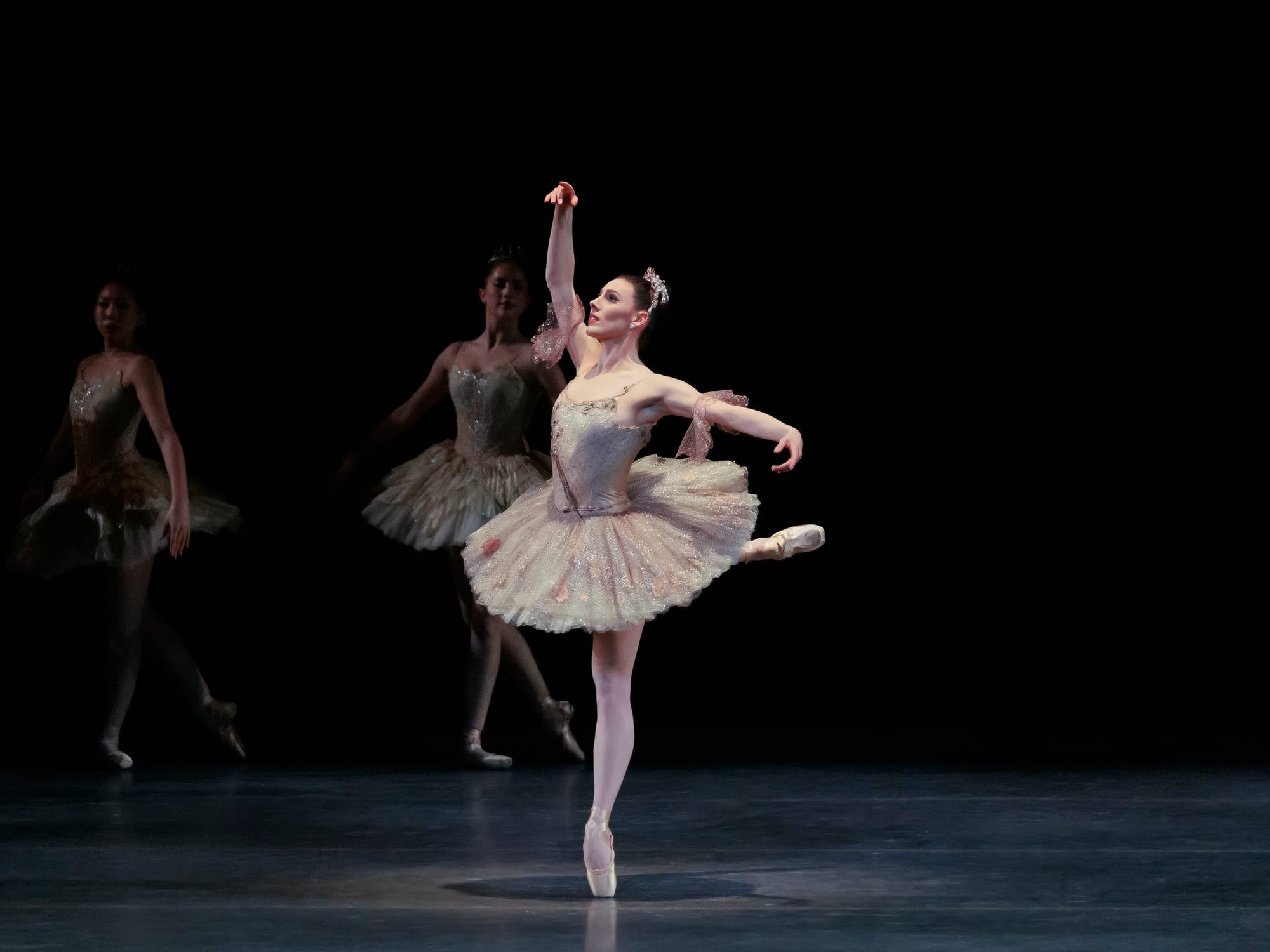
Emerging from a particularly well cast group of corps women as nymphs (and this was one place in the repertory where the women’s corps was well-chosen and beautiful), Peck’s mien was somber with muted grace and formality as her spirit waited to be set free. Melancholy at first and then eager as Emilie Gerrity’s lovely and warm Lilac Fairy presented him with Peck’s vision, Mejia responded with quiet emotion until the scene attained a sense of mythical grandeur.
The wedding duet in act two was then elevated as the couple’s real life love seemed to lend it a radiant feeling, with this impression surfing on the waves Tchaikovsky’s grand score. Knowing, as you do, that they are married off stage, you can’t help noticing how they adore each other. Yet one fancies that even if we didn’t know this, the impression would be the same, which also helped make up for some very spotty company dancing amongst various of the fairies in act one and performers in the wedding divertissement, as well as a ragged Garland Dance, about which more below.
If Peck and Mejia’s life off the stage strongly informed their performances, Nadon and Peter Walker’s debuts had a dramatic mystery at the other end of the spectrum.
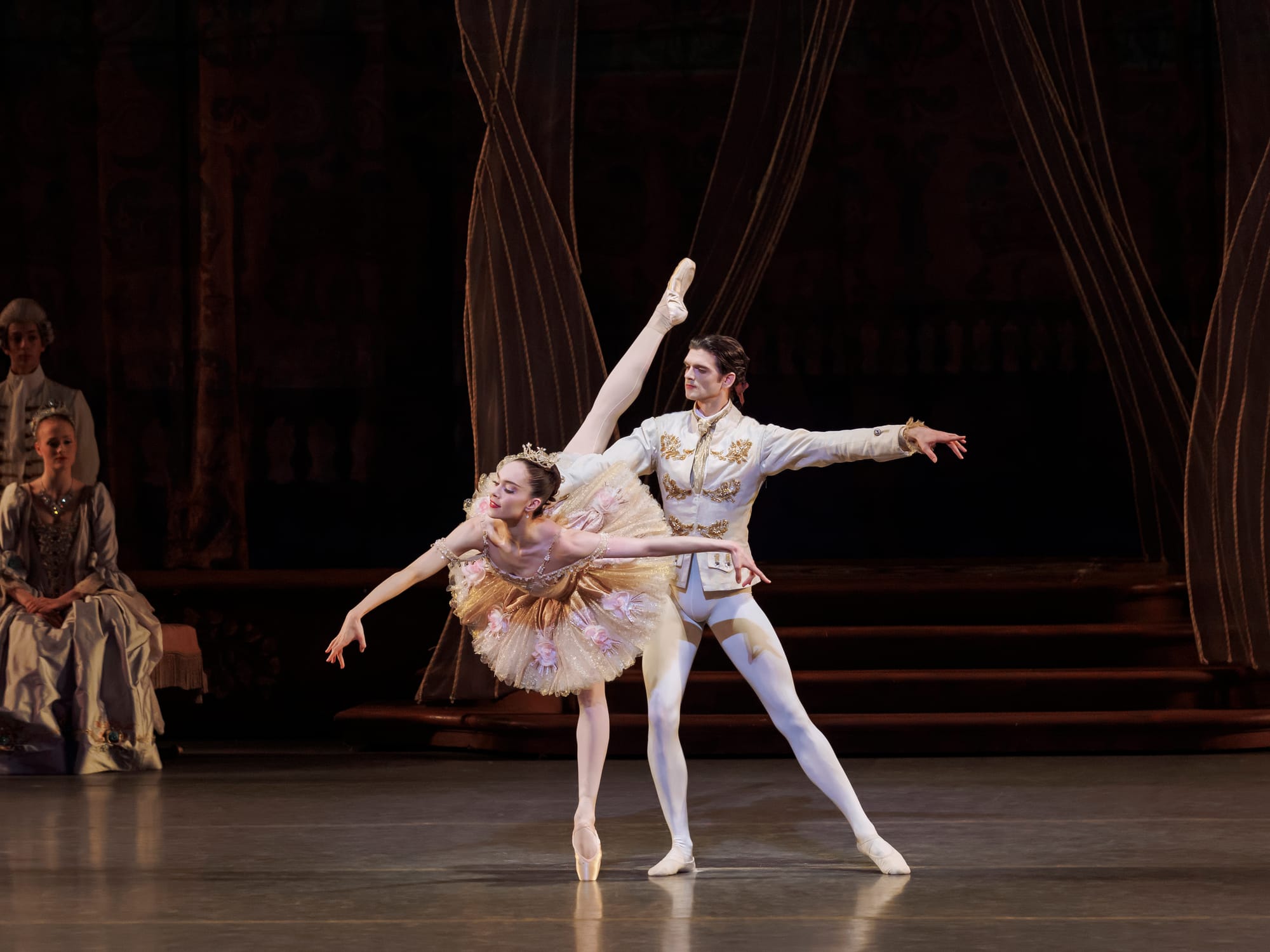
When first seeing the casting, I thought Nadon too tall for the role and wondered whether she wouldn’t have been more natural as the Lilac Fairy. Yet when Martins created the ballet, Kyra Nichols, at least as tall as Nadon, danced Aurora on the second night after being Lilac to Margaret Tracy’s Aurora in the opening, and Nadon’s casting here proved completely natural. Dancing with complete control of her long limbs and in particular using her back very powerfully to center and organize her movement, she gave one of the most commanding performances of her career. Everything she did was harmonious with movement organized from the core of her physique coming effortlessly from the inside out. The visual lines were magnificent as the repeated arabesques on pointe carried the motion through her back and into her working leg.
Her character’s progression from adolescence, to enchanted sleep and then to awakening, fulfilled love and marriage, were also well acted. Nadon has sometimes seemed distant in Balanchine. But both here and in Swan Lake last year she appeared to fully understand the imaginative content of her ballets, and gave unforgettable performances.
Dancing with her brings out the best in Walker, who had also been her Prince in “Swan Lake.” Partnering Nadon attentively and dancing his solos with an effortless strength that seemed new to him, his dance acting was also superb.
Throughout the two weeks the company danced “Beauty” the principal dancing continued by all accounts to be top notch, with the other casts including retiring principal Megan Fairchild (in her farewell to the ballet) alongside Anthony Huxley on one end, and the newest principal, Emma von Enck with David Gabriel on the other, and with the further couples being Isabelle LaFreniere with Ryan Tomash and Indiana Woodward with Chun Wai Chan. The company could be proud of its leading dancers in this ballet. The Lilac Fairy was in general strongly danced as was Carabosse.
That being said, when you progressed down the cast to the Fairy variations and also the solos and polonaise in act two, standards of performance lessened. This was also true of the deportment of the courtiers in the opening scene. While Martins’ “Beauty” always took a brisk approach to telling the story, it also aspired to a narrative grandeur, with more elaborate costumes and sets than were usual in 1991, as well as using a set of video projections to set a Baroque castle and landscape scene. The dramatic effect now, however, tips the impression from grandeur to comic book, and often to that of a high school play.
In act one, the King and Queen slouched around, dancers portraying courtiers sat in their hips, didn’t pull up in their torsos or lengthen their legs and point their feet, or much less walk like nobility or even like classical dancers. The company as a whole also appears to have expanded its parameters as to body types, height and build, to the point where in many ensembles it hardly looked like a “company.” Even in the late Martins era you always saw what artistic direction was looking for and a certain visual order prevailed. Today, watching something like the Garland Dance, the ensemble was visually incoherent to a much greater degree and in execution didn’t seem to know the blocking at times, as formations tentatively got in each other’s way. The group of male students from SAB who filled out the forces here (as well as in the polonaise at the wedding) was particularly egregious. While the principal dancing throughout the production was of the highest standards, the corps de ballet in its mass scenes did not look like a major international ballet company.
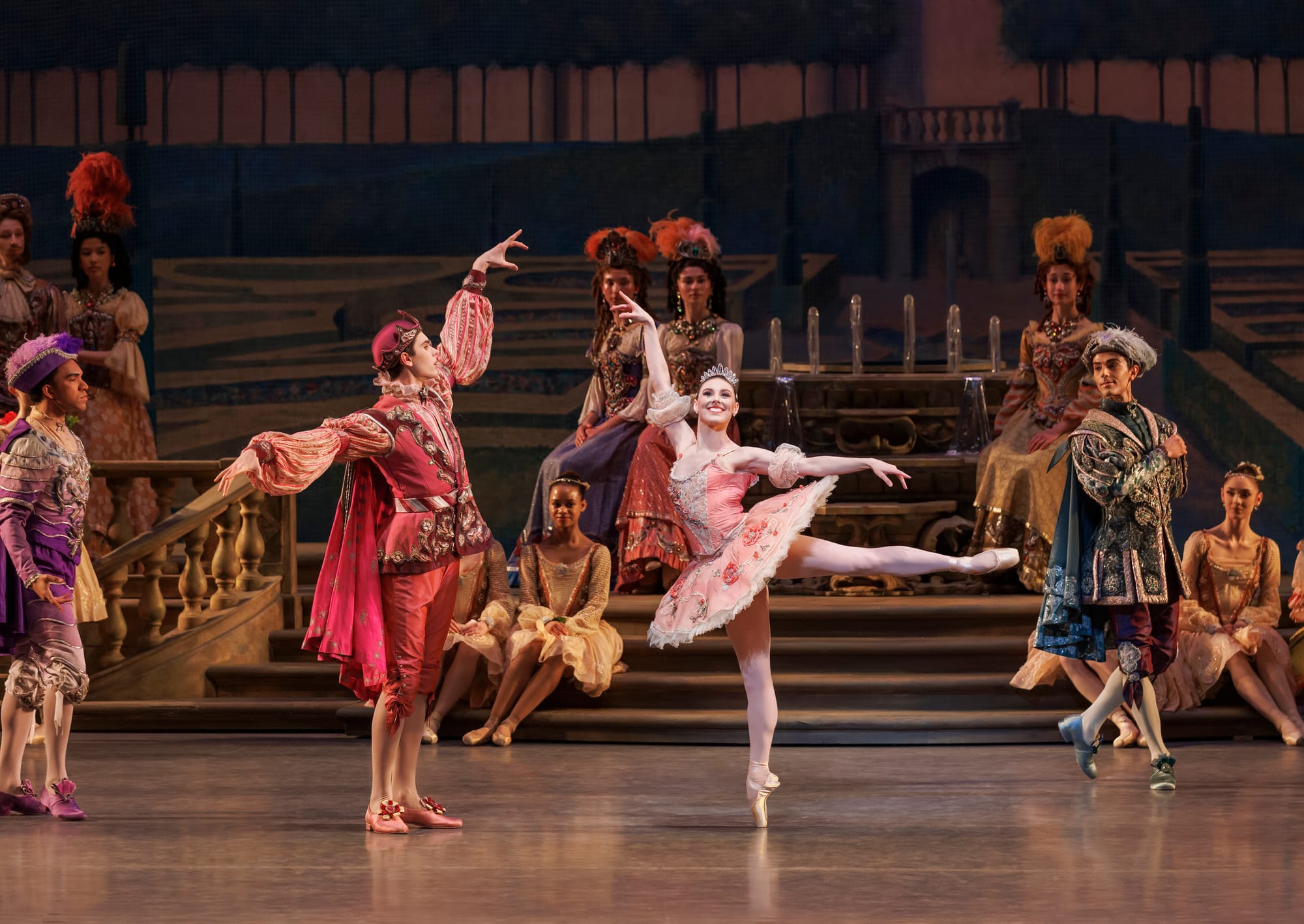
And ragged as these group scenes were, the impression carried over into the casting and performance of the act one variations and second act divertissement.
Time was NYCB had a hierarchy that included a de facto “senior corps de ballet.” Dancers had generally to be seasoned for a few years before being trusted with major solos. There were, of course, exceptions. One of the prerogatives of direction is to identify and push rising performers. But a general casting policy insured that more experienced performers danced harder parts. This was a thing of the past this winter when a veritable gaggle of the youngest company members, including dancers who were apprentices barely three months ago, jumped into major solos in “Beauty” as well as “Raymonda Variations.” As this was also the first full season after the retirement of Rosemary Dunleavy, long time head balletmaster at NYCB, you had to wonder if it wasn’t a chaotic succession.
Be that as it may, “Beauty” saw fairies who didn’t seem to know the choreography, certainly not well enough to make it musical, taller women dancing Jewel variations that required smaller demi-caractère performers, soloists in “Raymonda” who couldn’t execute basic elements of the choreography (such as hops on pointe that didn’t leave the floor) or in “Dances at a Gathering” a very promising young woman who is difficult to lift cast in a role that required her to be thrown across the stage and caught. This shotgun approach yielded occasional positive performances but in its totality gave the impression of a poorly trained ensemble.
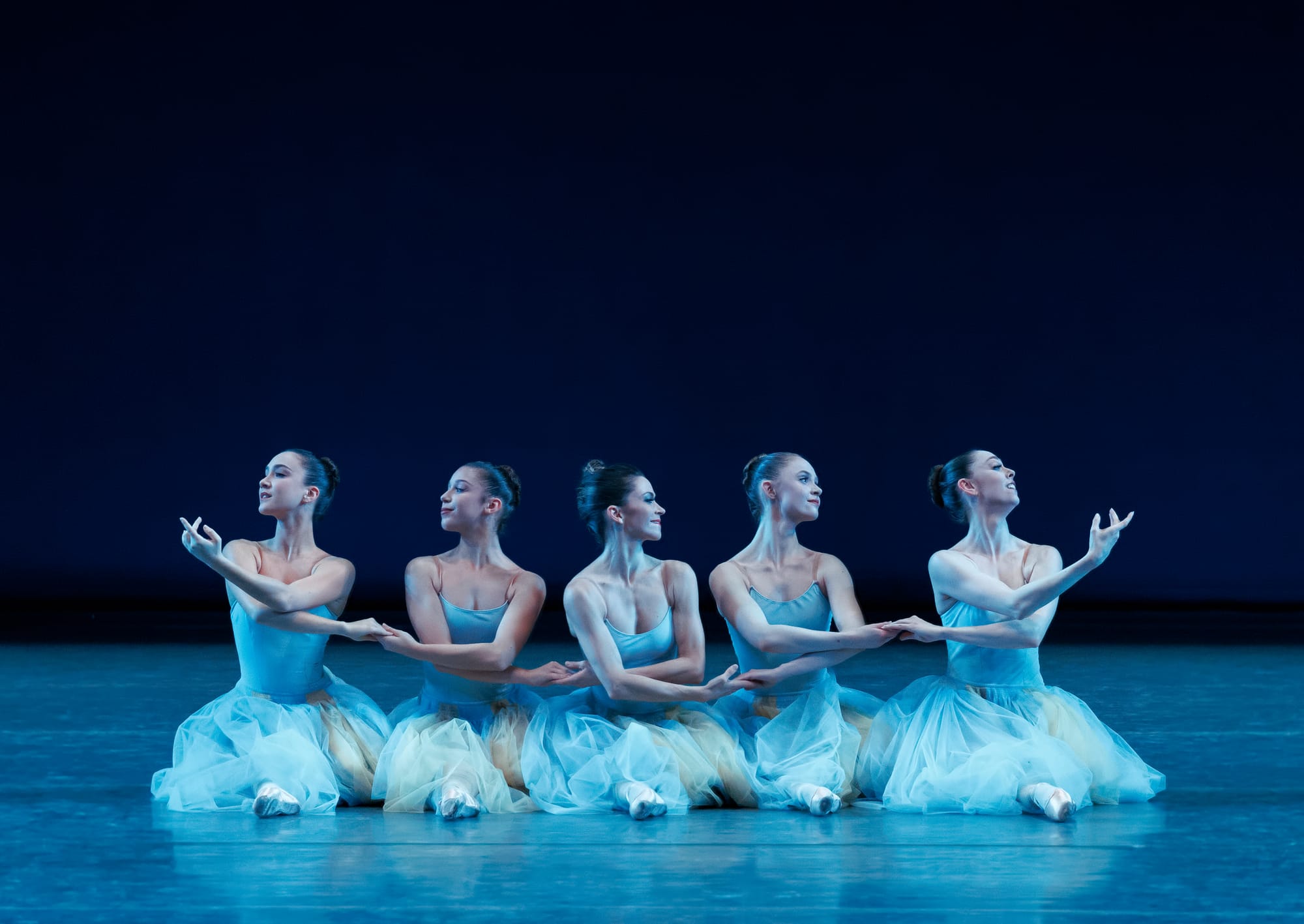
A lack of dramatic imagination among the rank and file in the Balanchine and Robbins repertory was a more particular issue. Balanchine works like “Serenade,” “Tombeau de Couperin,” and “Diamonds,” or Robbins’ ballets like “Opus19/The Dreamer” and “Dances at a Gathering,” require a strong shared imagination among the dancers. The stage is an imaginary dramatic space that the dancers collectively share. In “Serenade,” for example, the corps de ballet lives in the same dramatic space as the principal dancers from the moment the curtain goes up – a collective imagination that even precedes the principals when the curtain rises. Being Balanchine, it’s also a dramatic space embodying the music. The corps in “Serenade” not only witnesses but participates in the action as fundamentally as the Greek Chorus in a classic tragedy.
Likewise, in the dream plot of “Opus19,” the twelve members of the corps de ballet appear at times to be creatures conjured up by, or at least responding to, the leading man’s reverie. The collective imagination of everyone on stage is crucial to such a ballet. But when the curtain rose in “Serenade,” the corps de ballet was slack, with little sense that the group strongly felt the elevated moral and emotional stakes of the opening chords, where the meaning of classicism in a contemporary world seems to be in play. They might have been milling around and taking spots in a rehearsal. But rehearsals especially need to be emotionally charged and therein may lie the problem.
Dancers relate that Dunleavy always gave a speech, when setting “Serenade,” about the magic the ballet creates and how it starts with the corps. Unfortunately, they weren’t getting that message here.
copyright © 2026 by Michael Popkin