Point and Counterpoint

"Suite en Blanc", "Flight Pattern"
The National Ballet of Canada
Four Seasons Centre for the Performing Arts
Toronto, Canada
February 27, 2026
The National Ballet of Canada opened their winter season with a mixed program of two works that could not be more different: Serge Lifar’s potpourri of classical bravura dancing “Suite en Blanc” and Crystal Pite’s somber commentary on the global refugee crisis “Flight Pattern.” Both works feature a large ensemble of 36 company dancers. The former provides ample opportunity to appreciate the depth of talent in the company from the corps de ballet to three new principal dancers who joined the NBoC for the 2025/2026 season: Beckanne Sisk and Chase O’Connell from Houston Ballet and Agnes Su from Stuttgart Ballet. The latter briefly highlights a few specific dancers, but as with Pite’s other works, the most impressive moments are the large ensemble sequences. Many dancers appeared in both works. It must be tremendously jarring to switch between such vastly different styles and movement vocabularies, not only on the evening of the performance but also during the rehearsal period. But if there was any whiplash from swapping pointe shoes for socks and upright pulled up posture for earthy, grounded gestures, the NBoC dancers handled it well.
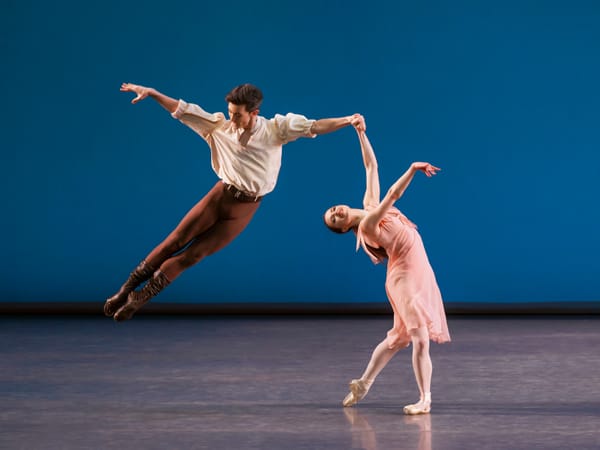
Lifar’s “Suite en Blanc” returned after it entered the NBoC repertoire two years ago. It is up there with “Études” and “Theme and Variations” as one of the most technically gruelling ballets that the company performs. Although it was created in 1943, its beauty and elegance are timeless. From the crisp white costumes to the unadorned set design, Lifar let the inherent harmony and logic of classical ballet technique speak for itself. Particularly as the 2025-2026 season is skewed in a contemporary direction, “Suite en Blanc” satisfies a craving for high quality classical ballet. Indeed, aside from “the Nutcracker”, the only tutus company members will don this season are the ones here. Including “Suite en Blanc” in the repertoire is also a test of where the company currently stands in their ability to pull off a large classical showpiece. There is no room for any weak links. A high technical standard is not merely something to be achieved, but also something that must be maintained and ballets like this help them do it.

Overall, the NBoC dancers rose admirably to the challenge. Despite a few bobbles here and there, they held it together. However, quite a few dancers had difficulty hiding the stress on their faces as they tackled Lifar’s unforgiving choreography. The tricky thing is that while Lifar uses some virtuoso steps like fouettés and grand jetés en tournant (steps that are hard and look hard), his choreography is also packed with steps that are far more difficult than they look. For instance, the average viewer may not know how much more difficult it is to execute a double pirouette from fifth position compared to from fourth. However, the audience will indeed notice the little hops and adjustments made on the landings. One male soloist consistently under-rotated every double tour en l’air by a quarter turn.
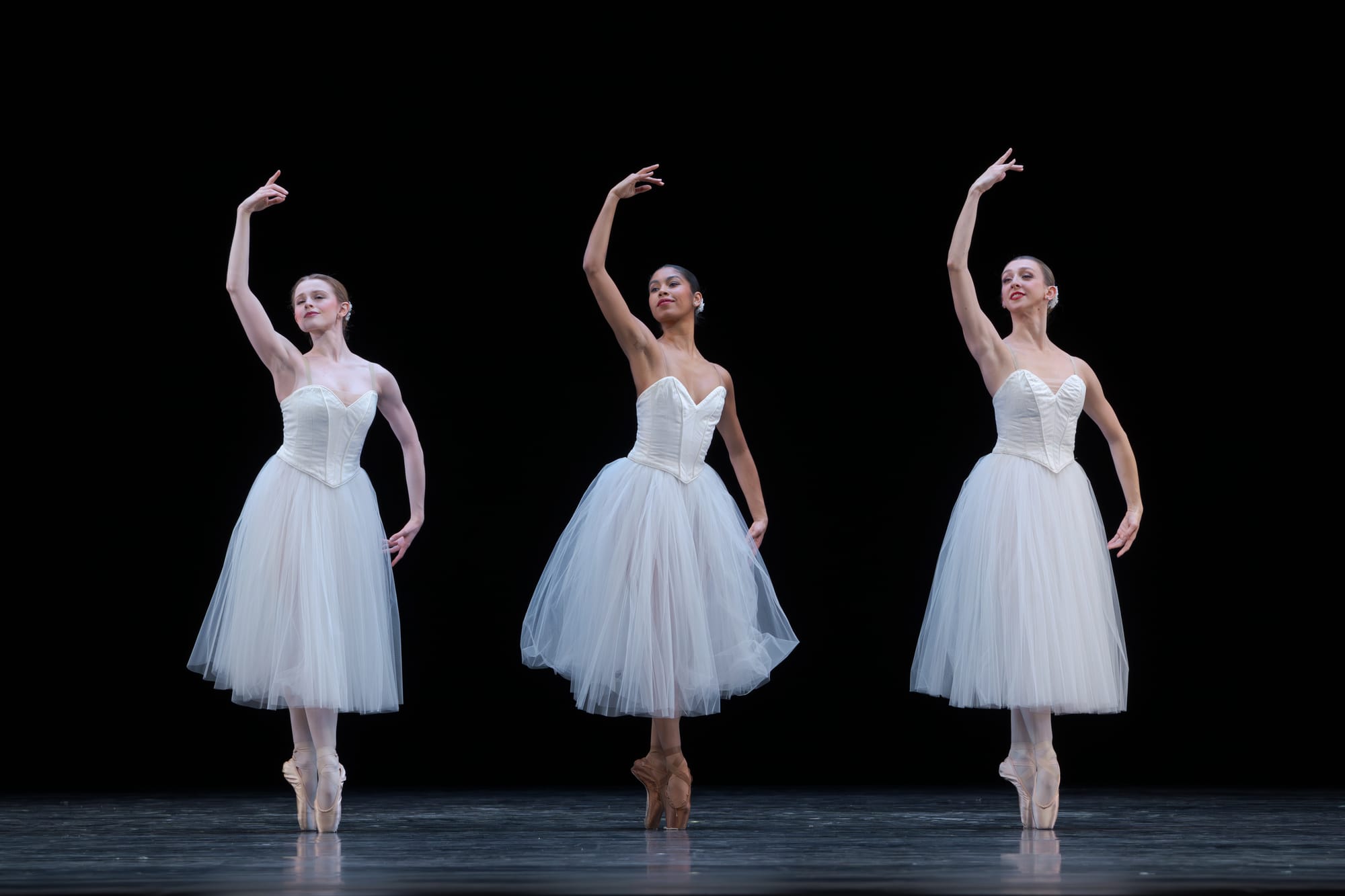
In the opening trio wearing long, romantic-style tutus Tene Ward stood out because she transmitted genuinely joy. She attacked the steps while maintaining expressive, soft port de bras and gentle épaulement. In Thème Varié, Sisk was a vision of steadiness and grace. She was totally on her leg, with unwavering balances, dizzying turns and luxurious extensions. She was accompanied by Peng-Fei Jiang and O’Connell who fared well with the incredibly fast jumps which do not allow much time for preparation. When Genevieve Penn Nabity entered for La Cigarette variation, the whole energy shifted because she was so self assured and at ease. Her secure technique gives her space and freedom to play with musicality, textures and intention. Instead of looking scared or stressed, she wore a cheeky expression as if telling the audience “watch me”. Naoya Ebe also nailed his “Mazurka” variation. His clean landings were just as impressive as his explosive jumps. Best of all, he timed his pirouettes (triples and quadruples at times) to match the accents of the music. Su and Christopher Gerty were well matched in the “Adage” section with gorgeous long lines and port de bras that brush the air as if wafting perfume. Their pas de deux was regal and romantic.
If the technique in “Suite en Blanc” is very exposed, in “Flight Pattern” it is hidden. On the surface, much of Pite’s movement style looks pedestrian — walking and running, crouching, lying on the floor. Hidden beneath the choreography, however, there is strength and precision. More than that, “Flight Pattern” requires the 36 dancers to maintain an emotional intensity that does not break for 30 minutes. “Flight Pattern” was created for the Royal Ballet in 2017 and did so well that it was later extended to a full length work, “Light of Passage” five years later. Pite has a distinct style and has already created successful large scale works for the NBoC: “Emergence” and “Angels Atlas”. Indeed, “Emergence” was her first commission for a major ballet company, back in 2009. With “Flight Pattern”, a response to the Syrian refugee crisis, Pite shows that dance can be a powerful commentary on current events. In ballet companies that still rely heavily on fairy tales, historical dramas or more abstract modern works, this is quite groundbreaking. It is risk-taking that pays off.
“Flight Pattern” is set to the first movement of Henryk Górecki’s Third Symphony, also known as the Symphony of Sorrowful Songs, which premiered in 1977. While many at the time interpreted this symphony as referencing World War II and the Holocaust, Górecki has stated that it deals with more universal themes around motherhood and the loss of a child. Pite has similarly taken a more archetypal and universal approach. In interviews, Pite has shared that creating this ballet was her way to cope with the current broken and conflicted state of the world, including the large number of displaced Syrians after the civil war broke out in 2011. However, nothing in the ballet specifically references that time. Rather, the dark scenes she creates of mass movement, waiting, searching and loss could be anywhere. Jay Gower Taylor’s sets are minimal yet effective, evoking at times a boat, a train station or a temporary shelter — liminal, in-between spaces. They bring to mind news images of immigrant detention centres or boats crossing the Mediterranean. At some point, the set shifts. A panel towards the back where dancers were coming and going is closed off, creating a claustrophobic space and heightened sense of urgency. The costumes by Nancy Bryant — dark overcoats, plain grey trousers and singlets — render the dancers anonymous. Lighting by Tom Visser bathes the dancers in a murky shadow. While it captures the mood of the piece, at times it can obscure the dancers’ faces, depending on where one is sitting in the theatre.
Pite has said this work is structured as a palindrome. The heart of “Flight Pattern” is marked by the entrance of a soprano, on this occasion the great Measha Brueggergosman-Lee making her debut at the Four Seasons Centre. Her words, sung in Polish, speak to the unfathomable pain of a mother losing a child. On stage, Hannah Galway breaks away from the group, crumbling to the floor in grief. This individual story is bookended by scenes where the entire collective moves as one body with common goals of safety and peace. In this way, “Flight Pattern” shows both the isolation and interconnectedness of the migration experience. There are recurrent motifs in the way the dancers cling to each other, rock back and forth or ripple their arms like birds. The title references migration patterns of birds in contrast to those of humans marked by both sadness and hope.

The entire ensemble moved precisely in tight formations. There are many moments of darting eyes and swiftly turning heads — a group that is unsettled, hypervigilant and not sure where to look. These details were perfectly synchronized. The moments of unison were punctuated by canons of movements, creating interesting layers in the choreography. The ensemble truly makes “Flight Pattern” what it is. That said, some individual dancers stood out for their break out roles. Ben Rudisin was highlighted towards the beginning. In his solo, his long limbs cut the air like blades and his face communicated the impossible choices a migrant must make in leaving their homeland. In the central pas de deux, Galway was partnered by Siphesihle November. Through intertwined lifts, pushes and pulls, one saw how a shared loss can either bring people closer or tear them apart. Towards the end, November had a tortured and athletic solo. His grunts and gasps were not dramatic embellishments but rather marks of exertion. In one jump, his body was totally horizontal in the air as he flew across space.
“Flight Pattern” does not give any easy answers. The tension and conflicts it alludes to are not resolved or tied up in a neat bow. As the piece concludes, snow starts falling, blanketing the stage in stillness where the was once frantic movement. The theatre was so silent you could hear your neighbour’s breath.
Copyright © 2026 by Denise Sum