Mass Appeal
“Pinocchio”
The National Ballet of Canada
Four Seasons Centre for the Performing Arts
Toronto, Canada
Mar. 13, 2026
Ballet (and opera) have been thrust into the public discourse after a certain celebrity recently made comments that these art forms are dying and “no one cares” about them. It was perfect timing for the National Ballet of Canada to promote their revival of Will Tuckett’s 2017 full length “Pinocchio”. Unlike more traditional or classical ballets, “Pinocchio” is punchy, high tech and designed for broad appeal. Its high production value can complete with musicals down the street at Mirvish theatres (Toronto’s answer to Broadway). It is an example of ballet trying to remain relevant and palatable to 21st century audiences. In promotional materials, the NBoC frequently mentions that this ballet has been programmed to attract new audience members who might never have seen a ballet before. New for this run, two lead narrators (played by actors) and an ASL interpreter have been added to every performance, in an attempt to make the experience even more accessible.
Carlo Collodi’s moralistic story, streamlined by librettist Alasdair Middleton, is familiar to many. The libretto takes the audience along on Pinocchio’s many adventures, covering many scenes at breakneck speed. Colin Richmond’s colourful and imaginative set and costume designs ensure there is always something interesting to look at. Video projections by Douglas O’Connell add movement and scale. Special effects allows characters to fly and swim. The score by Paul Englishby, while not especially memorable, carries the action well. With its swift pace and jam packed scenes, it seems like a ballet designed for short attention spans. “Pinocchio” may succeed as a ballet for people who do not like or know about ballet. However, in doing so, it may inadvertently alienate ballet fans. For all its impressive stagecraft, “Pinocchio” is quite lacking in choreographic depth or interest. After all is said and done, the actual dancing often feels like an afterthought.
The narrators are non-dance roles, played by Maya Doherty and Trevor Patt, who are frequently on stage in various costumes to match the scene. In a way, this is an improvement upon the original 2017 run where the spoken lines were delivered by dancers. The actors are able to deliver the text with greater dynamics and projection. However, the script often feels somewhat redundant. It often expresses things that the audience can already observe visually. The rhyming verse is cute but sometimes words are muffled due to the volume of the orchestra or other happenings on stage. Is it really necessary at the beginning to have an actor explain, “human father, wooden son, now your journey has begun”?
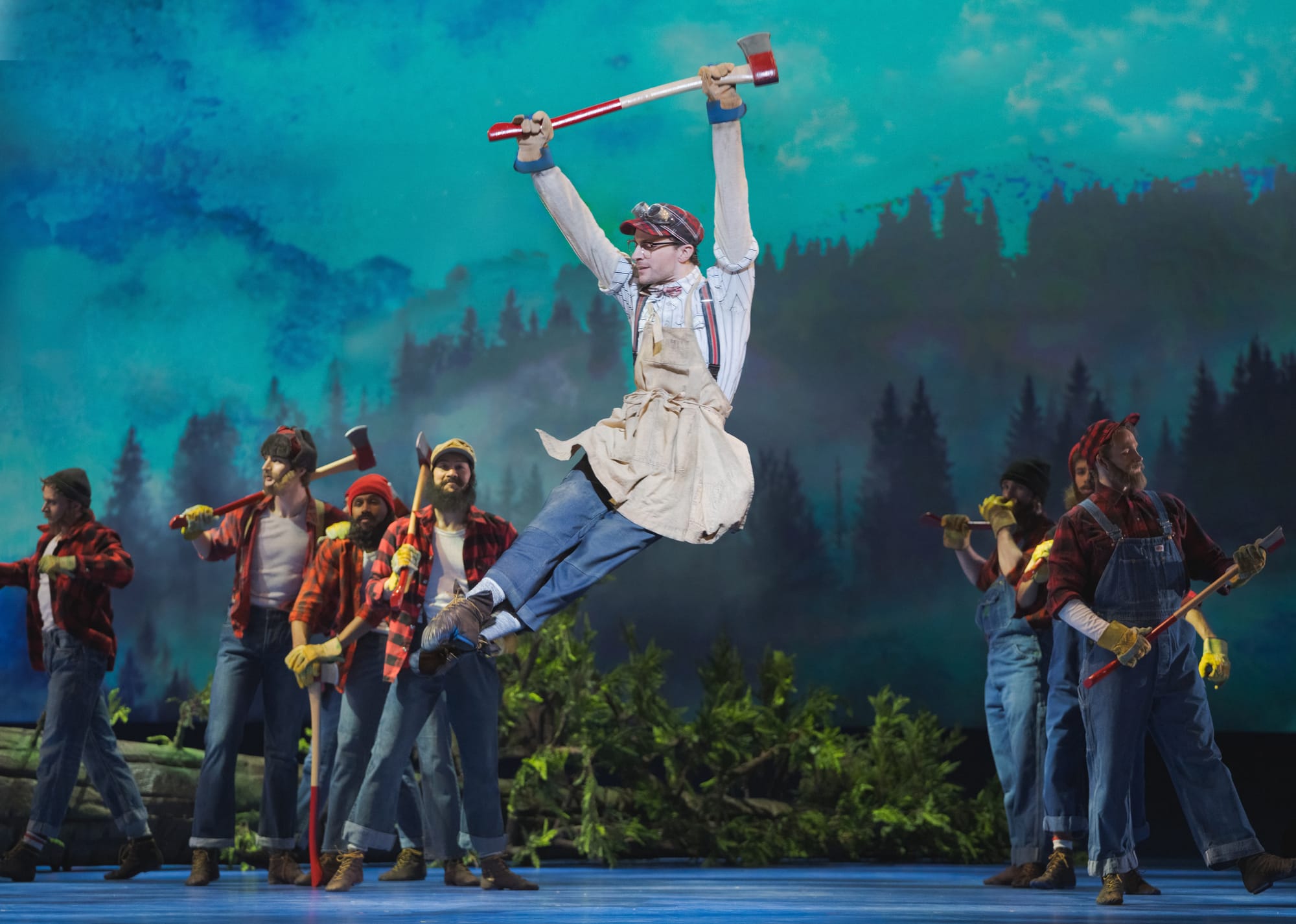
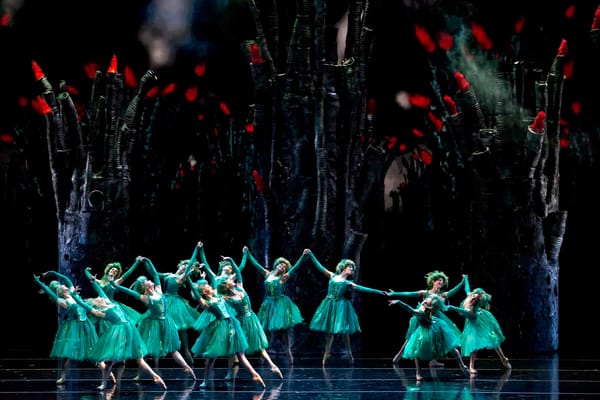
Tuckett’s “Pinocchio” is transplanted from Italy and set firmly on Canadian soil. The ballet opens with Pinocchio’s birth in the middle of a redwood forest that looks like British Columbia. In this version, he is found, rather than created, by Geppetto (Donald Thom). Several lumberjacks gather around a fallen tree. They try unsuccessfully to chop the trunk, until the Blue Fairy (Beckanne Sisk) appears. She gives Geppetto a magic axe. Suddenly an area in the trunk starts to sparkle, Geppetto cuts the tree there and Pinocchio crawls out. Noah Parets is perfectly awkward and rigid as the puppet who dreams of becoming human. His costume makes his limbs look truly knobby and wooden, while his Bambi-like wobbly movements accentuate the effect. Because his movements have to be so stiff, greater emphasis is placed on facial expression and timing. Parets executes these elements skillfully. The Blue Fairy promises that if he is good, he will become a real boy.
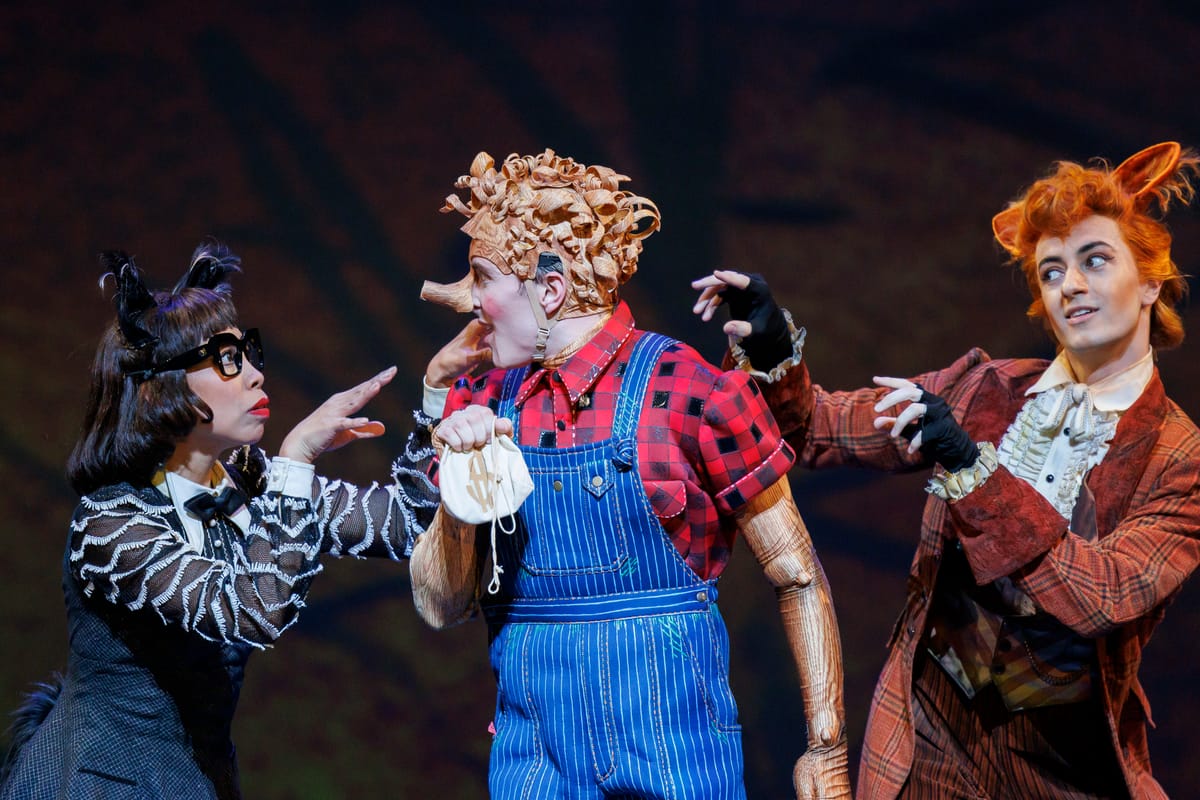
What follows is a whirlwind of events as Pinocchio is torn between his desire to please Geppetto, follow the rules and go to school, and the hedonistic temptations around him. We meet a cat (Jenna Savella) and fox (Isaac Wright) intent on steering him towards the latter. The ballet follows the book’s episodic nature, jumping from scene to scene. Unfortunately, this means that the dancing never really builds momentum. Instead, it comes in stops and starts. The most coherent corps de ballet work is for the shadows or attendants of the Blue Fairy, dancers in androgynous blue unitards and bathing caps, resembling a team of synchronized swimmers that came out of a Dr. Seuss book. The second act features a section for them which mimics a dream sequence, a hallmark of many classical ballets. However, even their choreography is quite repetitive and feels like a lot of filler steps. There are a lot of balancés.
Savella and Wright were quite cheeky and fun together as Pinocchio’s fake friends. Their duets were reminiscent of the white cat and Puss in Boots from “The Sleeping Beauty”. They are both strong dancers who did their best to breathe some life into what limited steps they were given. They got to show their acting chops too, as they relished in their deception of Pinocchio. In one scene, for instance, they tell him to bury his cash in order to grow a money tree, only to dig up and steal it once he falls asleep. In the bar scene, they run up a huge tab of drinks only to disappear once the bill arrives. When a distraught Geppetto puts up missing person posters as he is searching for Pinocchio, they tear them down. Each character had their own musical leitmotif; theirs was slinky and jazzy.
The action moves from the school Pinocchio is supposed to attend, to a steampunk-inspired puppet show that he is distracted by, to a kitschy retro diner called the Red Lobster Inn. Canadian references abound. At the diner, we see a depressed moose downing beers, a pair of beaver tourists wearing Niagara Falls ponchos, and a gaze of raccoons dressed like 1980’s Madonna complete with teased hair and shoulder pads. The party is broken up by the arrival of a Mountie — no animals are allowed at the bar. Later, in a city scene, Toronto's CN tower appears in the backdrop. These elements lend a specificity and familiarity that local audiences can certainly appreciate.
In between episodes, the ballet reminds us of Pinocchio’s quest. The narrators come back to a common refrain, “what makes a real boy is…”. Just like the characters in “The Wizard of Oz” represent different virtues, each adventure Pinocchio embarks on illustrates a human characteristic he strives to attain, whether it is “brains” or “guts”. When he lies to the Blue Fairy, his nose grows (a very clever feature of his costume). She graciously sends blue birds to peck it back down to size, but it is clear that the next time he may not be so lucky.
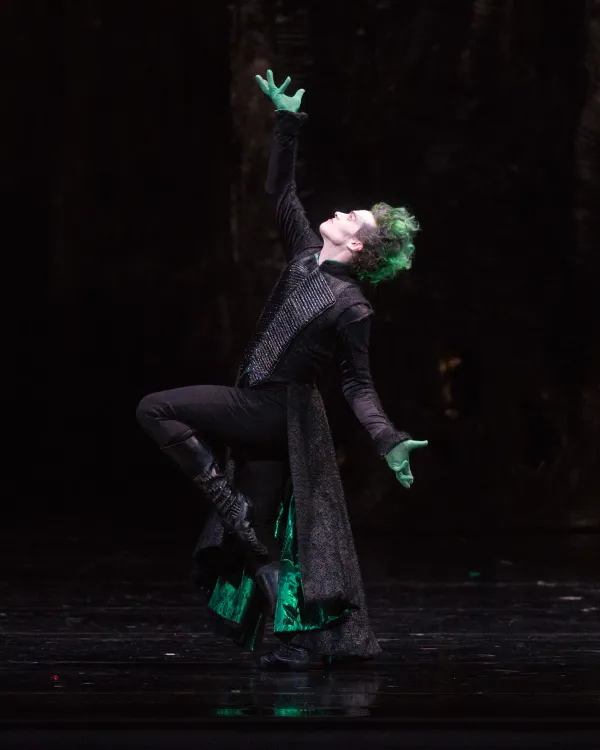
His resolve is truly put to the test in Funland, an amusement park led by a somewhat deranged ringmaster, danced brilliantly by Naoya Ebe. With his striped pants and sequins, he resembles the Mad Hatter from “Alice’s Adventures in Wonderland”. He has some of the most difficult choreography and he executes it well. Unfortunately, some of the most exciting sequences, like a long series of pirouettes à la seconde, are hidden behind props or other activity downstage.
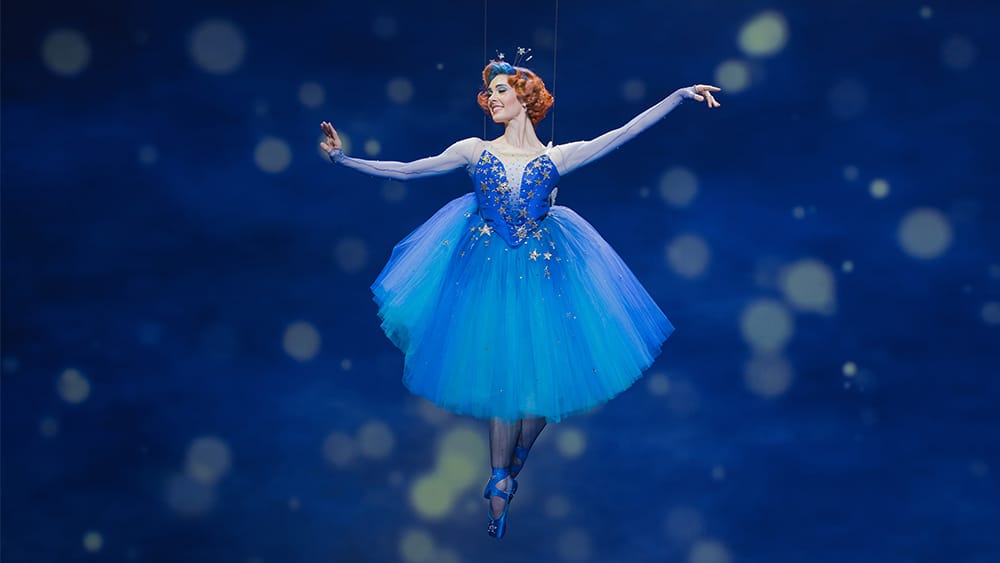
Some of the most effective and magical scenes were the ones involving aerial work in a harness. Both Sisk and Parets excelled here. Sisk was calm and ethereal as she floated above the action. Parets had a lengthy swimming scene that looked unbelievably realistic. Later, he is also suspended by balloons that swoop down and save him from the fate of the other naughty children who are turned into donkeys at Funland.
Various characters from earlier in the ballet re-appear in the belly of the whale who has swallowed both Geppetto and Pinocchio. The reunion is an emotional one. Pinocchio finally redeems himself, applying his creativity and knowledge towards helping himself and others get out by fashioning a raft out of random objects from the whale’s cavernous insides. The ballet ends in a quiet, seaside town, complete with a lighthouse — a nod to Canada’s maritime provinces. The simplicity and gentle landscape of this scene offer a welcome change from the rest of the ballet which is quite busy and frenetic. Peace has been restored. Pinocchio has become a real boy. Good has triumphed over evil. A mischievous boy has learned hard won lessons.
This “Pinocchio” while not particularly groundbreaking or original, is fun and entertaining enough, more so if looked at through the lens of theatre. However, as a ballet, it leaves much to be desired. The success of the storytelling rests on narrators, elaborate sets and video projections rather than choreography. If making ballet more relevant involves reducing the amount of dancing and mime in it, we might be in trouble.
Copyright © 2026 by Denise Sum