Future Bright

"Twinkliana","Les Petite Riens", "Cortege Hongrois"
School of American Ballet
Peter Jay Sharp Theater
New York, New York
June 2 2012, matinee
The annual SAB performance opened with Sean Lavery's "Twinkliana", set to Mozart's "12 Variations". This charming exercise was performed by younger students, who looked assured and engaging, showing how much variety can be found dancing on demi-point. "Les Petite Riens", Peter Martins' 1987 ballet, also do Mozart, is also basically an exercise, a formal, pleasant excursion into "Divertimento No. 15" territory, without that majestic work's power. Martins choreographed it for young NYCB corps dancers (including Wendy Whelan and Peter Boal), and it suits younger dancers; it is straightforward dancing, if a little clinical, with no overly complicated partnering gimmicks. The four couples (Misa Kasamatsu with Austin Bachman, Morgan Lovette with Julian Lacey, Kathryn McDonald with Dustin True, and Indiana Woodward with Craig Wasserman) danced well, accenting the little grace notes built into the choreography.
Kasamatsu is a long-legged beauty, but managed her quick turns and delicate footwork very well. Bachman'ssolo, too, had quick changes of direction, and his jumps had a special boyancy. Though there was little contrast between the couples, the second pas de deux emphasized turns, and the third jumps, and each couple danced clearly and precisely. Indiana Woodward, in the fourth couple stood out for her ability to float her arms. This was a neat, placid work, suited to students.
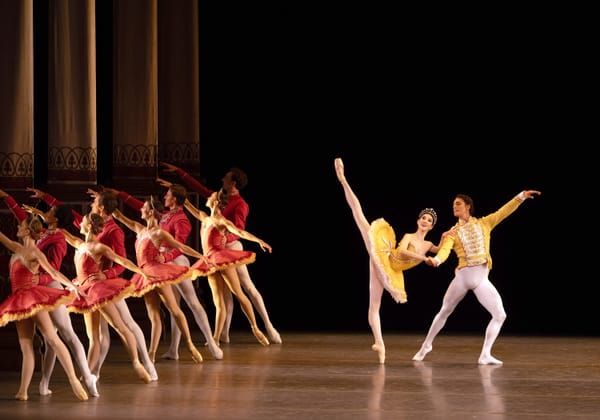
The last piece, though loaded with energetic Hungarian-inspired folk dances, was not made for students. Balanchine set "Cortege Hongrois" as a farewell for Melissa Hayden, and the female solo is the epitome of womanly grace. It is very similar to the solo that has come down from Petipa's ballet, which he choreographed for Pierina Legnani a few years before she retired, and, according to the very complicated story, the French princess Raymonda is dancing a Hungarian dance to honor the King of Hungary who has returned from the Crusades with her fiance. None of this back-plot, of course, is present in Balanchine's version, but the delicate Hungarian flavor, the grandeur, and the warmth of the original are all there, and, for me at least, it is the absolute peak of Petipa's hymns to feminine beauty. There was nothing girlish or tentative about Mikayla Lambert's scrupulous performance, and she gave the langorous phrases their proper weight. Fortunately, Balanchine kept the dramatic clap which has disappeared in the Russian "Raymondas", and Lambert's claps had drama and authority.
Her partner, Silas Farley, had a gracious stage presence, and he gave his ballerina a warm look of satisfaction and pride at the end of their pas de deux that was completely winning. He had a particularly juicy way of moving through the jumps that was elegant without being flamboyant. The two soloists, Daniela Aldrich and Olivia MacKinnon, looked very well-rehearsed, and gave their dances an interesting individuality. Aldrich was explosive, and seemed to be dancing in imaginary books, with MacKinnon gave her a delicacy, with find footwork and rippling arms. The character couple, who got to flash through a czardas, was Elinor Hitt and Sebastian Villarini Velez. He didn't attempt the kick-the-back-of-his-head move that some at City Ballet have done, but danced with a fine flair, as did his partner. The character corps could have dug into the stage a bit more--those boots were made for stomping, but the finale was thrilling, riding on the crest of that beautiful music.
copyright 2012 by Mary Cargill