Comrades
"Monotones I and II", "Serenade after Plato's Symposium", "Prodigal Son"
American Ballet Theatre
David H. Koch Theater
New York, NY
October 26, 2016
American Ballet Theatre's now traditional Fall season is a treat for its audience, which gets to see interesting one-act ballets, full of fine dancing from the corps and soloists (as well as the principals), with few tutus in sight. The October 26 program stood out for its varied and interesting choreography and its well-rehearsed, dynamic dancing in works by Sir Frederick Ashton, Alexei Ratmansky and George Balanchine – a wonderful line up.
Ashton opened the evening with the serene, detailed and sublime "Monotones I and II", a ballet in two long breaths where two trios float through music by Eric Satie. "Monotones I" (confusingly choreographed after Monotones II), danced by Stella Abrera, Isabella Boylston, and Joseph Gorak, has unfortunately lost its unique helmeted headdresses and is now danced with the same space caps as "Monotones II" which slightly reduces its earthy, archaic feel, though the dancers still seem to be looking out at a timeless desert expanse rather than the moonbeam shining on "Monotones II".
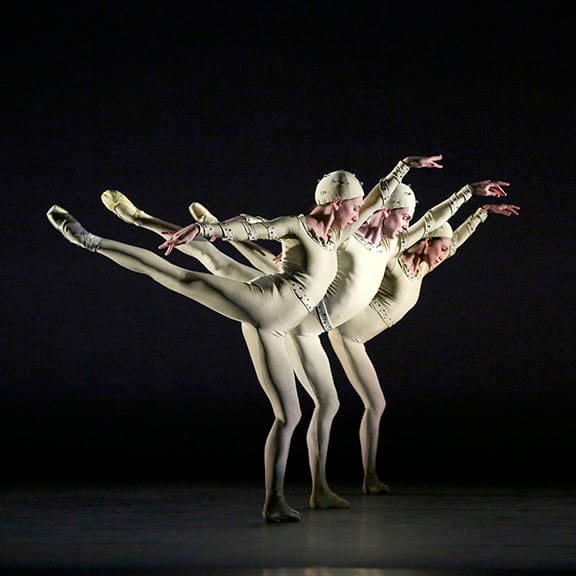
The three dancers were well-matched, though there were a few wobbles (Abrera was rock-solid). The magnificent hops in arabesque, though, where the dancers blend and separate, seeming to merge with the music, was perfectly timed and absolutely magical.
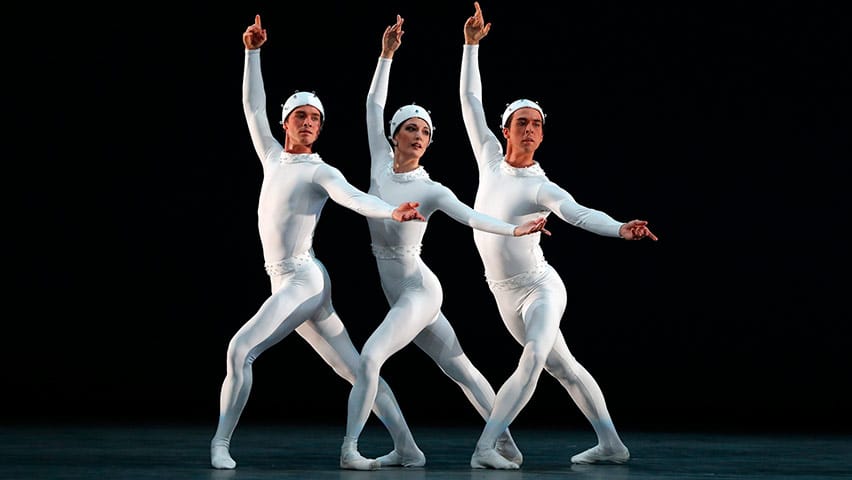
Veronika Part, Cory Stearns, and Thomas Forster danced "Monotones II" with a calm, iridescent warmth. The beautiful shapes flowed smoothly, but the work was so much more than a flawless exercise in geometry, as the dancers seemed to swim in harmony, a combination of abstraction and generosity. The moments when they linked hands had an almost physical force, a connection between them shared with the audience that seemed to embody a human connection.
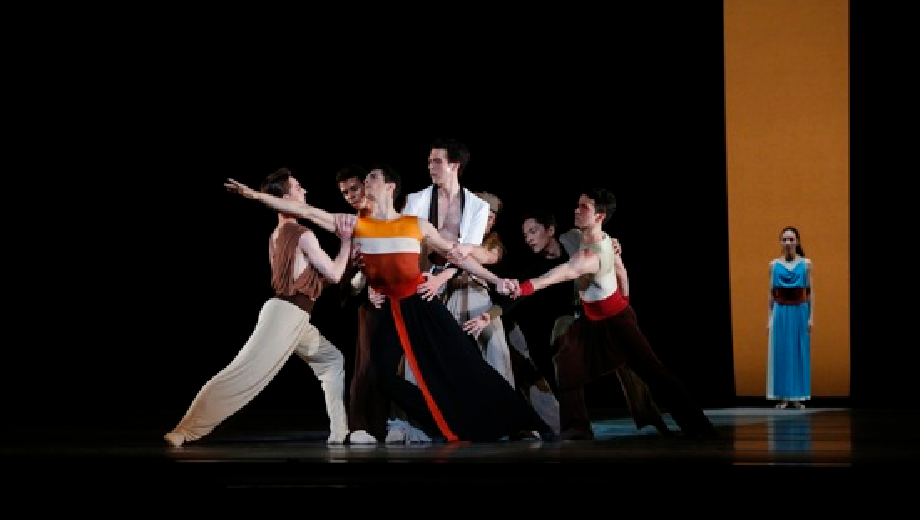
Alexei Ratmansky's "Serenade after Plato's Symposium", to music by Leonard Bernstein, also celebrates humanity, and it does have its calm moments, but generally it is an explosion of eager energy. The seven men (Jeffrey Cirio, Marcelo Gomes, Blaine Hoven, Calvin Royal III, Gabe Stone Shayer, Arron Scott, and James Whiteside) embody ideas inspired by Plato's "Symposium", though Ratmansky did not make a danced essay and the piece, though multi-layered, should not be Greek to anybody.
The issues of questioning, sorrow, compassion, and joy are universal and Ratmansky wove them through some of the most magnificent male dancing I have seen. He used a sort of quasi-mime, a little open-armed shrug by Cirio, to open the work, and the dancers responded in an informal series of dances, as if there were tossing ideas back and forth, sometime on their own and sometimes in groups. There were numerous highlights but I was especially struck by Royal's calm dignity, Scott's thrilling little spins where it seemed that no one could move faster (or think more quickly), and Stone Shayer's quick, fleeting joyful jumps. But apparently there has to be a woman and Devon Teuscher, looking like an Attic statue, appeared as a bit of an afterthought to entice, comfort, or inspire (it wasn't clear) Marcelo Gomes.
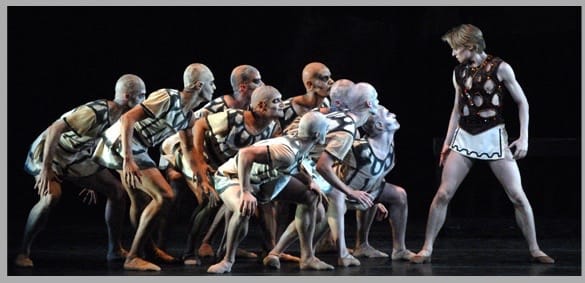
There is nothing ambiguous about the Siren in Balanchine's "Prodigal Son" and Veronika Part, in her debut, was a particularly rapacious spider to Daniil Simkin's helpless little fly. She was icy glamor personified, and managed the cape with aplomb, though there was a small wardrobe malfunction, as she didn't quite cover herself up with it before exploding in all her glory. Some of the hand gestures were a bit perfunctory (her arms should snake behind her head as if it had a mind of its own). But she made the "oh woe is me" moment when she beats her breast in apparent self-loathing into a powerful vignette, and few have looked more striking in that costume.
Simkin combined a naturalized mime with stylized moves to create an individual and universal Prodigal, a sort of an Everyboy. He was a willful, stubborn and very young Prodigal, an open-hearted naif eager to make friends with anyone, almost wagging his tail with excitement shaking those awful goons' hands. His final, despairing crawl home and his abject humiliation was unexaggerated and deeply moving. The poor boy deserved all the friends he could get.
Copyright © 2016 by Mary Cargill