An Exemplary Raymonda
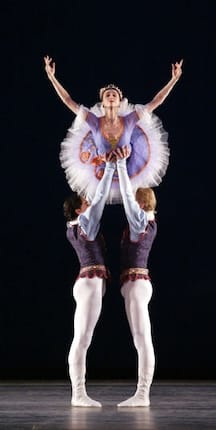
"Raymonda"
American Ballet Theatre
Metropolitan Opera House
New York, NY
June 3, 2004
A student is reported to have said, on seeing his first Hamlet, that he didn’t understand why people thought it was so great, since it was all clichés. Ballet goers might have the same reaction to Raymonda—the garlands, the scarves, the vision scene, the character dances are all familiar. But in Petipa’s hands these seem less like a formula than a manifesto, a final restatement of a belief in pure beauty, of the perfection of form. In ABT’s version, Raymonda tends to look like the first full-length abstract ballet, with gorgeous variation after gorgeous variation.
Abstract, of course, does not imply lack of meaning, and in Nina Ananiashvili’s hands Raymonda was almost as rich and complex as Aurora. The opening scene is full of light, tripping, and beautifully shaded steps, the perfect embodiment of a young girl on her birthday. Her vision scene was more delicate and lyrical, and the final Hungarian variation was the epitome of mature, secure love. Her dancing has an ease and a lushness that hides her formidable technique, and she has retained her fresh, unmannered approach to the classics—it is hard to believe that those eyes first shone on New York in the mid 1980’s.
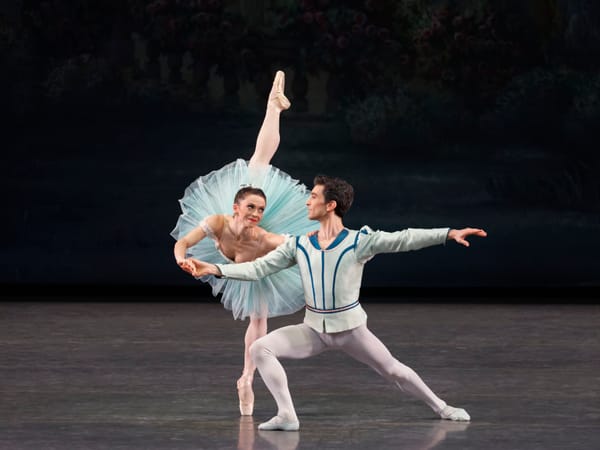
Her Jean de Brienne was Maxim Belotserkovsky, replacing Jose Manuel Carreño. I think the role would be a little more impressive had Anna-Marie Holmes and Kevin McKenzie kept his original entrance in Raymonda’s dream. Belotserkovsky certainly enters that scene like a dream lover (he looks unbelievable handsome in his blue and silver costume), but the effect is somewhat muted because we have already seen him prancing mightily in the opening scene. Belotserkovsky has a certain grand remoteness that works very well for de Brienne, and his dancing had a relaxed but rigorous grace.
Gennadi Saveliev was his Saracen rival, and he is a puzzle. Saveliev can dance with a fine romantic fervor, as his "Theme and Variations" showed, and he is an intelligent and subtle actor as Tybalt. But his flamboyant and flashy Abderakhman made me wonder in exactly what part of Arabia the Gopak originated.
The pas de cinq for Raymonda and her four friends featured David Hallberg, Ricardo Torres, Veronika Part, and Michele Wiles. It is both a technical tour de force and a delicate picture of friendship, as Raymonda sits in her chair playing her music and watching the dance. The variations, while never exceeding their classical rigor, had a warmth and generosity that was truly adult. Wiles and Part were not the most stylistically matched of pairs; Wiles is a sparkling technician and Part is the kind of dancer for whom the arabesque was invented, but their individual qualities certainly shone.
ABT’s Raymonda is certainly not a perfect work; the duel, after the Grand Pas Classique, is an anti-climax, and it would make more dramatic sense if the White Lady could work her magic in it, rather than turning Jean de Brienne into Romeo going after Tybalt. But there are so many beauties in this production, not the least of which is the chance to revel, once more, in Ananiashvili’s exemplary style.
copyright © 2004 by Mary Cargill