Shallow Waters
"Swan Lake"
American Ballet Theatre
Metropolitan Opera House
June 21, 2010
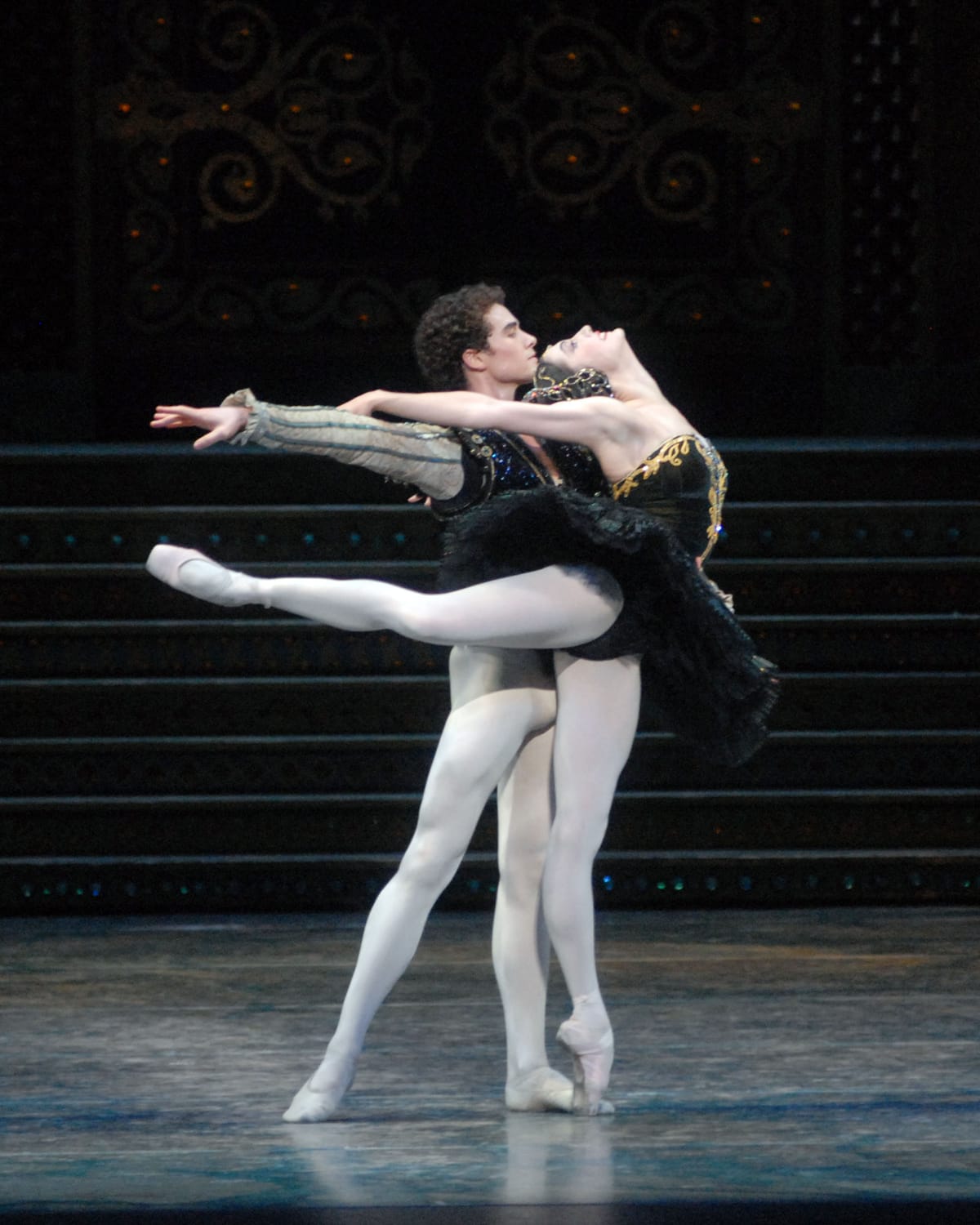
Kevin McKenzie's bizarre version of the perennially popular "Swan Lake" landed in New York again, with all of its misguided aspects intact. The traditional version, the one the music illuminates, is a mysterious fairy tale about the malign power of nature and the impossibility of real choice in an irrational world. It is, in effect, the opposite of "The Sleeping Beauty", where nature is basically kind, and the world is rational. ABT's version is an artistic Ponzi scheme, where irrelevant flourishes and meaningless steps are added to a hollow core, until eventually the ballet topples over into complete irrelevance. The theatrical missteps are numerous, from the glitzy Hallmark card inspired front curtain (no mysterious and hidden Act II lake to contrast with the boisterous Act I) to the premature entrance of Odette (no overture should go to waste is apparently a new command), and the puzzling disappearance of Siegfried's traditional first act curtain, where he stands alone, seeing the swans summoning him to his fate. But despite these (and many other) lapses, there is some choreography left in the poor old bird. Opening night showed off the magnificent Veronika Part, with Cory Stearns (who was pressed into service when Marcelo Gomes, who was substituting for Roberto Bolle, became injured.)
Stearns performed very well under what must have been somewhat under-rehearsed circumstances. Part is tall and the lifts were somewhat iffy; it does seem that for a taller dancer, these Act II lifts could be rethought, since they are later additions anyway (does Benno ring any bells with modern producers?). Stearns did his best in the first act hub-bub, and I liked the way he made it clear to his mother that he knew he shouldn't have been drinking with the boys. His acting, though, was sometimes too naturalistic; he was obviously trying to make Siegfried into a character, but he should always walk like a Prince, not a fella. (He was not helped by McKenzie's over-the-top histrionics which has Siegfried wallowing in front of the curtain to the Act IV overture chewing away at all the scenery in sight.) But his innocent happiness in Act III, when he thought he had found The One, which exploded into his dancing, was so moving, since we knew it couldn't last.
Part's majesty and slightly distant stage presence make her a natural for Odette, and she spun the phrases as if she were dancing through a moonbeam. Her mime was a bit muddied, but since the story she was supposed to tell didn't match the story on stage, it is understandable that the references to her mother's tears forming the lake wouldn't resonate. Her Odile was cool as well, reptilian rather the seductive. This was a calculated triumph, with a hint of a sneer at the poor deluded man she was trapping. The fouettes were fast, furious, and centered, and Siegfried was well and truly caught.
The pas de trois in the first act, which retains much of the traditional feel, was very well danced, and generated real excitement. Sarah Lane and Yuriko Kajiya had an interesting contrast, Lane rounded and flowing, and Kajiya light and scrupulous. Jared Matthews was a generous and supportive partner. In the character dances, Maria Bystrova showed off her luscious back bends in the Spanish dance, and Simone Messmer danced with a polished intensity (with a hint of the campfire) in the czardas. The poor princesses still have to prance in front of Siegfried with the hired help, and the Neapolitan, no matter how exuberant Joseph Phillips and Craig Salstein were, still has about as much to do with Naples as Spam pizza. But the pieces of "Swan Lake" that have survived were truly beautiful.
copyright © 2010 by Mary Cargill