Roberta Marquez: a Tiny, Proud Nikiya
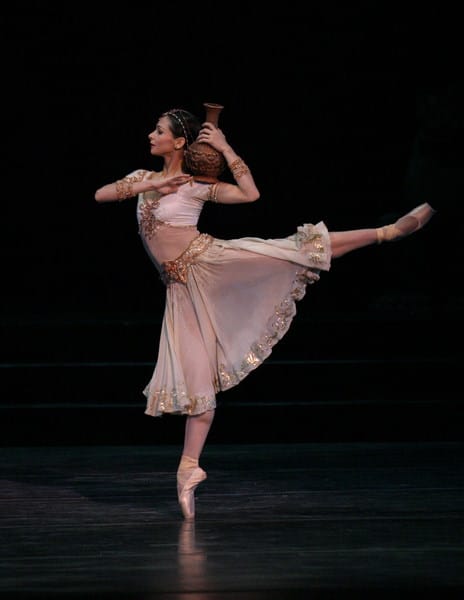
La Bayadère
American Ballet Theatre
Metropolitan Opera House
New York, New York
May 14, 2004
American Ballet Theatre’s version of the great Russian ballet, "La Bayadère", is now twenty-five years old, and it remains a strong and lush production. The sets and costumes, by Pierluigi Samaritani and Theoni Aldredge are vibrant and danceable, and evoke the nineteenth-century opulence without seeming to be overly heavy or a dated pastiche. And since I am someone who heart sinks when that first shade strikes that first arabesque on that ramp because I know that in twenty minutes the most beautiful classical choreography in the world will be over, I find it a ballet on which it is impossible to overdose.
ABT imported the Brazilian-trained, Royal Ballet based Roberta Marquez to dance Nikiya to Ethan Stiefel’s Solor. She is a very tiny dancer with perfect proportions and a generosity of movement that reads large. Her Nikiya was not a shy little waif; this was not Giselle’s first cousin. Her wonderfully theatrical entrance, where the High Brahmin reveals her to the world, showed a proud woman who knew her own worth. She had firmness without arrogance. Marquez's Nikiya showed no fear at the High Brahmin’s advances, just disgust and almost contempt—“How could you stoop so low to forget your place?” she seemed to say, without denigrating her own position.
This made her luxurious surrender to Solor all the more potent, and swearing an oath to this Nikiya really meant something. Her Nikiya’s inner steel worked very well in the confrontation with Gamzatti (danced by Irina Dvorovenko, who was in touch with her inner Joan Crawford). The mime could have been a little more forceful, and seemed a bit rushed. I missed some of the deliberate insult of Gamzatti’s “You see all these riches. I can give them to Solor, while you are only a contemptible little dancer”, but it remains a very powerful scene.
Dvorovenko pulled out all the stops during her engagement party, going for what looked like a quad at the end of her fouettés, and almost making it. The audience roared, and the approach certainly suits Gamzatti, since her father’s world is centered on her.
Nikiya’s plaintive little solo, with the wonderful rippling arms, was an effective contrast to the fireworks, but now that the Kirov has shown us what the original looked like, giving Nikiya back her musical instrument would make the arms even more lovely. Marquez tried some fancy balances which didn’t quite come off, unfortunately. These balances, possibly unintentionally, had a metaphorical logic, since during them the Radjah (Guillaume Graffin at his most imposing, menacing best) ordered the Aya to give Nikiya the poisoned basket—so Nikiya’s life was hanging in the balance, as it were.
Marquez also had an unusual approach to her little dance of joy after she thinks Solor has given her the flowers. There was no delirious rapture, she just looked at him as if saying “If you did give me these, they why are you still sitting over there.” Her death, like her life, was completely her own decision.
She was a true shade in the vision scene, a disembodied spirit. She has a lovely jump and beautiful turns, but unfortunately, her feet seem a bit weak, and there were some awkward moments in her point work in the rigorous, exposed choreography. Ethan Stiefel’s dancing was thoroughly spectacular, crisp, clean, and flamboyant without being flashy. Solor, fortunately, has not become Corsaired, and Stiefel danced the role with a real dramatic intensity.
La Bayadère is a true company ballet, and there were many notable performers. The corps, of course, is front and center. There were a few bobbles during the shades scene, but it was danced with a hypnotic uniformity. Renata Pavam, as the first shade, was especially notable, with her delicate timing and beautiful arabesque. David Hallberg, as Solor’s unnamed friend, can make walking seem like poetry. In the pas d’action, Maria Bystrova danced with an irresistibly lush fullness. Victor Barbee’s High Brahmin was a smoldering mass of conflicted emotion, and Graffin’s Radjah was, as always, a completely filled out study of ruthless power. Now if only the shades scene were longer!
copyright © 2004 by Mary Cargill