One Night Only
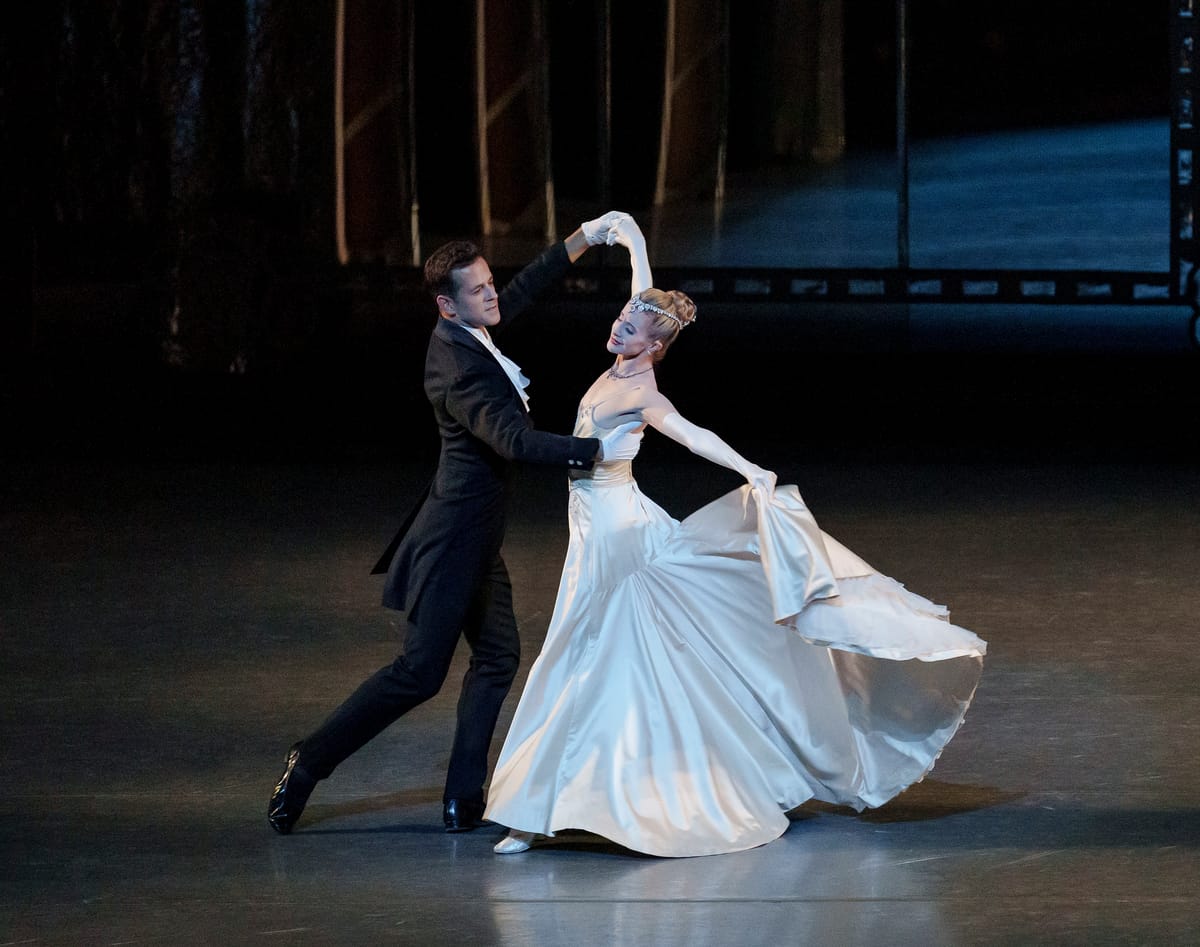
"Episodes", "Vienna Waltzes"
New York City Ballet
David H. Koch Theater
Lincoln Center
New York, New York
October 13, 2022
In a night filled with debuts, the audience was focused on one particular couple, the first and last performance of the final scene of "Vienna Waltzes" by Sterling Hyltin, who is retiring at the end of the season after on last "Nutcracker", and Robert Fairchild, who left City Ballet in 2017, returning to say farewell to his frequent partner. (Hyltin danced with him in his farewell performance of "Duo Concertant" and requested him for hers.). The audience greeted both with loud applause, but then watched with a breathless silence, concentrating on every nuance.
Hyltin gave a hypnotically interior rendition of the famous entrance, drifting in slowly and the curtseying to her memories; the gestures looked completely spontaneous, as if she were alone with her thoughts. Fairchild seemed to appear out of her consciousness, holding her gently and then fading away. He danced with a dignified gravitas, yet with a lightness that made him seem to float. Hyltin melted into his arms before he disappeared, leaving her alone until they were absorbed into the whirling mass of black and white.
The audience would not leave until the couple returned for a final curtain call, and saw Fairchild present Hyltin with a bouquet, a hug, and a few words, then stand back to let the audience cheer her one last time. She is a dancer of translucent clarity who is retiring too soon and this was one of the most memorable and moving debuts on record.
Amongh the other debuts, Chun Wai Chan stood out in the first movement of "Episodes", Balanchine's spike, analytical, and interesting exploration of Webern, for his solid, generous partnering and lyrical upper body. He has a natural and unforced warmth that seems to embrace everyone on stage. It certainly embraced Isabella LaFreniere, also a debut, and she seemed to be experimenting with the quirky moves, pausing slightly as she flexed her foot or crooked her leg, as if these poses were a new toy she was playing with.
Claire Kretzschmar, with Gilbert Boldin III (his debut) also seemed to be enjoying the second movement as they tiptoed along in their separate spotlights with a witty nonchalance, Bolden apparently overawed by Kretzschmar's power. The tentative intertwining, as her hands fluttered towards him, hinted at a genuine but not sentimental connection.
Emilie Gerrity (her debut) and Taylor Stanley danced the third movement and Gerrity entered with a fashion model strut, calm and confident. Stanley, with his unique, flowing style, was a courtly partner, turning and manipulating her to show her off. The geometry of the section, with the four corps women weaving in and out of those spiky shapes is intriguing and inventive, but I expect the piece will send few people home eager to listen to more Webern, and the final section, with the Bach orchestrations, does come as a welcome change. Sara Mearns seemed to generate her own organ music, lush, soaring, and magnificent.
"Vienna Waltzes" on the other hand, is all melody, though its chocolate box prettiness does hide some stunning variety, elegant patterns, and subtle dramas. Krtezschmar, who is retiring at the end of the season, debuted in the first movement, partnered by Aaron Sanz in his debut. Kretzschmar gave her dancing an emotional arc, playfully flirtatious at the beginning, then shy as the realization of her love overcame her, then gloriously confident as he walked off into a bright future. This was a more optimistic interpretation of the Ending, which some dancers approach with a more moonlit sense of foreboding (he is a soldier, after all and the Austro-Hungarian Empire did fight wars) but Kretzschmar made it glow.
Sanz is one of NYCB's most versatile dancers; I first noticed him as Leandre in Balanchine's "Harlequinade", usually a one-dimensional, vain fop, who Sanz made almost pathetic with his stork-like, awkward dignity. Sanz has danced the more astringent black and white ballets with a sharp clarity, but he is especially welcome in the more romantic roles (Balanchine has many poets), and his Hapsburg officer was ardent and courtly.
Megan Fairchild and Anthony Huxley were a joy in the second movement, the only one which used point shoes. Huxley, with his clear, juicy jumps and airy landings, did seem to fly and Fairchild's mixture of charm and speed was effervescent. There is a great deal of speed but not always much charm in the third section, the Explosions-Polka. With its exaggerated, unflattering male costumes based on those of the post-French Revolutionary Incroyables (they would probably be punks now) and blatant sauciness it would, I expect, win the vote for the most requested section to be dropped. But Sara Adams and Harrison Coll (in their debuts) downplayed the flouncing and concentrated on the fast, fancy footwork, showing how exhilarating character dancing can be.
There is more character dancing in the fourth, the "Merry Widow" section, which Miriam Miller and Adrian Danchig-Waring (both debuts) as the anonymous couple who might as well be called Hanna and Danilo. Danchig-Waring was a bit stiff and diffident as the worldly wise Hapsburg officer out for a night on the town, and Miller, who looked absolutely stunning in the costume, danced the role like a young, rather shallow, cold-hearted flirt. She made a beautiful picture, but she had no history.
Then, finally, there was the last section, with Hyltin and Fairchild saluting their history in that candlelit, perfumed ballroom, a long sigh, full of gratitude and maybe a few regrets for the inevitable passage of time.
© 2022 Mary Cargill