Benched
"Concerto DSCH", "Polyphonia", "For the Love of Duke"
New York City Ballet
Koch Theater
Lincoln Center for the Performing Arts
New York, NY
January 22, 2011
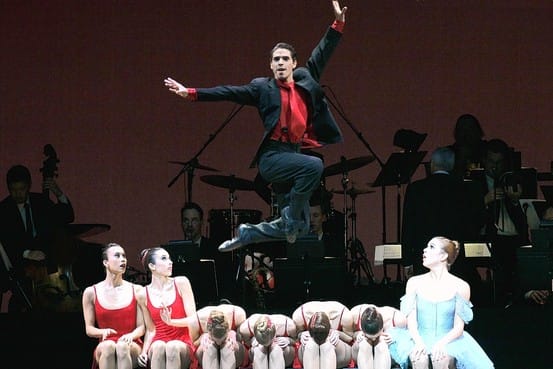
"For the Love of Duke", Susan Stroman's new work for City Ballet to Duke Ellington, is made up of two short pieces, "Frankie and Johnny...and Rose", a premiere, and "Blossom Got Kissed", first seen in 1999. Stroman is best known as a Broadway choreographer, and this new piece will, one hopes, convince her that ballet isn't her forte. "Frankie and Johnny...and Rose" featured Amar Ramasar, Tiler Peck, Sara Mearns and a bench. These are usually vibrant and musical dancers, but they were stymied by the dull choreography and lame jokes--basically, Ramasar loves Peck while dancing on a bench, Mearns prances in (with an unfortunate hairdo that makes her look like Woody Woodpecker), wags her hips, and entices Ramasar, who pushes Peck off the bench. Peck changes from a nice girl to a floozy, wags her hips, and knocks Mearns off the bench, then eventually, after much hip wagging, (and a series of fouettes by Mearns) both girls knock Ramasar off the bench, and strut off. It seems like it is trying to be "Who Cares?", a ballet that all three dancers shine in, but the jokes are lame and obvious, the choreography limited, and Stroman seems to think that mugging and glittery tights equals characterization.
"Blossom Got Kissed" was originally made for Maria Kowroski and Robert La Fosse, and highlighted the daffy, slightly underplayed, screwball comedy charm that Kowroski can have, and Kowroski gave the prissy, awkward ballet girl who must turn into a red hot jazz baby to find happiness a radiant and beautiful innocence. Her replacement, Savannah Lowery, lacks Kowroski's comedic skills, and just looked awkward. (She too, spent much of the time being shoved off that bench by smaller, more adgile dancers.) She is much larger than her partner, Robert Fairchild, and their pas de deux lacked any rapport. This made the basic lesson of "conform and get your man" seem a cruel joke.
Alexei Ratmansky's "Concerto DSCH", to Dmitri Shostakovich's "Piano Concerto No. 2", which opened the evening, also has its share of jokes, but they come from the witty and unexpected choreography which uses the astounding techniques of the various dancers, not just to wow the audience, but to illuminate the music. The first movement is dominated by Ashley Bouder and her cohorts, Joaquin de Luz and Andrew Veyette, as a playful pas de trois bounding through the stage, but Ratmansky gives them quirky little off center movements as well as big thrilling jumps, and the audience watches, not just in awe, but in wonder.
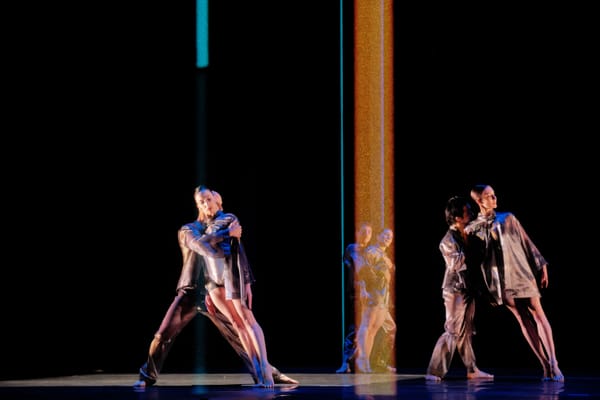
The second movement, the emotional heart of the piece, is an adagio for Wendy Whelan and Tyler Angle. Ratmansky avoids the Whelan as human pretzel cliche, and uses the lyrical but strong vein makes her such a compelling dancer. The choreography is unexpected, too, as the main couple, highlighted by a spotlight, is accompanied by ghostly couples, at times echoing their movements and at times amplifying them. Nor is the ending a traditional pose, as the couple, divided by some intangible tragedy, leaves at different sides of the stage.
The final movement doesn't quite match the cheerful energy of the first, or the mystery of the second, as both Angle and Whelan bound on in as if the second movement never happened, a somewhat jarring change of mood. But the work is fine, thrilling, and makes the dancers look both exciting and interesting.

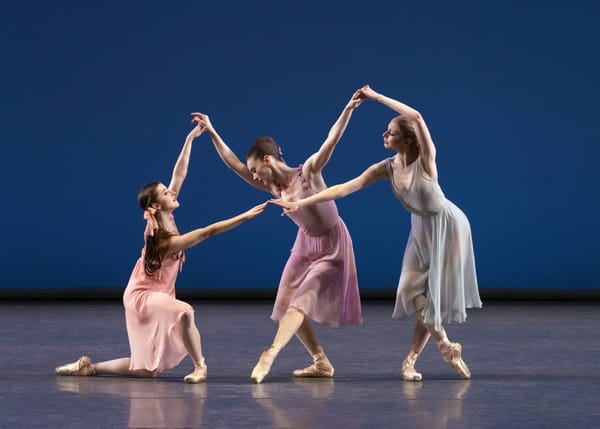
Christopher Wheeldon's "Polyphonia", to piano music by Gyorgy Ligeti, shares some of these virtues, but Wheeldon makes his dancers seem too aware of the audience, insisting, by blank stares and vacant looks, that they are cool and we are not. There are four couples, who variously enter and exit to piano music--yes, it does look at times like a post-modern "Dances at a Gathering". Maria Kowroski and Jared Angle do a couple of Agon-lite pas des deux, with the flexed feet, exaggerated extensions and peculiar shapes that have been seen many times, but never with the impact of the original. The most interesting dancing came from two corps members, Lauren Lovette (in a debut in the part originally danced by Alexandra Ansanelli) partnered by Chase Finlay. Finlay, a fine dancer, is also a generous partner, and has the rare ability to focus an audience's attention just by concentrating on his partner. Lovette danced her smokey, mysterious solo with a haunting elegance--not a bench in sight.
copyright © 2011 by Mary Cargill